
The President and the Power Grid
There is a sharp discontinuity between the second Trump Administration’s electricity policies and those of previous presidential administrations. President Trump has directed the Department of Energy to use statutory authority designed for wartime conditions and sudden emergencies to prevent electric utilities from retiring aging coal plants. In doing so, he has elevated the president’s role in electric-grid governance and reduced the primacy of the expert regulatory agency—the Federal Energy Regulatory Commission—that Congress authorized to govern electricity markets and grid reliability.
This Essay places these actions in historical context. It recounts the executive branch’s role in electricity policy during the first part of the twentieth century, when the federal government responded to wartime crises by building new electricity supplies and actively managing existing electricity infrastructure. While these early and mid-twentieth century executive actions may superficially resemble present-day events, they were profoundly different. Even amid the urgency of wartime, the executive branch was laying the foundation for an integrated grid managed by expert government agencies, not through direct presidential decrees, and it was working for technological progress, not regression. Building on this history, this Essay then explains why the present-day shift from expert agencies to presidential power in electric-grid governance matters. The most obvious reason is that it will carry heavy financial and environmental costs to consumers and the nation. But the increased assertion of presidential power in electric-grid governance also has doctrinal significance in light of recent developments in Supreme Court jurisprudence governing statutory interpretation and presidential use of emergency authorities.
Introduction
In May 2025, the U.S. Department of Energy (DOE) ordered Consumers Energy, an electric utility serving Michigan, to halt the planned retirement of its J.H. Campbell power plant.1Federal Power Act Section 202(c): Midcontinent Independent System Operator (MISO), U.S. Dep’t of Energy, https://www.energy.gov/ceser/federal-power-act-section-202c-midcontinent-independent-system-operator-miso [https://perma.cc/M22M-UHY8] (DOE website linking to order and subsequent filings); J.H. Campbell Complex Retirement, Consumers Energy, https://www.consumersenergy.com/about-us/electric-generation/campbell-complex-retirement [https://perma.cc/7XG8-DL9E] (discussing power plant). The approximately 1,500-megawatt (MW) plant is the state’s second-largest coal plant and one of its largest stationary sources of air pollution.2Benjamin Storrow, Michigan Coal Plant Tests Trump’s Commitment to Fossil Energy, Climatewire (Aug. 7, 2025), https://www.eenews.net/articles/michigan-coal-plant-tests-trumps-commitment-to-fossil-energy-2/ [https://perma.cc/S9FN-Q46G]; 10 Groups Push Back Against Trump’s Illegal Campbell Plant Extension, NRDC (June 18, 2025), https://www.nrdc.org/press-releases/ten-groups-push-back-against-trumps-illegal-campbell-plant-extension [https://perma.cc/9ZXS-2DZB]; see also Sarah Leach, Activists, Officials Call for Closure of Ottawa County Coal Plant as Utility Looks to Recover Costs, Mich. Advance (Aug. 13, 2025), https://michiganadvance.com/2025/08/13/activists-officials-call-for-closure-of-ottawa-county-coal-plant-as-utility-looks-to-recover-costs/ [https://perma.cc/VH8L-9MLM]; Marianne Lavelle, Trump’s Order to Keep Michigan Coal Plant Running Has Cost Million So Far, Inside Climate News (Oct. 31, 2025), https://insideclimatenews.org/news/31102025/michigan-campbell-coal-plant-operation-has-cost-80-million/ [https://perma.cc/4NKK-NUP2]. For Consumers Energy, this was a disruptive order. The sixty-three-year-old plant was scheduled to permanently retire the following week, after years of planning and sign-offs from all relevant state and federal regulators and grid operators.3Leach, supra note 2. Consumers Energy had already spent hundreds of millions of dollars replacing the coal plant’s output with renewable energy and a new natural-gas-fired power plant.4See Brian Martucci, Consumers Energy to Invest More Than B in Renewables, Distribution by 2029, Util. Dive (Nov. 18, 2025), https://www.utilitydive.com/news/consumers-energy-campbell-large-load-earnings/805778/ [https://perma.cc/5NAD-4XJX]. When the utility received the DOE order at the start of Memorial Day weekend, it had to turn on a dime to rehire workers, obtain coal supplies at inflated prices, and begin incurring what in just a few months would become over $100 million in losses—all to keep online an aging plant that the utility and grid operators had determined was no longer needed.5See Lucas Smolcic Larson, Tab for Keeping Michigan Coal Plant Open Under Trump Orders Grows to 5M, MLive (Feb. 12, 2026), https://www.mlive.com/news/2026/02/tab-for-keeping-michigan-coal-plant-open-under-trump-orders-grows-to-135m.html [https://perma.cc/HK7C-3YWY]; Consumers Energy Co., Annual Report (Form 10-K) 117–18 (Dec. 30, 2025) (discussing net costs of DOE orders); Brett Dahlberg, Michigan Coal Plant Set to Shut Down in 8 Days Must Stay Open, Trump Administration Says, Mich. Pub. (May 24, 2025), https://www.michiganpublic.org/transportation-infrastructure/2025-05-23/michigan-coal-plant-set-to-shut-down-in-8-days-must-stay-open-trump-administration-says [https://perma.cc/AG69-84BS] (discussing criticism of DOE order by leaders of the Michigan Public Service Commission); Leach, supra note 2 (describing costs). Who should pay for those losses—only Consumers Energy ratepayers or all ratepayers in the region—and whether such costs should have been incurred at all are questions now being litigated in multiple forums.6See infra Part III (discussing litigation).
DOE’s order was unprecedented in multiple ways. In issuing the order, DOE relied on Section 202(c) of the Federal Power Act (FPA), which authorizes DOE to order the “temporary” connection of power plants or electric transmission facilities during “the continuance of any war” or “emergency” conditions.716 U.S.C. § 824a(c)(1) (describing conditions for use of emergency authority). State and federal regulators had already determined that the Campbell plant was not needed to serve the utility’s customers or to ensure regional or local grid reliability.8Dahlberg, supra note 5. But DOE nevertheless alleged that Michigan was facing emergency conditions due to insufficient regional electricity supply.9 Dep’t of Energy, Order No. 202-25-3, Midcontinent Independent System Operator (MISO) 202(c) Order (2025), https://www.energy.gov/sites/default/files/2025-05/Midcontinent%20Independent%20System%20Operator%20%28MISO%29%20202%28c%29%20Order_1.pdf [https://perma.cc/X5T3-HCNK].
The DOE order also departed significantly from the distinct roles Congress had created for federal agencies and states to regulate electricity production. Those roles have emphasized the development of market-structuring regulations by the Federal Energy Regulatory Commission (FERC)—a relatively technocratic agency—through processes governed by the procedural and substantive constraints of administrative law.10Sharon B. Jacobs, The Statutory Separation of Powers, 129 Yale L.J. 378, 407–27 (2019) [hereinafter Jacobs, Statutory Separation of Powers] (discussing history, structure, and role of FERC). Congress also preserved substantial state authority over power plants within their territories.1116 U.S.C. §§ 824(a), (b)(1) (discussing state authority). But with electricity, as in many other realms,12For two among many possible examples, see Justice Department Struggles as Thousands Exit—and Few Are Replaced, A.B.A. J. (Nov. 19, 2025), https://www.americanbar.org/advocacy/governmental_legislative_work/publications/washingtonletter/november-25-wl/outside-the-gao-1125wl/ [https://perma.cc/2UQ5-TUD3] (describing the loss of much of the DOJ’s workforce and the politicization of hiring); Mattathias Schwartz, Zach Montague & Ernesto Londoño, Judges Grow Angry Over Trump Administration Violating their Orders, N.Y. Times (Feb. 24, 2026), https://www.nytimes.com/2026/02/23/us/politics/judges-contempt-immigration-trump.html [https://perma.cc/TXZ8-5UM2] (describing the second Trump Administration’s persistent disregard for judicial orders). the second Trump Administration has changed the rules. The Consumers Energy order was just a starting point. More FPA Section 202(c) orders have followed, with all similarly requiring aging, expensive, and, in some cases, inoperable coal-fired power plants (along with one dual-fuel oil and gas plant) to stay online regardless of their costs or abilities to even generate electricity.13See Sonal Patel, DOE Uses Emergency Powers to Freeze More Than 2 GW of Coal Retirements as Opposition Intensifies, Power (Dec. 31, 2025), https://www.powermag.com/doe-uses-emergency-powers-to-freeze-more-than-2-gw-of-coal-retirements-as-opposition-intensifies/ [https://perma.cc/6U5B-FNZX]; infra Part III (discussing DOE orders to keep coal plants open in Indiana, Colorado, and Washington); Jeffrey Tomich, DOE Ordered Indiana Coal Plant to Run Despite Owner’s Objection, Climatewire (Apr. 17, 2026), https://subscriber.politicopro.com/article/eenews/2026/04/17/doe-ordered-indiana-coal-plant-to-run-despite-owners-objection-cw-00877750 [https://perma.cc/YN8P-WYDH]; infra Appendix at pp. 30–33 (describing plants subject to Section 202(c) orders in 2025). Still more appear to be in the works.14See 2026 DOE 202(c) Orders, U.S. Dep’t of Energy, https://www.energy.gov/ceser/2026-doe-202c-orders [https://perma.cc/SY6S-CUNC]; Claire Brown & Brad Plumer, Trump Wants to Halt Almost All Coal Plant Shutdowns. It Could Get Messy, N.Y. Times (Jan. 16, 2026), https://www.nytimes.com/2026/01/16/climate/trump-coal-plants.html [https://perma.cc/CQ2L-2EWF].
These orders are part of a broader shift. They have followed a series of executive orders in which President Trump declared an “energy emergency,”15Exec. Order No. 14,156, 90 Fed. Reg. 8433 (Jan. 20, 2025). told federal agencies to stop permitting wind and solar projects, and directed DOE to adopt new planning rules that favor coal and nuclear power and to use those new rules to force plants to stay open.16See infra Part III. Collectively, these executive orders represent a new vision for centralized authority over the management of the electric grid. Technocratic, expert-driven decisionmaking is increasingly on the outs, as is the notion that economic value will be a central driver of policy choices. For instance, the orders prohibiting the J.H. Campbell plant in Michigan from retiring marked the first time the DOE had ever issued an order under Section 202(c) on its own initiative, rather than in response to a formal request by a utility, a state, or a regional grid operator.17See infra Appendix at pp. 33–48 (describing events leading up to 202(c) orders issued by DOE); see also Kenneth W. Irvin, Christopher J. Polito, Riley Desper & Priya Kareddy, Department of Energy Blocks Shutdown of Coal-Fired Power Plant and Oil- and Gas-Fired Generator Units With Federal Emergency Orders, Sidley Env’t Health & Safety Brief (June 13, 2025), https://environmentalhealthsafetybrief.sidley.com/2025/06/13/department-of-energy-blocks-shutdown-of-coal-fired-power-plant-and-oil-and-gas-fired-generator-units-with-federal-emergency-orders/ [https://perma.cc/Z9P4-98UM]; Dahlberg, supra note 5.
Though the DOE Section 202(c) orders mark a major change from recent electricity-governance practices, they might at first seem to have historical antecedents. During and after both world wars, the federal executive branch played an active role in managing existing electricity resources to support the war effort.18See infra Part I. Thus, one might infer that, as much as the Trump Administration’s use of emergency statutory authority to override expert decisionmaking processes is unusual, it might still have historical support. That possible inference creates a need to place the current use of Section 202(c) orders in historical context. This Essay supplies that context.
Part I recounts the executive branch’s role in electricity governance during the first part of the twentieth century. In what, until recently, would have seemed like a maximalist use of federal authority, the federal government responded to the imperatives of war by building new electricity supplies and actively managing existing electricity infrastructure. But even amid the urgency of wartime, the executive branch was laying the foundation for an integrated grid managed by expert government agencies, not through direct presidential decrees. Part II describes the executive branch’s involvement in electricity governance over the latter part of the twentieth century and the beginning of the twenty-first. The general theme of this era also was not assertive presidential control, but instead deference to congressionally created regulatory and ratemaking agencies. Part III details the second Trump Administration’s increased reliance on never-before-used statutory emergency authorities to depart from longstanding electric-grid governance. Finally, Part IV explains why this matters, focusing on both its doctrinal significance as well as the heavy financial and environmental costs of the current exercise of presidential authority.
I. Electricity and Executive Power During Wartime
There is an element of nostalgic militarism in the Trump Administration’s energy rhetoric.19This is in addition to the administration’s militaristic rhetoric more generally. See, e.g., Exec. Order No. 14,347, 90 Fed. Reg. 43893 (Sep. 5, 2025) (Trump executive order changing the name of the Department of Defense to the Department of War). The administration’s emphasis on conflict and its proclivity for declaring emergencies seem calibrated to recall periods of national ambition in the face of crisis, as though the perceived imperatives of acquiring Greenland and powering data centers are on par with opposing Nazi aggression.20Robert Jimison, Some Republicans Begin to Echo Trump’s Case to Acquire Greenland, N.Y. Times (Jan. 20, 2026), https://www.nytimes.com/2026/01/20/us/politics/republicans-trump-greenland.html [https://perma.cc/8TCU-4KZB]; see generally Alexandra B. Klass & Dave Owen, Allocating Electricity, 94 Geo. Wash. L. Rev. 60 (2026) (discussing data centers). The allusions might seem strained, but the president’s rhetoric does evoke a real past. During World War I and World War II, the United States really did face major challenges with electricity generation, and the federal government played an active role in responding to these challenges.21See infra Sections I.A, I.C. But any initial appearance of similarity is largely illusory. As described below, the wartime executive branch addressed electricity-related challenges primarily through the work of legislatively authorized administrative agency programs, not through direct presidential control. When the wars ended, the emergency measures stopped, but wartime innovations, like heightened grid integration, laid the foundations for future economic growth.
A. World War I
On the eve of the United States’ entry into World War I in 1917, electricity systems in the United States were poorly prepared to support a war. Electricity was still a relatively new technology, and though deployment was growing rapidly22 U.S. Dep’t of Com., Bureau of the Census, Historical Statistics of the United States, Colonial Times to 1970, at 827 (Bicentennial Ed. 1975) (Growth of Residential Service Table) [hereinafter Electrical Census Data]. and manufacturers increasingly relied on electricity,23Arthur G. Woolf, The Residential Adoption of Electricity in Early Twentieth-Century America, 8 Energy J., Apr. 1987, at 19, 20. approximately 75 percent of U.S. dwellings still lacked electric power.24Electrical Census Data, supra note 22. Because the technology for long-distance, high-voltage transmission lines had yet to emerge, electricity generation and consumption were intensely local processes.25Woolf, supra note 23, at 22. The nation generally lacked regional—let alone national—grids, and a direct federal role in governing electricity sales was still decades away. As a result, the sudden and sharp increase in manufacturing war supplies and munitions26See, e.g., Charles Keller, The Power Situation During the War (1921) [hereinafter Keller Report]; Benjamin Rolsma, The New Reliability Override, 57 Conn. L. Rev. 789, 798–800 (2025). caused power shortages and rolling blackouts throughout the “Steel Belt,” including urban industrial centers such as Niagara Falls, Buffalo, and Pittsburgh.27 Keller Report, supra note 26, at 3 (“The tremendous industrial activity resulting from the war orders placed by the English, French, and Russian Governments, in the Buffalo-Niagara Falls territory had, in 1915, resulted in so complete an exhaustion of surplus power . . . .”); id. at 11 (“[A] congestion of war orders and manufacturing had completely exhausted the power resources of the district, which includes . . . Pittsburgh . . . .”).
One of the federal government’s responses was the creation of an entity called the “Fuel Administration.”28Records of the U.S. Fuel Administration [USFA], U.S. Nat’l Archives and Recs. Admin., https://www.archives.gov/research/guide-fed-records/groups/067.html#67.1 [https://perma.cc/E3NH-BZTV]. The agency was born out of the Food and Fuel Control Act of 1917, which granted President Wilson sweeping authority “to facilitate the movement, of foods, feeds, fuel . . . to prevent, locally or generally, scarcity, monopolization, hoarding, injurious speculation, manipulations, and private controls . . . and to establish and maintain governmental control of such necessaries during the war.”29Food and Fuel Control Act, Pub. L. No. 65-41, 40 Stat. 276 (1917). Much of the agency’s work focused on coal consumption, but in contrast to present-day efforts, the goal was to limit consumption, not increase it. For example, it fixed coal prices to control retail consumption30See, e.g., Price Fixed for Lake Coal, N.Y. Times, Oct. 29, 1917, at 14. and it appointed local committees to enforce price schedules.31Garfield Asks Aid of Coal Consumers; Wants Them to Co-operate in Enforcing Prices Fixed by Him. To Name State Agents Seeks Voluntary Arrangements with Operators for Adjustment of Contracts, N.Y. Times, Sep. 8, 1917, at 3. More creative efforts included “Heatless Mondays,” which were weekly prohibitions against heating certain buildings,32Ed Lewis, Look Back: Heatless Mondays Began in 1918 to Conserve Fuel, Times Leader (Jan. 16, 2022), https://www.timesleader.com/news/1534897/look-back-heatless-mondays-began-in-1918-to-conserve-fuel [https://perma.cc/BXM2-BDCM]. and “Gasless Sundays,” which discouraged the driving of automobiles for pleasure.33David Proper, World War I Gasless Sundays Shut Down Much Travel, Keene Sentinel (Nov. 22, 2005), https://www.keenesentinel.com/opinion/columnists/guest/world-war-i-gasless-sundays-shut-down-much-travel-by-david-proper/article_5dae9f48-fea1-5aab-b65e-c0a19f709bee.html [https://perma.cc/BB5A-K4BB].
The Fuel Administration was one of several wartime agencies. Congress also created a Council of National Defense,34Created and funded through the 1916 Army Appropriations Act. 50 U.S.C. § 1, Editorial Notes. which in turn proposed the formation of a War Industries Board (WIB).35War Purchase Board of Three Proposed, N.Y. Times, July 11, 1917, at 3. President Wilson ultimately approved the board, and it was tasked with coordinating the purchase of supplies between the Army and the Navy (since the Department of Defense did not yet exist to facilitate such coordination).36Benjamin R. Beede, War Industries Board, Int’l Encyclopedia of the First World War, https://encyclopedia.1914-1918-online.net/article/war-industries-board/ [https://perma.cc/4TA2-B5NS] (last modified Oct. 8, 2014). Its initial efforts were lackluster, but the board eventually found some success in negotiating contracts between the military and private industry, creating a model of coordination later used in the Great Depression and World War II.37Burton Kaufman & Larry Schweikart, United States Establishes the War Industries Board, EBSCO (2023), https://www.ebsco.com/research-starters/military-history-and-science/united-states-establishes-war-industries-board [https://perma.cc/9UW7-7B33].
Most of these efforts did not appear to be heavily influenced by President Wilson, and most focused on contracting for supplies and on consumption of energy resources rather than on managing the nation’s still-nascent electricity-transmission infrastructure. Nevertheless, the WIB worked, initially unsuccessfully, toward the development of an interregional electrical grid. Recognizing that the United States’ industrial strength was limited by the localization of electrical power, the WIB requested that Congress introduce a bill granting the president authority to (1) centralize control over existing electric infrastructure and (2) develop new sources of generation.38 Leah Emanuel, Will Rogers & Wilson Rickerson, Converge Strategies, LLC, Powering the Fight: Lessons from the Grid at War 6 (2025). During the war itself, those efforts came to naught; Congress did not pass the proposed bill.39See H.R. 12776, 65th Cong. (1918). But the WIB succeeded in bringing attention to the importance of a nationwide power network, finding supporters in both industry and government.40 Emanuel et al., supra note 38.
When the federal government wound down its wartime operations, it continued to assess its wartime efforts, and the resulting study helped lay the foundations for the modern grid. In 1919, the Secretary of War tasked Colonel Charles Keller with investigating and reporting on the shortcomings of American electrical production during the war.41See Keller Report, supra note 26. Keller focused on power shortages in areas of critical wartime production.42Id. at 1. For instance, Keller described the complete exhaustion of electrical supply in the Niagara Falls district, which stymied the wartime production of steel and chemicals for nearby plants,43Id. at 2–8. and serious output reductions in Pittsburgh, where a “congestion of war orders and manufacturing had completely exhausted the power resources of the district.”44Id. at 11. Keller’s report emphasized the importance of diversification of electricity supplies,45Id. at 20. but his primary proposed solution was grid integration. He reasoned that while some regions struggled to meet the power demands of production, power elsewhere was held “idle” and “unused.”46Id. at 9, 20. By building “broad lines” connecting regions and allowing electricity to flow to locations where demand outstripped supply, interconnection would increase the efficiency of consumption.47Id. at 19.
B. The Interwar Period
After World War I, interconnection and electricity consumption continued to grow rapidly. Expansions of electrical infrastructure allowed transmission beyond the central hubs of cities.48Sam Kalen, Muddling Through Modern Energy Policy: The Dormant Commerce Clause and Unmasking the Illusion of an Attleboro Line, 24 N.Y.U. Env’t L.J. 283, 292 (2016). Electricity use shifted toward an economy-wide customer base rather than primarily powering American industry.49Id. at 291. By 1930, over 68 percent of dwellings were electrified.50Woolf, supra note 23, at 21 tbl. 1. Meanwhile, electricity provision shifted increasingly toward large, consolidated companies, leading to an enduring business and governance model involving private monopolies and governmental price regulation.51Kalen, supra note 48, at 301–03.
Much of that regulation was handled by state public utility commissions, which still regulate the retail prices charged by electric utilities.52 Lincoln L. Davies, Alexandra B. Klass, Uma Outka, Hari M. Osofsky, Joseph P. Tomain & Elizabeth J. Wilson, Energy Law and Policy 378, 384–85 (4th ed. 2026) (discussing history of federal and state regulation of the electricity sector); New York v. FERC, 535 U.S. 1, 5–7 (2002) (same). But federal roles also evolved, and the interwar period saw the emergence of regulatory structures that would endure and grow through the rest of the twentieth century—and that are central to the controversies of the present day. In 1920, Congress created the Federal Power Commission (FPC) and granted it “the authority to regulate the construction, operation, and maintenance of nonfederal hydroelectric power generation.”53 Adam Vann, Congr. Rsch. Serv., IF11411, The Legal Framework of the Federal Power Act (2020), https://www.congress.gov/crs-product/IF11411 [https://perma.cc/C7R8-649W]. Congress also gave the FPC partial insulation from political control.54Congress specified that the FPC would have five members, who would be appointed by the president with the advice and consent of the Senate; that the members would serve fixed terms; and that no more than three members would be from the same political party. An Act to Reorganize the Federal Power Commission, ch. 572, 46 Stat. 797 (1930) (codified as amended at 16 U.S.C. § 792) (amending Federal Water Power Act, ch. 285, 41 Stat. 1063 (1920)); see generally Marla Barnes, Tracing the Timeline: 101 Years of the Federal Power Act, Nat’l Hydropower Ass’n (June 7, 2021), https://hydro.org/powerhouse/article/tracing-the-timeline-101-years-of-the-federal-power-act/ [https://perma.cc/DEX6-Y3K8] (recounting Congress’s creation of the FPC in 1920 and its decision to convert it to a five-member commission in 1930).
Congress would soon enhance the FPC’s authority. The continued expansion and interconnection of electrical grids, the increase in market power of privately owned utilities, and a Supreme Court case limiting state regulation of interstate electricity sales55Pub. Utils. Comm’n v. Attleboro Steam & Elec. Co., 273 U.S. 83 (1927). led, in 1935, to the enactment of reform legislation, including major amendments to the Federal Power Act (FPA).56Act of August 26, 1935, ch. 687, tit. II, 49 Stat. 838 (1935) (codified as amended at 16 U.S.C. §§ 791a et seq.). On the same day it enacted the FPA, Congress also enacted the Public Utility Holding Company Act of 1935 (PUHCA), designed to reduce the size and economic power of utility holding companies. See Aneil Kovvali & Joshua C. Macey, The Corporate Governance of Public Utilities, 40 Yale J. on Regul. 569, 616 (2023) (discussing PUHCA). The law expanded the FPC’s jurisdiction, mandated that all rates and charges for interstate wholesale electricity sales and the transmission of electricity be “just and reasonable,” and provided a mechanism to remedy rates that failed to meet this standard.57 Vann, supra note 53. Retail sales remained subject to state regulation, as did decisions about the siting and permitting of power plants and transmission facilities.58See 16 U.S.C. § 824(b)(1); Matthew R. Christiansen & Joshua C. Macey, Long Live the Federal Power Act’s Bright Line, 134 Harv. L. Rev. 1360, 1371–72 (2021).
The FPA gave the FPC only modest authority over interconnections,59Public Utility Act of 1935, ch. 687, § 202(b), 49 Stat. 803, 848 (current version at 16 U.S.C. § 824a(b)) (giving the FPC power to order “a public utility . . . to establish physical connection of its transmission facilities”). but also included broader interconnection authority under limited circumstances. Section 202(c) provided:
During the continuance of any war in which the United States is engaged, or whenever the Commission determines that an emergency exists by reason of a sudden increase in the demand for electric energy, or a shortage of electric energy or of facilities for the generation or transmission of electric energy, or of fuel or water for generating facilities, or other causes, the Commission shall have authority, either upon its own motion or upon complaint, with or without notice, hearing, or report, to require by order such temporary connections of facilities and such generation, delivery, interchange, or transmission of electric energy as in its judgment will best meet the emergency and serve the public interest.60Public Utility Act of 1935, ch. 687, § 202(c), 49 Stat. 803, 849 (current version at 16 U.S.C. § 824a(c)).
That provision was narrow by design.61See generally Rolsma, supra note 26 at 798–802 (recounting legislative history). It was motivated by Congress’s experience with severe electricity shortages during World War I.62 S. Rep. No. 74-621, at 49 (1935). Postwar investigations, including the Keller Report, revealed that many power shortages during the war resulted from the lack of interconnection among isolated utility systems, not because the nation had insufficient generating capacity.63See Keller Report, supra note 26, at 18–19. But Congress also remained reluctant to grant the FPC broad authority over electric utilities’ grid interconnections.64See Horace M. Gray, The Integration of the Electric Power Industry, 41 Am. Econ. Rev. 538, 544 (1951). Consequently, and “with the Keller report in mind,” Congress drafted Section 202(c) as an extraordinary power.65Rolsma, supra note 26, at 801. A Senate committee report stated that the provision was “a temporary power designed to avoid a repetition of the conditions during the last war, when a serious power shortage arose.”66 S. Rep. No. 74-621, at 49 (1935). The report also observed that natural emergencies such as droughts could lead to similar crises,67Id. an apparent reference to drought-fueled power shortages in California from 1918 to 1920.68Public Utility Holding Companies: Hearings on H.R. 5423 Before the H. Comm. on Interstate and Foreign Com., 74th Cong. 272–74 (1935) (statement of Lester S. Ready, Chief Consultant, Nat’l Power Surv.). But the context for the provision, like its text, shows that Congress intended it as an extraordinary power for emergency use.
C. World War II
Throughout the 1930s, memories of the last war and the possibility of the next one loomed over federal electricity governance. As early as 1935, the FPC published a survey—completed at President Roosevelt’s request—that assessed the nation’s existing and potential hydropower systems and addressed problems of national defense.69See Fed. Power Comm’n, Power Ser. No. 1, National Power Survey Interim Report (1935). The report described the potential for power shortages in the eastern and midwestern industrial centers if the United States “should become involved in war,”70Id. at xi. emphasized the need for increased interconnection, and imagined a larger role for the federal government in planning future electrification.71Id. at 55.
By the late 1930s, as events in Europe turned increasingly ominous, that focus intensified.72 Julie A. Cohn, The Grid: Biography of an American Technology 106 (2017). In March 1938, President Roosevelt directed the FPC and the War Department to jointly survey the nation’s wartime power capacity.73Philip J. Funigiello, Kilowatts for Defense: The New Deal and the Coming of the Second World War, 56 J. of Am. Hist. 604, 605 (1969). Roosevelt was aware of President Wilson’s struggles during World War I and “resolved beforehand to map out a national defense power program in order to avert a shortage of electricity.”74Id. at 604. The agencies concluded that wartime load would lead to a widespread energy shortage and deemed the state of the nation’s electricity landscape “so serious as to require immediate attention.”75 Philip J. Funigiello, Toward a National Power Policy: The New Deal and the Electric Utility Industry, 1933–1941, at 230 (1973) (quoting Confidential Memorandum on Shortages of Electric Generating Capacity for War-Time Needs from Fed. Power Comm’n & War Dep’t (July 1, 1938) (on file with Manuscript Division, Library of Congress, George W. Norris Papers, Box 2, Tray 72)). The warnings proved prescient. Within weeks of Pearl Harbor, industry groups reported shortages.76Power Needs Met, Kellogg Reports, N.Y. Times, Dec. 22, 1941, at 31.
Even before the war, there were intense disagreements about how those needs should be met. One conflict concerned whether the federal government should emphasize interconnection of electricity systems, the construction of new power plants, or both. The FPC, building on preferences dating back to the Keller Report, favored a combination. In the summer of 1938, the FPC engineering staff proposed a comprehensive plan that would serve both wartime needs and long-term national power policy. The FPC plan called for the construction of an interconnected network of high-capacity transmission lines and the expansion of hydroelectric and steam-electric power.77 Funigiello, supra note 75, at 234. The War Department opposed this approach, arguing that it was unnecessarily expensive and would divert resources from military rearmament.78See id. (citing Memorandum to the National Defense Power Committee (Aug. 12, 1938) (on file with Franklin D. Roosevelt Library, Hyde Park, N.Y., Leland Olds Papers, Box 61)). Instead, the War Department favored constructing additional coal-fired power plants in each industrial center.79See id. The FPC stuck to its position. It saw no reason “why its more comprehensive program should be sacrificed because in the past the military had done a poor job of looking after its armaments.”80Id. Ultimately, the FPC’s approach prevailed, with key administration figures concluding that it was better suited to meeting defense needs and more consistent with broader New Deal policy commitments.81See id. at 234–35.
A second conflict concerned who within the government should exercise wartime authority. In September 1938, President Roosevelt established the National Defense Power Committee (NDPC) to recommend solutions for alleviating the predicted wartime energy shortages identified by the FPC and War Department’s survey.82Id. at 235. However, after significant bureaucratic conflict within the NDPC, President Roosevelt concluded that the committee structure was unworkable. Instead, he turned to the FPC, which Roosevelt viewed as staffed by technically competent administrators capable of decisive action.83Id. at 251.
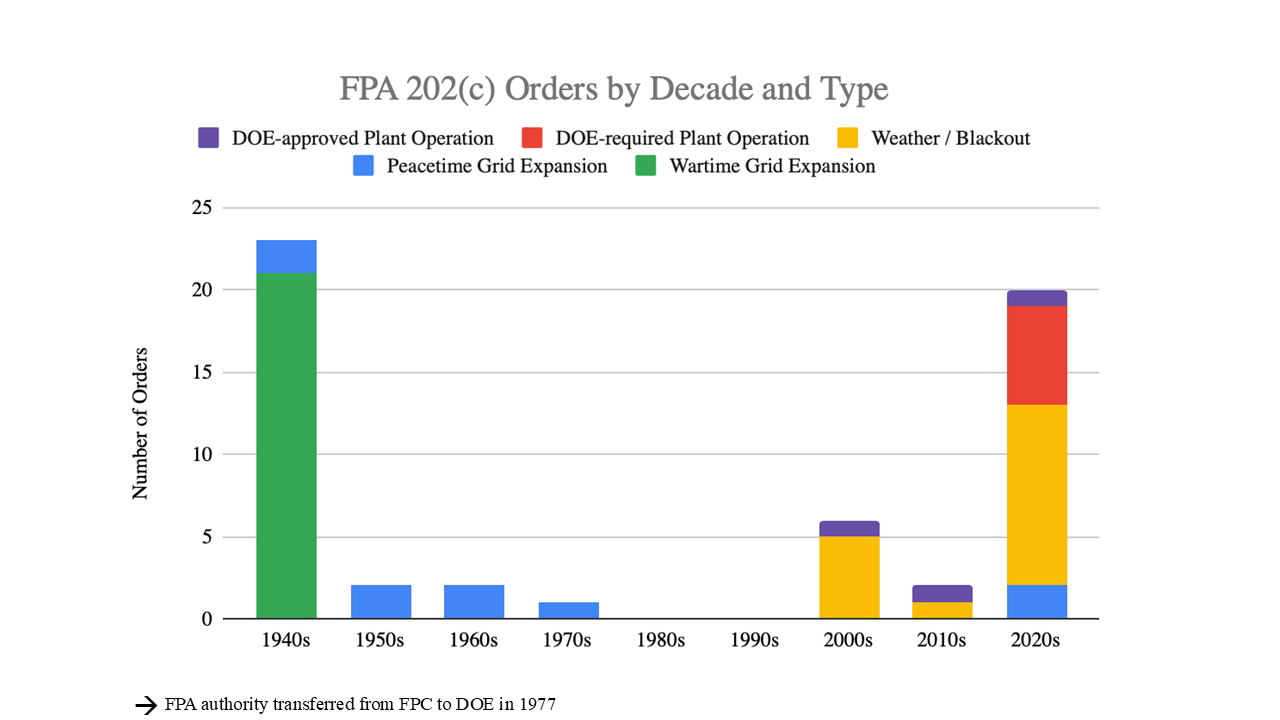
Over the course of the war, the FPC used its FPA Section 202(c) authority twenty-two times.84Rolsma, supra note 26, at 803. In June 1941, the FPC found that “an emergency . . . exists in the southeastern area of the United States, resulting from a sudden increase in the demand for electric energy to meet the requirements of national defense production.”85Recommendation for Curtailment of the Use of Elec. Energy in the Se. States, 2 F.P.C. 990, 990 (1941). The Commission followed this declaration with ten separate Section 202(c) orders on the same day.86See, e.g., Ga. Power & Light Co., 2 F.P.C. 993, 993–94 (1941); Fla. Power Corp., 2 F.P.C. 994, 994–95 (1941); Ga. Power & Light Co., 2 F.P.C. 995, 995–96 (1941); Ala. Elec. Coop., 2 F.P.C. 996, 996–97 (1941); Tenn. Valley Auth., 2 F.P.C. 997, 997–98 (1941); Carolina Aluminum Co., 2 F.P.C. 998, 998–99 (1941). Among other recommendations and mandates, these orders compelled the interconnection of Florida Power & Light Company and the Florida Public Service Company,87Fla. Power & Light Co., 2 F.P.C. 991, 991 (1941). the construction of a 100,000-volt circuit from a Duke Power Company substation to a Carolina Aluminum Company substation,88Duke Power Co., 2 F.P.C. 992, 992 (1941). and the construction of a 110,000-volt circuit interconnecting New Orleans Public Service, Inc. and the Mississippi Power Company.89New Orleans Pub. Serv., Inc., 2 F.P.C. 992, 992–93 (1941). Each order recognized the state of emergency due to increased wartime demand and declared that an emergency connection of facilities or increased generation, transmission, or delivery was necessary.90See, e.g., Fla. Power & Light Co., 2 F.P.C. 991, 991 (1941); Duke Power Co., 2 F.P.C. 992, 992 (1941).
Beyond ordering individual interconnections, the FPC played a key role in creating “power pools,” which were arrangements through which private utilities would share power. These pools changed how utilities operated, for many of them were unaccustomed to treating power grids as shared resources or working with their competitors, and some had carefully avoided interstate sales to prevent federal regulation.91See Cohn, supra note 72, at 109. Soon, major regions of the country were functioning as part of coordinated electricity networks with interties between regions, which meant that power shortages in some areas could be met with electricity from others with excess supplies.92Id. at 112–13. Later historical accounts have treated these power pools as one of the most important innovations of the United States’ World War II energy policies.93Id. at 117, 120.
In multiple ways, these World War II innovations helped sow the seeds for a more national grid and the complex electricity markets of the present day. As interconnected systems grew larger and remained coupled nearly full-time during the war, the traditional challenges of managing frequency and load became more intricate and demanding, leading to technological innovations that became industry standards.94Id. at 114–17. Institutional capacity also grew, as both federal agencies and utilities had to learn how to work across institutional boundaries. More generally, the United States moved quickly away from the prewar world, in which electricity distribution often involved poorly connected or disconnected private fiefs, and toward the efficiencies of an interconnected economy and grid.
II. Federal Grid Governance in the Modern Era
As the prior Part illustrates, the federal government’s wartime role in grid management was assertive. But that role also emphasized grid integration and relied on agencies—particularly the FPC—rather than direct presidential control. That emphasis on agencies fits with broader themes of this era, for the early part of the twentieth century saw much of the emergence of the modern administrative state.95See generally Cass Sunstein, After the Rights Revolution (1990) (chronicling the twentieth-century expansion of administrative governance). Regulatory agencies increasingly exercised congressionally delegated authority, often with only modest executive oversight, across a wide range of economic spheres.96See id. at 18–24. Electricity, even during wartime, was no exception.
Until recently, that trend continued. This Part surveys the federal electric grid management systems that continued to emerge and evolve from the postwar period through the present, and that trace their roots to the innovations of the interwar period and World War II. These systems and their history are complicated, and no generalization holds entirely true across multiple agencies or over such a long span of time. Nevertheless, throughout this period, management of the nation’s electric grid, though heavily influenced by the federal government, was generally not a sphere of substantial presidential influence either through executive orders or DOE actions. Instead, the dominant actor became FERC, an expert agency97See Kirti Datla & Richard L. Revesz, Deconstructing Administrative Agencies (and Executive Agencies), 98 Cornell L. Rev. 769, 825 (2013). that operated under legislative delegations conferring sweeping discretion,98See Jodi L. Short, In Search of the Public Interest, 40 Yale J. on Regul. 759, 804 (2023). whose decisionmaking was steeped in technical expertise,99See Sharon Jacobs, The Challenges of Participatory Administration, 58 UC Davis L. Rev. 323, 340–45 (2024) [hereinafter Jacobs, Challenges of Participatory Administration] (describing the technical and sometimes opaque nature of electricity regulation). and that showed stable policy commitments even across presidential administrations.100See Francisco “A.J.” Camacho, Trump Wants Agencies on a Short Leash. What Does that Mean for FERC?, E&E News (Dec. 10, 2024), https://www.eenews.net/articles/trump-wants-agencies-on-a-short-leash-what-does-that-mean-for-ferc/ [https://perma.cc/62UJ-AQ9H].
A. The Federal Energy Regulatory Commission: The Electric Grid Regulator
This Section picks up where Part I left off and describes the evolution of FERC regulation through the early twenty-first century. After World War II, technologies and challenges evolved, federal regulation of the energy sector continued to develop, and new agencies emerged. For instance, in the 1940s, Congress created the Atomic Energy Commission (AEC) to regulate the commercial use of nuclear power.101Atomic Energy Act of 1946, Pub. L. No. 79-585, 60 Stat. 755 (1946). It also created new authorities within the executive branch, partly in response to the energy crisis following the 1973 Arab Oil Embargo.102For discussions of how the Arab Oil Embargo transformed U.S. domestic energy policy, see generally Daniel Yergin, The Prize: The Epic Question for Oil, Money & Power 644–47 (1991); Jay Hakes, Energy Crises: Nixon, Ford, Carter, and Hard Choices in the 1970s, at 200–01, 217, 224–27, 342–43 (2021). In 1977, Congress enacted the Department of Energy Organization Act (DOE Act), which split up the FPC’s responsibilities.103Department of Energy Organization Act, Pub. L. No. 95-91, 91 Stat. 565 (1977) (codified as amended at 42 U.S.C. §§ 7101–352); see also A Brief History of the Department of Energy, Dep’t of Energy, https://www.energy.gov/lm/brief-history-department-energy [https://perma.cc/P6CL-HGPV]. Congress gave some federal energy activities to the newly created DOE, described in more detail in Section II.B, with a secretary appointed by the president and subject to Senate confirmation.104Department of Energy Organization Act §§ 201–02 (codified as amended at 42 U.S.C. §§ 7131–32). And it assigned the FPC’s responsibility for electricity-grid regulation and ratemaking to the newly created FERC.105Unlike DOE, FERC is a five-member commission supported by a career staff. Each member serves a five-year term, terms are staggered, no more than three commissioners are from the same political party, and each commissioner is appointed by the president and must be confirmed by the U.S. Senate. Id. § 401(b)(1) (codified as amended at 42 U.S.C. § 7171).
Subsequent legislation—including the Energy Policy Act of 1992,106Energy Policy Act of 1992, Pub. L. No. 102-486, 102 Stat. 2776. the Energy Policy Act of 2005,107Energy Policy Act of 2005, Pub. L. No. 109-58, 119 Stat. 594. and the Infrastructure Investment and Jobs Act of 2021,108Infrastructure Investment and Jobs Act, Pub. L. No. 117-58, 135 Stat. 429 (2021). among others—expanded FERC’s regulatory authority over the electricity sector. That authority now includes responsibilities to protect power-grid reliability through creating mandatory reliability standards, monitoring and investigating energy markets, and penalizing market participants that violate market rules.109See What FERC Does, Fed. Energy Regul. Comm’n, https://www.ferc.gov/what-ferc-does [https://perma.cc/79J4-KSH8]; Paul W. Parfomak, Cong. Rsch. Serv., R48349, The Federal Energy Regulatory Commission (FERC): Authorities and Membership 3–4 (2026); Sharon Jacobs & Ari Peskoe, Energy Emergencies vs. Manufactured Crises: The Limits of Federal Authority to Disrupt Power Markets, 2019 Harv. L. Sch. Env’t & Energy L. Program 6–7 (2019) (discussing how the Energy Policy Act of 2005 authorized FERC to regulate grid reliability); see also 16 U.S.C. § 825f, j (authorizing FERC to conduct investigations into FPA violations); id. § 825o-1 (granting FERC authority to assess penalties of up to million per day for each FPA violation).
FERC has done a lot with that authority. The central story of electricity regulation over the last fifty years has been a movement away from systems built around private monopolies and governmental price regulation and toward increased market competition.110See FERC v. Electric Power Supply Ass’n, 577 U.S. 260, 267 (2016) (describing FERC’s evolving role); see generally Joseph P. Tomain, The Past and Future of Electricity Regulation, 32 Env’t L. 435 (2002) (describing these changes). In the 1980s and 1990s, FERC adopted market-based rates for independent power producers,111See Morgan Stanley Cap. Grp. Inc. v. Pub. Util. Dist. No. 1 of Snohomish Cnty., 554 U.S. 527, 535 (2007) (describing market-based rates, among other regulatory reforms). enacted regulations designed to allow utilities to sell power outside their service areas, and required open-access transmission. These reforms limited the ability of utilities to engage in price discrimination against independent power producers or purchasers that needed to use the utilities’ power lines.112See New York v. FERC, 535 U.S. 1, 7–12 (2002). And it encouraged the formation of regional transmission organizations (RTOs), which are nonprofit, private entities that utilities use to jointly manage the shared grid and oversee wholesale auctions for energy and other grid services.113See Electric Power Supply Ass’n, 577 U.S. at 267–68; see also Energy Markets, Fed. Energy Regul. Comm’n, https://www.ferc.gov/opp/energy-markets [https://perma.cc/44GH-DEFL].
FERC, together with RTOs and states, also helps maintain “resource adequacy,” which means ensuring that there is adequate electricity generation to meet bulk-power-system needs and avoid brownouts and blackouts.114Reliability Explainer, Fed. Energy Regul. Comm’n, https://www.ferc.gov/reliability-explainer [https://perma.cc/CF3Q-8LDY]; Resource Adequacy for a Clean Energy Grid, Stinson (Nov. 2021), https://acore.org/wp-content/uploads/2021/11/RA-for-a-Clean-Energy-Grid_Legal-Analysis.pdf [https://perma.cc/4FXD-9DMY]; Joshua C. Macey, Shelley Welton & Hannah Wiseman, Grid Reliability in the Electric Era, 41 Yale J. on Regul. 164, 195–96 (2024) (discussing resource adequacy). While the FPA left jurisdiction over energy-generation plants primarily to states, many states have directed or permitted their utilities to join RTOs, which—subject to FERC review and oversight—impose resource-adequacy requirements on member utilities.115See Resource Adequacy for a Clean Energy Grid, supra note 114. Utilities fulfill those obligations through long-term planning and technical analysis, which they complete in cooperation with states, RTOs, and FERC.116See Macey, Welton & Wiseman, supra note 114, at 194–96. Likewise, the North American Electric Reliability Corporation (NERC), with authorization from Congress in the Energy Policy Act of 2005, sets mandatory standards for grid reliability, subject to FERC review and oversight.117Id. at 205. Notably, Congress created no role for DOE in addressing long-term resource adequacy or grid reliability.
To what extent these innovations have been successful is one of the central questions of energy law. The debates are broad, rich, and variegated, with scholars arguing whether FERC’s reforms have been sufficiently democratic;118See, e.g., Jacobs, Challenges of Participatory Administration, supra note 99 at 345–49, 384–87 (analyzing FERC’s efforts to promote democratic participation). adequately sensitive to the needs of disadvantaged communities and to emerging concepts of energy justice;119E.g. Shalanda H. Baker, Anti-Resilience: A Roadmap for Transformational Justice within the Energy System, 54 Harv. C.R.-C.L. L. Rev. 1, 36–37 (2019) (arguing that FERC has insufficiently addressed social and racial justice concerns). aggressive enough in pursuit of decarbonization;120E.g. Shelley Welton, Electricity Markets and the Social Project of Decarbonization, 118 Colum. L. Rev. 1067, 1112–13 (2018) (discussing limitations associated with RTO decarbonization efforts requiring FERC approval). and overly solicitous of the roles of traditional vertically integrated private utilities,121See, e.g., Ari Peskoe, Is the Utility Transmission Syndicate Forever?, 42 Energy L.J. 1, 45–46, 61 (2021). among many other subjects.
But amid the many debates, some things are relatively clear. Most importantly, these reforms have opened up electricity markets to many new participants who have brought increased competition and created downward pressure on prices.122See generally Fed. Energy Regul. Comm’n, 2024 State of the Markets Report (2025) (noting that wholesale prices are declining even as grid additions are dominated by solar, natural gas, wind, and battery storage). These reforms also have allowed the market entry of new types of energy generation, including wind and solar.123See id. at 28–32. One other feature of FERC’s transformation of grid regulation also bears mentioning: Presidents did not have much to do with it. No presidential proclamation spurred FERC’s orders creating wholesale electricity markets, RTOs, or approaches to resource adequacy. Nor did the overall trajectory of agency policy shift dramatically from administration to administration. Instead, the agency’s direction remained consistent over long periods of time, and its decisionmaking was largely technocratic, with elected politicians exercising influence through legislation, not presidential directives.124See Jacobs, Statutory Separation of Powers, supra note 10, at 416–18.
B. The Department of Energy: Electricity Innovator, Research Partner, Funder, and Emergency Responder
In contrast to the FPC and FERC, DOE’s origin story comes from the Manhattan Project, the highly classified effort by the U.S. War Department to work intensely with the scientific community to create the world’s first nuclear weapon.125A Brief History of the Department of Energy, U.S. Dep’t of Energy, https://www.energy.gov/lm/brief-history-department-energy [https://perma.cc/P6CL-HGPV]. This initiative required “large, multi-purpose facilities that became the nation’s first national laboratories,” which today are housed within the Office of Science at DOE.126History, U.S. Dep’t of Energy, https://www.energy.gov/science/history [https://perma.cc/3ANB-M9XP]. For decades, different offices within DOE have supported many aspects of energy research, development, demonstration, and deployment—including in the electricity sector—through billions of dollars in grants, loans, and other funding.127Zahava Urecki & Tanya Das, The Department of Energy’s Role in Fostering Innovation to Meet America’s Energy Needs, Bipartisan Pol’y Ctr. (Oct. 2, 2025), https://bipartisanpolicy.org/issue-brief/the-department-of-energys-role-in-fostering-innovation-to-meet-americas-energy-needs/ [https://perma.cc/FN2L-4HSR].
DOE also acts as a first responder for grid emergencies. But until recently, DOE had understood its emergency-response authority to be limited to short-term responses to genuine emergencies, and it had exercised its powers—for the most part—accordingly. As discussed in Part I, Congress, in 1935, authorized the FPC to issue temporary orders to require grid-stabilizing actions by private-sector actors in times of war or emergency in Section 202(c) of the FPA.128Public Utility Act of 1935, ch. 687, § 202(c), 49 Stat. 803, 849 (codified at 16 U.S.C. § 824a(c)). Later, when Congress enacted the Department of Energy Organization Act of 1977 (discussed in more detail in Section II.A) and divided executive branch electricity-related authority among multiple new federal agencies, it transferred the FPC’s Section 202(c) authority to DOE.129See Department of Energy Organization Act, Pub. L. No. 95-91, 91 Stat. 565 (1977) (codified at 42 U.S.C. §§ 7101–352); A Brief History of the Department of Energy, U.S. Dep’t of Energy, https://www.energy.gov/lm/brief-history-department-energy [https://perma.cc/P6CL-HGPV].
The FPC and, later, DOE have exercised 202(c) emergency authority dozens of times, but until recently, both agencies hewed closely to the statutory language limiting its use to wartime conditions and sudden emergencies.130See DOE’s Use of Federal Power Act Emergency Authority, U.S. Dep’t of Energy, https://www.energy.gov/ceser/does-use-federal-power-act-emergency-authority [https://perma.cc/T956-JFKR]. As discussed in Part I, the FPC invoked this authority during World War II, primarily to compel grid integration.131See supra Section I.C; Ashley J. Lawson, Cong. Rsch. Serv., R48568, Federal Power Act: The Department of Energy’s Emergency Authority (2025), https://www.congress.gov/crs-product/R48568 [https://perma.cc/3MF8-DCWX]; see also Rolsma, supra note 26, at 843–46 tbl. 2 (detailing Section 202(c) orders); infra Appendix at pp. 42–48 (same). The FPC also issued orders during and after the Korean War, but issued just seven 202(c) orders from 1944 until DOE assumed authority in 1977.132Rolsma, supra note 26, at 803–04, 844 tbl. 2; infra Appendix at pp. 39–41. And when a utility challenged the FPC’s decision not to use 202(c) to address the Arab Oil Embargo in the early 1970s, the D.C. Circuit Court of Appeals sided with the FPC, finding that dependence on foreign oil was a “continuing” emergency and that 202(c) “speaks of ‘temporary’ emergencies, epitomized by wartime disturbances . . . .”133Richmond Power & Light v. FERC, 574 F.2d 610, 615 (D.C. Cir. 1978), quoted in Rolsma, supra note 26, at 812.
Until recently, DOE itself understood that authority to be highly cabined. In 1981, DOE issued regulations defining an “emergency” for purposes of Section 202(c), and those regulations emphasize the agency’s intent that its emergency authority should not be a substitute for long-term utility planning.134The regulations defined “emergency” as:
[A]n unexpected inadequate supply of electric energy which may result from the unexpected outage or breakdown of facilities for the generation, transmission or distribution of electric power. Such events may be the result of weather conditions, acts of God, or unforeseen occurrences not reasonably within the power of the affected “entity” to prevent. An emergency also can result from a sudden increase in customer demand, an inability to obtain adequate amounts of the necessary fuels to generate electricity, or a regulatory action which prohibits the use of certain electric power supply facilities.
10 C.F.R. § 205.371 (2025) (“Definition of emergency”); see also Emergency Interconnection of Electric Facilities and the Transfer of Electricity to Alleviate an Emergency Storage of Electric Power, 46 Fed. Reg. 39984, 39985–86 (Aug. 6, 1981). The regulations also state that “while a utility may rely upon these regulations for assistance during a period of unexpected inadequate supply of electricity, it must solve long-term problems itself.”135Emergency Interconnection of Electric Facilities and the Transfer of Electricity to Alleviate an Emergency Storage of Electric Power, 46 Fed. Reg. at 39985. Those regulations remain in place, and, in accordance with them, DOE went twenty years before issuing its first 202(c) order.
Around 2000, DOE’s practices began to change, but initially only modestly. In 2000, DOE began issuing orders to address grid failures—like the 2003 Northeast blackout and the 2001 California electricity crisis—and weather-related emergencies, such as hurricanes, heat waves, and cold waves.136See Rolsma, supra note 26, at 805–06, 839–42; Lawson, supra note 131, at 3–4 tbl. 1. The duration of these orders almost always ranged from a few hours to fewer than ninety days.137 Lawson, supra note 131, at 2–3; see also Rolsma, supra note 26, at 838, 839 tbl. 1; Jacobs & Peskoe, supra note 109, at 12. More importantly, until DOE’s orders preventing the retirement of the J.H. Campbell plant in Michigan, DOE had never issued an emergency order on its own initiative. Instead, it had acted only in response to a formal request by a utility, a state, or a regional grid operator.138See Irvin et al., supra note 17 (“[U]nlike other Section 202(c) orders, the Campbell Order was issued by the DOE on its own initiative—not in response to a power plant owner, transmission provider, or grid operator application.”); Lawson, supra note 131, at 6 (same). For a table including all Section 202(c) orders to date, see infra Appendix. Likewise, it had never pointed to long-term resource-adequacy concerns as a justification to use its Section 202(c) authority.139Cf. Dep’t of Energy, Order No. 202-25-7, Midcontinent Independent System Operator (MISO) 202(c) Order (2025), https://www.energy.gov/sites/default/files/2025-08/MISO%20Order%20No.%20202-25-7.pdf [https://perma.cc/FD8Y-NENU] (citing evidence of “a potential longer term resource adequacy emergency in MISO” to justify continued additional dispatch of the Campbell Plant).
III. The Trump II Transformation
Whatever stability federal electricity governance may have enjoyed has come to an end. This Part describes the executive orders and implementation actions that have inserted President Trump’s self-described “energy dominance”140See, e.g., Establishing the National Energy Dominance Council, The White House (Feb. 14, 2025), https://www.whitehouse.gov/presidential-actions/2025/02/establishing-the-national-energy-dominance-council/ [https://perma.cc/WB98-PY22]. agenda into aspects of electric-grid governance that Congress placed primarily in the FPC’s, and then FERC’s, control since before World War II.
President Trump’s pursuit of what he has termed “energy dominance” began in his first term, with policies designed to promote fossil fuels, particularly coal, and to discourage the development of renewable energy, particularly wind.141See generally Lincoln L. Davies, Kiersten Rule Davies & Kathryn Glenn Speckart, Trump Energy Policy 2.0, 71 Nat. Res. & Energy L. Inst. 2-1 (2025). That agenda mostly failed, as the relatively lower costs of renewable power and natural gas meant that renewable generation and gas continued to grow and coal continued to decline.142Mickey Francis, U.S. Renewable Energy Consumption Surpasses Coal for the First Time in Over 130 Years, U.S. Energy Info. Admin. (May 28, 2020), https://www.eia.gov/todayinenergy/detail.php?id=43895 [https://perma.cc/DBM8-JLTD]. But upon taking office again in 2025, President Trump revived these efforts, this time with an entirely new level of vigor.
On his first day in office, President Trump declared a “national energy emergency,” citing his authority under the National Emergencies Act of 1976 (NEA).143Exec. Order No. 14,156, 90 Fed. Reg. 8433 (Jan. 20, 2025). The order declared that the nation had inadequate energy to meet its needs and directed the heads of federal executive departments and agencies to “identify and exercise any lawful emergency authorities available to them” to facilitate the development and use of domestic energy resources.144Id. at 8434. Other executive orders early in the second Trump Administration began laying the groundwork for DOE to take control of the electric grid. In April 2025, an order entitled “Strengthening the Reliability and Security of the United States Electric Grid”145Exec. Order No. 14,262, 90 Fed. Reg. 15521, 15521 (Apr. 8, 2025). stated that DOE should conduct its own electric grid resource adequacy analysis and, “to the maximum extent permitted by law, streamline, systemize, and expedite” its procedures for issuing orders under Section 202(c) of the FPA.146Id.
In many ways, these directives broke with the past. As discussed in Part II, Congress expressly reserved authority for states to address resource adequacy and delegated authority to FERC and FERC-regulated regional entities to ensure grid reliability.147See supra Part II. With no change in the governing statutory law, the April 2025 electric-grid executive order reassigned a dominant role for both authorities to DOE. And nothing in the executive order required or suggested that DOE should or could consult with FERC, RTOs, NERC, or states in conducting its analysis.
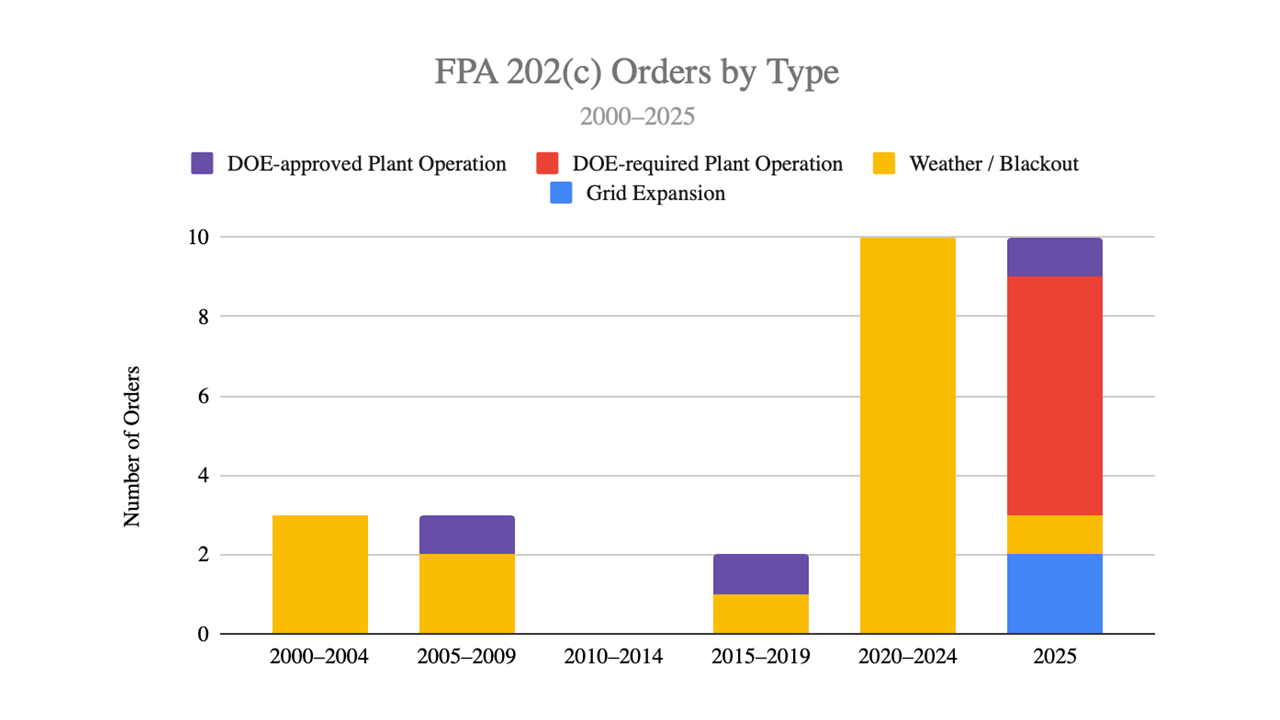
DOE wasted no time working to implement these mandates directing it to take control of the electric grid. Among other things, DOE began issuing a barrage of Section 202(c) orders.148See 2025 DOE 202(c) Orders, U.S. Dep’t of Energy, https://www.energy.gov/ceser/2025-doe-202c-orders [https://perma.cc/9AZQ-D5SF]; infra Appendix at pp. 30–33. All of the orders issued in 2025 directed aging, and, in some cases, inoperable, coal or oil plants to be made available for dispatch beyond their scheduled retirement dates.149See 2025 DOE 202(c) Orders, supra note 148. Notably, during the first Trump Administration, DOE had considered using its Section 202(c) emergency authority to prevent utilities from retiring uneconomic coal and nuclear plants, but the agency was concerned about its legal authority to do so.150Jacobs & Peskoe, supra note 109, at 21–25; Jeff Horwitz, Michael Biesecker & Matthew Daly, Despite Earlier Assurance, Trump Denies Coal a Lifeline, Christian Sci. Monitor (Aug. 22, 2017), https://www.csmonitor.com/USA/2017/0822/Despite-earlier-assurance-Trump-denies-coal-a-lifeline [https://perma.cc/UQD6-KYW2]; Letters from Murray Energy Corp. to Trump Admin. (Aug. 2017) (on file with Ted Bridis, Associated Press), https://embed.documentcloud.org/documents/3936141-Murray-s-letters-to-Trump-administration/ [https://perma.cc/JZV3-5BPB]. By 2025, DOE had shed those concerns.
The first of those orders, as discussed in the Introduction, involved the J.H. Campbell coal plant in Michigan.151 Dep’t of Energy, Order No. 202-25-3, Midcontinent Independent System Operator (MISO) 202(c) Order (2025), https://www.energy.gov/sites/default/files/2025-05/Midcontinent%20Independent%20System%20Operator%20%28MISO%29%20202%28c%29%20Order_1.pdf [https://perma.cc/X5T3-HCNK]. Significantly, neither the plant owner nor the regional grid operator—the Midcontinent Independent System Operator (MISO)—had sought DOE assistance or expressed any concern about the plant’s closure.152See Dahlberg, supra note 5. Consumers Energy, the plant’s owner, had already purchased a gas plant and taken other actions to make up for any reduction in generation capacity arising from the closure.153MPSC Approves Consumers Energy Integrated Resource Plan Settlement Agreement, Takes Additional Steps to Boost Electricity Capacity, Mich. Pub. Serv. Comm’n (June 23, 2022), https://www.michigan.gov/mpsc/commission/news-releases/2022/06/23/mpsc-approves-consumers-irp_takes-steps-improve-capacity [https://perma.cc/7JCK-LKLG]; Consumers Energy Co., supra note 5, at 21. It had also received approval from the state and federal grid reliability regulators for its transition plan.154Leach, supra note 2. In fact, the utility’s transition plan to cleaner and lower cost energy sources—a plan that state regulators had approved—was expected to save the utility’s customers $600 million over the next twenty years.155Lavelle, supra note 2. And even after DOE issued its order, MISO affirmed that it had sufficient energy supplies in the region for the next year.156Kyle Davidson, Trump Administration Extends Operation at West Michigan Coal Plant for Another 90 Days, Mich. Advance (Aug. 21, 2025), https://michiganadvance.com/2025/08/21/trump-administration-extends-operation-at-west-michigan-coal-plant-for-another-90-days/ [https://perma.cc/QN5R-62CM].
Beyond erasing those savings, the order created new costs for Consumers Energy and for Michigan consumers. Based on the utility’s SEC filings, between the issuance of the first DOE order on May 23, 2025, and December 31, 2025, Consumers Energy had incurred losses of $135 million—the difference between the cost to continue to keep the plant online and the power-sale revenues during that time period.157Larson, supra note 5; Consumers Energy Co., supra note 5, at 117–18. Someone—most likely consumers—will need to pay for those losses.158Lavelle, supra note 2; see Consumers Energy Co., supra note 5, at 117–18 (describing allocation of Campbell costs to customers).
The DOE’s order prompted legal challenges from states, environmental advocacy groups, and other stakeholders. One action—brought by Michigan, other states in the MISO region, and environmental advocacy groups in the D.C. Circuit Court of Appeals—challenged the DOE’s orders arguing, among other things, that there were no conditions that justified DOE’s exercise of emergency authority under FPA Section 202(c).159See Initial Opening Brief of the States of Illinois, Michigan, and Minnesota at 25, Michigan v. Dep’t of Energy, No. 25-1159, 2025 WL 3697045 (D.C. Cir. Dec. 19, 2025).
If the Campbell plant order was just a one-off event, it would still be concerning. Even that one order’s costs are huge, not to mention the adverse local health and environmental impacts of continuing to operate the plant.160Teresa Homsi & Alexander Rabin, Opinion: Keeping Coal Plant Online Isn’t Just Costly, It Risks Michiganders’ Health, Bridge Mi. (Nov. 14, 2025), https://bridgemi.com/guest-commentary/opinion-keeping-coal-plant-online-isnt-just-costly-it-risks-michiganders-health/ [https://perma.cc/N2K3-L72J]; Ariel Wittenberg, Pollution from Coal Plants Was Dropping. Then Came Trump and AI., E&E News (Nov. 24, 2025), https://www.eenews.net/articles/ai-gives-coal-plants-a-lifeline-as-trump-makes-them-dirtier/ [https://perma.cc/YLD6-CFAD]. But instead, the Campbell order was the beginning of a pattern. Between May 2025 and March 2026, DOE issued multiple Section 202(c) orders designed to delay the closure of coal-fired power plants.1612025 DOE 202(c) Orders, supra note 148; 2026 DOE 202(c) Orders, supra note 14; infra Appendix at pp. 30–33. These included: (1) orders requiring a fifty-two-year-old plant in Washington state to keep its last coal-fired boiler online despite longstanding plans to retire it and then convert the plant to run on natural gas;162Ethan Howland, DOE Orders 730-MW TransAlta Coal Plant in Washington to Keep Running, Util. Dive (Dec. 17, 2025), https://www.utilitydive.com/news/doe-transalta-centralia-emergency-order/808123/ [https://perma.cc/WG5B-C2QW]. (2) orders requiring a coal plant in Colorado, which was inoperable and set to close in two days at the time of the order, to instead be made available for dispatch;163Ethan Howland, DOE Orders 446-MW Colorado Coal Unit to Keep Running, Util. Dive (Jan. 6, 2026), https://www.utilitydive.com/news/doe-colorado-coal-craig-tristate/808849/ [https://perma.cc/T3HX-66HX]; Brown & Plumer, supra note 14. and (3) orders requiring a sixty-year-old coal unit in Indiana to remain available for dispatch beyond its retirement date, despite pleas from its owner that the plant would not be able to operate without tens of millions of dollars of unplanned ratepayer costs for maintenance and upgrades.164Benjamin Storrow & Hannah Northey, DOE Orders 2 Indiana Coal Plants to Continue Operating, Greenwire (Dec. 24, 2025), https://www.eenews.net/articles/doe-orders-2-indiana-coal-plants-to-continue-operating/ [https://perma.cc/THD9-VWXV]; Tomich, supra note 13. Owners of the coal plants—as well as states and environmental groups—have responded with legal challenges.165See, e.g., Ethan Howland, Coal Plant DOE Ordered to Stay Online Unlikely to Run Given “Flush” Power Supplies: CEO, Util. Dive (Mar. 4, 2026), https://www.utilitydive.com/news/washington-earthjustice-sue-doe-centralia-emergency-order-transalta/813754/ [https://perma.cc/T3HX-66HX] (describing litigation over Washington coal plant); Sam Brasch, The Owners Want to Close This Colorado Coal Plant. The Trump Administration Says No, NPR (Feb. 23, 2026), https://www.npr.org/2026/02/23/g-s1-110980/trump-coal-energy-colorado [https://perma.cc/63P8-2BED] (describing litigation over Colorado plant). Nevertheless, similar emergency orders continue to emerge.166See, e.g., Ethan Howland, DOE Orders OUC’s 465-MW Coal Unit in Florida to Continue Running, Util. Dive (June 5, 2026), https://www.utilitydive.com/news/doe-orlando-coal-florida-stanton-emergency-202/822119/ [https://perma.cc/K3DM-TAYK]. Indeed, DOE Secretary Chris Wright declared, at a White House event in January 2026, that he planned to use DOE’s Section 202(c) authority to prevent as many coal-plant retirements as possible over the next three years.167Brown & Plumer, supra note 14.
As with the Campbell plant order, none of the subsequent DOE orders were issued in response to requests by utilities, grid operators, or states. None of the orders resolve the issue of who beyond the utilities’ own ratepayers will bear the costs of maintaining these plants or the costs of replacement electricity resources utilities had already procured in anticipation of the plants’ imminent closures.168Howland, DOE Orders 730-MW TransAlta Coal Plant in Washington to Keep Running, supra note 162; Howland, DOE Orders 446-MW Colorado Coal Unit to Keep Running, supra note 163.
Again, all of this was a marked break from the past. The bar graphs below show the Trump Administration’s significant departure in the use of Section 202(c) orders from Section 202(c)’s historical use. The key point of the charts is simple: Orders preventing specific plants from retiring were frequent in 2025 and 2026 but have no historical precedent.
IV. The President and the Power Grid
The prior Part described the sharp discontinuity between the second Trump Administration’s electric grid policies and those of previous administrations. This Part explains two reasons why this discontinuity matters. The first reason relates to important doctrinal questions regarding statutory interpretation and presidential use of emergency authority. The second reason is practical. The grid governance approaches from which the second Trump Administration has departed, while far from perfect, gave the United States electricity systems that were strong, evolving, and improving.169See supra Part II (describing FERC actions). Abandoning the lessons of that experience does not bode well for the future of the grid.
A. Presidential Power and Statutory Interpretation
The DOE Section 202(c) orders raise significant questions of statutory interpretation. For instance, since 2022, the Supreme Court has used the major questions doctrine to rein in executive branch agency actions where the perceived absence of a clear statement from Congress has raised questions about the “history and breadth of the [agency’s] authority” or where the action has been of major “economic and political significance.”170West Virginia v. EPA, 142 S. Ct. 2587, 2608 (2022) (quoting FDA v. Brown & Williamson Tobacco Corp., 529 U.S. 120, 160 (2000)). In 2026, the Court confirmed that statutes delegating emergency authority to the executive branch are not immune from scrutiny under the major questions doctrine.171See Learning Resources v. Trump, 146 S. Ct. 628, 641 (2026). Relatedly, the Court has indicated there are red flags when agencies move outside what the justices perceive to be those agencies’ traditional roles. As Justice Barrett has put it, “Another telltale sign that an agency may have transgressed its statutory authority is when it regulates outside its wheelhouse.”172Nebraska v. Biden, 143 S. Ct. 2355, 2382 (2023) (Barrett, J., concurring).
The DOE Section 202(c) orders raise each of these concerns. It would be an understatement to say that Section 202(c) does not provide clear authority to order the indefinite operation of power plants in circumstances where the electric grid is operating normally and no responsible party has requested DOE intervention.173See 16 U.S.C. § 824a(c) (allowing orders only in response to an “emergency”). While each individual order might not have major economic or political significance, at least outside the specific grid area the affected power plant serves, the collective goal is clearly the kind of reworking of electricity-generation systems that the Court already has treated as raising major questions.174See West Virginia, 142 S. Ct. at 2612–13 (arguing that choices about the amount of coal-fired power on electricity grids are major questions). In fact, the impact of the Trump Administration’s Section 202(c) orders might be much greater than that of the Clean Power Plan, for the Clean Power Plan aligned with market trends, while the 202(c) orders attempt to fight those trends. See id. at 2627–28 (Kagan, J., dissenting) (“[T]he Clean Power Plan never went into effect. The ensuing years, though, proved the Plan’s moderation. Market forces alone caused the power industry to meet the Plan’s nationwide emissions target—through exactly the kinds of generation shifting the Plan contemplated.”). And most strikingly, the orders move DOE outside its traditional role; for decades, project-specific decisions about modes of electricity generation have been left to state governments and private ordering within a grid-governance framework overseen by FERC.175See supra Part II (describing state authority over power plants). Indeed, outside the narrow and temporally limited context of wartime and short-term, unexpected emergencies, the federal government has not been in the business of directly ordering particular power plants under private ownership to open or close.176See supra Part II (describing history and roles of federal agencies in grid governance). In raising these concerns, we do not endorse the major questions doctrine, which has been subject to extensive and persuasive scholarly criticism.177See, e.g., Jody Freeman & Matthew C. Stephenson, The Anti-Democratic Major Questions Doctrine, 2022 Sup. Ct. Rev. 1, 4 (2022) (describing the major questions doctrine as a “novel clear statement rule that not only ignores but inverts long-standing administrative law principles.”); Mila Sohoni, The Major Questions Quartet, 136 Harv. L. Rev. 262, 266 (2022) (“[T]he new major questions doctrine allows the Court ample leeway to preserve major rules when the muse so moves it—even when those rules rest on statutory authority as contestable to the naked eye as the authority that underwrites rules that fail to pass muster.”). But if the courts wish to apply it in an ideologically neutral way, then a Section 202(c) case would be an excellent opportunity.
B. Practical Consequences
Beyond the doctrinal implications, there are practical consequences associated with the DOE’s Section 202(c) orders for electric utilities and their customers and more generally for electric-grid governance. As described throughout this Essay, through both research and regulation, the federal government until now has consistently supported the development and deployment of new technologies, helping to build an electricity system that is more diverse than even the most optimistic World War II–era planners would likely have dreamed of. While no one would call it perfect, FERC has created a system of regulated markets overseen by a technically savvy and politically stable bureaucracy.178Michael Panfil & Rama Zakaria, Uncovering Wholesale Electricity Market Principles, 9 Mich. J. Env’t & Admin. L. 145, 149 (2019) (“Although the Commission’s makeup itself may change from year to year, the rationale and logic undergirding its work has been remarkably durable and consistent since the introduction of competitive wholesale markets.”). That system has helped produce a variety of good results,179See supra notes 122–124 and accompanying text. and it has done so with only light involvement from a series of presidents.
The Trump Administration’s interventions reflect a very different way of thinking about the role of government in managing the grid. In that alternative way of thinking, use of emergency authorities allows the administration to promote favored energy resources, like fossil fuels, regardless of costs and markets. Conventional and basic-level economic and political theories—including works that once were canonical on the political right—can easily predict the consequences: If business opportunities are allocated by centralized and political authorities who have a limited understanding of, or interest in, the economics of electricity, then consumer costs will rise and quality will drop.180See generally, e.g., Friedrich A. Hayek, The Road to Serfdom (1944) (arguing that centralized planning leads to both despotism and poor economic outcomes); Milton Friedman, Capitalism and Freedom (1962) (advancing similar critiques of centralized economic power).
Already, that is exactly what is happening. The Trump Administration is embracing the technologies of the past, like decades-old coal plants with poor reliability records, high maintenance costs, and adverse environmental impacts.181See Richard L. Revesz & Jack Lienke, Struggling for Air: Power Plants and the “War on Coal” 10–12 (2016) (summarizing the environmental costs of coal); see also Tomich, supra note 13 (discussing unreliability of plants subject to the 202(c) orders). Many of the plants in question are not even able to operate, undermining the DOE’s claim that they are in any position to address “emergency” conditions under the statute.182See Tomich, supra note 13 (discussing operational failure of coal unit in Indiana and quoting utility’s president as saying that required maintenance and upgrades “will require substantial investment to support an inefficient and increasingly unreliable asset”); Benjamin Storrow, 3 Coal Turbines Ordered to Stay Open by DOE Have Not Run, Climatewire (Apr. 10, 2026), https://subscriber.politicopro.com/article/eenews/2026/04/10/3-coal-plants-ordered-to-stay-open-by-doe-have-not-run-00866256 [https://perma.cc/S9FN-Q46G] (discussing reasons why multiple plants subject to 202(c) orders have not run or have run well below their historic averages either due to maintenance problems or because grid operators did not need them). The increased costs associated with the administration’s Section 202(c) orders are staggering.183See Greg Alvarez, DOE Forces Busted Coal Plant to Stay Online for “Energy Emergency” but Halts 2.5 Million Homes’ Worth of New Power, Power Line (Jan. 11, 2026), https://thepowerline.substack.com/p/doe-forces-busted-coal-plant-to-stay [https://perma.cc/WCG7-2D7Z]. One estimate puts the costs to consumers of keeping aging coal plants online at over $3 billion a year.184Michael Goggin, The Cost of Federal Mandates to Retain Fossil-Burning Power Plants, Grid Strategies (Aug. 2025), https://earthjustice.org/wp-content/uploads/2025/08/grid-strategies_cost-of-federal-mandates-to-retain-fossil-burning-power-plants.pdf [https://perma.cc/WH35-EVTJ]; see also Brown & Plumer, supra note 14 (identifying costs of at least billion per year).
There is another cost associated with the Section 202(c) orders beyond the immediate excess consumer costs. The DOE orders will inevitably discourage states and power companies from engaging in the type of rational long-term planning that FERC and state public utility commissioners have encouraged and, in some cases, required. Using the J.H. Campbell plant as an example, the electric utility, regional grid operator, and state and federal regulators identified an uneconomic resource that needed to be retired, planned years in advance to replace it with cheaper and cleaner resources, and charged ratepayers for carrying out that plan. Then the DOE Secretary upended those plans just days ahead of the plant’s retirement.185See supra notes 2–5, 158–164 and accompanying text (discussing circumstances of DOE’s order). If such actions become expected, no electric utility or state regulator can be confident that resource plans and the commitments they have made to ratepayers will be carried out. The result is deeply destabilizing to the kind of sensible economic decisionmaking and resource planning that the private sector and state and federal regulators need to be able to engage in.
Moreover, the administration’s use of Section 202(c) orders to commandeer long-term grid-planning is uniquely free from the substantive and procedural constraints that usually accompany federal administrative actions, both in the electricity sector and more generally. The orders are issued by the DOE Secretary without notice and comment;186See 16 U.S.C. § 824a(c) (allowing orders “with or without notice, hearing, or report”). the statute does not require consideration of costs or other factors that usually are part of utility regulatory decisions;187See id. and DOE has taken the position that, as “emergency” decisions, these actions should be given enormous deference.188See Respondents’ Initial Answering Brief at 17–18, 47–48, 52, 61, Michigan v. Dep’t of Energy, No. 25-1159, 2025 WL 3697045 (D.C. Cir. Dec. 19, 2025) (referring multiple times to the “broad discretion” Section 202(c) grants to DOE to determine what constitutes an emergency and the deference the court owes to DOE in exercising its judgment). As such, these actions are uniquely prone to arbitrary, impulsive, politically driven decisionmaking—a mode of administrative action that is particularly unsuited to expertise-laden technical and policy questions like how best to meet resource-adequacy needs over a long-term time horizon.189See, e.g., Ethan Howland, Coal Plant Owners Say DOE “Emergency” Order to Run it Violates Constitution, Util. Dive (Feb. 2, 2026), https://www.utilitydive.com/news/doe-emergency-order-craig-colorado-coal-tri-state/811088/ [https://perma.cc/TFN5-KVRS] (quoting the CEO of Colorado utility that owns the coal plant as stating that the order violates the Federal Power Act and constitutes an unconstitutional taking of private property because it “requires the operation of an uneconomic resource and disrupts ordinary and orderly planning, development, and investment in generation resources”). Consumers and the environment both will pay the price.
Conclusion
In years to come, grid managers will occasionally face genuine emergencies. Circumstances will arise, suddenly and without warning, that could not have been planned for, and those crises could require quick and short-term federal interventions in management of the grid. When those circumstances arise, the nation may appreciate the wisdom of including Section 202(c) in the Federal Power Act. But that sort of crisis intervention is not what has happened in 2025 and 2026. Instead, DOE has used Section 202(c) in ways that have no historical analog, neither during the crisis years of World War II nor in the decades since, and that are creating problems rather than resolving them. The immediate burdens on consumers will be substantial, and the long-term consequences for grid management may well be worse. Future administrations and present-day courts would do well to return Section 202(c) to its traditional place and, more broadly, to restore systems of grid governance that have served the nation relatively well.
Appendix
Federal Power Act § 202(c) Orders (1941-2025)190The information used to create this table is from the following sources: DOE’s Use of Federal Power Act Emergency Authority, Dep’t of Energy, https://www.energy.gov/ceser/does-use-federal-power-act-emergency-authority [https://perma.cc/T956-JFKR]; Rolsma, supra note 26, at 839–46; Lawson, supra note 131. The table includes DOE’s renewal of orders issued in 2025 through April 1, 2026.
Order | Date | Subject Matter | Direction | Duration |
December 2025 (renewed March 2026 via Order No. 202-26-21) | 446.4 MW coal plant in Colorado ordered to remain operational despite planned retirement date in December 2025 | DOE directed Tri-State Generation and Transmission Association and its coowners to continue to operate the Craig Station in Colorado. | Continuous since December 30, 2025 | |
December 2025 (renewed March 2026 via Order No. 202-26-20) | 103.7 MW coal-fired generating unit in Indiana ordered to remain operational despite planned retirement in December 2025 | DOE directed CenterPoint Energy and the Midcontinent Independent System Operator, Inc. (MISO) to continue to operate the F.B. Culley Generating Station in Indiana. | Continuous since December 23, 2025 | |
December 2025 (renewed March 2026 via Order No. 202-26-19) | Two 423.5 MW coal-fired generation units in Indiana ordered to remain operational despite planned retirement in December 2025 | DOE directed Northern Indiana Public Service Company and MISO to continue to operate the R.M. Schahfer Generating Station in Indiana. | Continuous since December 23, 2025 | |
December 2025 (renewed March 2026 via Order No. 202-26-18) | 729.9 MW coal-fired generation unit in Washington State ordered to remain operational despite planned retirement in December 2025 | DOE directed TransAlta to continue to operate the Centralia Generating Station in Washington. | Continuous since December 16, 2025 | |
July 2025 (extended October 2025 via Order No. 202-25-6A) | 397 MW oil-burning generator unit in Maryland allowed to exceed its yearly operational-hour allotment | In response to a request from regional transmission organization PJM, DOE permitted PJM and Talen Energy Corporation to dispatch an oil-burning generator unit beyond its yearly allotment of permitted operational hours when necessary to meet PJM’s anticipated demand. | 156 days | |
June 2025 | Additional generation permitted beyond authorized emissions limits | In response to a request from investor-owned utility Duke Energy Carolinas, DOE authorized utility to use its generating units as needed to meet demand regardless of emission or permit limitations due to expected weather-related energy shortfalls. | 42 hours | |
May 2025 (renewed August 2025, November 2025, and February 2026 via Order No. 202-26-17) | Two 380 MW dual fuel oil-gas generating units in Pennsylvania, ordered to remain operational | DOE directed Constellation Energy and PJM Interconnection to continue to operate two natural gas and oil generating units set to retire on the Eddystone Generating Station in Pennsylvania despite their planned retirement in May 2025. | Continuous since May 30, 2025 | |
May 2025 (renewed August 2025, November 2025, and February 2026 via Order No. 202-26-16) | 1560 MW coal plant in Michigan ordered to remain operational | DOE directed Midcontinent Independent System Operator, Inc. (MISO) and Consumers Energy to continue to operate the coal-fired Campbell Power Plant in Michigan despite its planned retirement in May 2025. | Continuous since May 23, 2025 | |
May 2025 (renewed August 2025, November 2025, and February 2026 via Order No. 202-25-2C) | Vegetation management ordered | DOE directed the Puerto Rico Electric Power Authority to conduct vegetation management to ensure the operate of the generation facilities as demanded by Order No. 202-25-1, below. | Continuous since May 16, 2025 | |
May 2025 (renewed August 2025, November 2025, and February 2026 via Order No. 202-25-1C) | Expanded generation ordered due to chronically weak power grid further damaged by natural disasters in Puerto Rico | DOE directed the Puerto Rico Electric Power Authority to dispatch generation units to expand baseload generation. | Continuous since May 16, 2025 | |
October 2024 | Additional generation permitted beyond authorized emissions limits | In response to a request from Duke Energy Florida, DOE permitted Duke Energy Florida to dispatch additional generation despite emission and permit limits to meet load requirements due to expected shortfalls caused by Hurricane Milton. | 3 days | |
September 2023 | Additional generation permitted beyond authorized emissions limits | In response to a request from the Electric Reliability Council of Texas (ERCOT), DOE permitted ERCOT to dispatch additional generation despite emission and permit limits due to weather-related shortfalls caused by an extreme heat wave. | 26.5 hours | |
December 2022 | Additional generation permitted beyond authorized emissions limits | In response to a request from PJM Interconnection, DOE permitted PJM to operate certain generating units at maximum capacity despite emission and permit limits due to expected shortfalls caused by extreme winter weather. | 30.5 hours | |
December 2022 | Additional generation permitted beyond authorized emissions limits | In response to a request from the Electric Reliability Council of Texas (ERCOT), DOE permitted ERCOT to operate certain generating units at maximum capacity despite emission and permit limits due to expected shortfalls caused by extreme winter weather. | 36.5 hours | |
September 2022 | Additional generation permitted beyond authorized emission limits | In response to a request from the Balancing Authority of Northern California (BANC), DOE permitted BANC to dispatch additional generation despite emission and permit limits due to expected shortfalls caused by extreme heat. | 7 days | |
September 2022 | Additional generation permitted beyond authorized emissions limits | In response to a request from the California Independent System Operator Corporation (CAISO), DOE permitted CAISO to operate certain generating units at maximum capacity despite emission and permit limits due to expected shortfalls caused by extreme heat. | 7 days | |
September 2021 | Additional generation permitted beyond authorized emissions limits | In response to a request from the California Independent System Operator Corporation (CAISO), DOE permitted CAISO to operate certain generating units at maximum capacity despite emission and permit limits due to expected shortfalls caused by extreme heat. | 60 days | |
February 2021 | Additional generation permitted beyond authorized emissions limits | In response to a request from the Electric Reliability Council of Texas (ERCOT), DOE permitted ERCOT to operate certain generating units at maximum capacity despite emission and permit limits due to expected shortfalls caused by extreme winter weather. | 5 days | |
September 2020 | Additional generation permitted beyond authorized emissions limits | In response to a request from the California Independent System Operator Corporation (CAISO), DOE permitted CAISO to operate certain generating units at maximum capacity despite emission and permit limits due to expected shortfalls caused by extreme heat. | 8 days | |
August 2020 | Temporary interconnection permitted in response to weather-related shortages in Texas | In response to a request from CenterPoint Energy Houston Electric (CEHE), DOE permitted CEHE to utilize a temporary connection to another Texas utility system to restore electric service after Hurricane Laura caused grid outages. | 46 days | |
June 2017 (multiple renewals through December 2018) | Use of noncompliant coal-fired generating units in Virginia permitted | In response to a request from PJM Interconnection, DOE permitted continued use of two coal-fired generation units that were noncompliant with the Mercury and Air Toxics Standards initially due to expected shortfalls caused by extreme heat. The order was renewed through December 2018 upon PJM’s request to allow for continued use during the construction of a new transmission line that would augment the region’s power grid. | 630 days | |
April 2017 | Use of noncompliant coal-generating unit in Oklahoma permitted | In response to a request from Grand River Dam Authority (GRDA) in Oklahoma, DOE permitted GRDA to utilize a coal-generating unit that was noncompliant with the Mercury and Air Toxics Standards to meet demand after two other units became inoperative after a local fire and flooding. | 90 days | |
September 2008 | Temporary interconnection in Texas permitted | DOE authorized CenterPoint Energy to temporarily connect to other Texas utility systems to restore electric service after Hurricane Ike caused grid outages. | 48 days | |
September 2005 | Temporary interconnection in Texas permitted | DOE authorized CenterPoint Energy to temporality connect to other Texas utility lines to restore power lost as a result of Hurricane Rita. | 34 days | |
December 2005 (renewals through January 2007) | Generating station in the DC area ordered to remain operational | In response to a request from the District of Columbia Public Service Commission, DOE required Mirant Corporation to continue operating its Potomac River generating station despite plans to cease operations. DOE found that ceasing operations of the station would likely cause outages. | 558 days | |
August 2003 | Transmission ordered between New York and Connecticut | DOE ordered the New York Independent System Operator and ISO New England to require Cross-Sound Cable Company to operate between Connecticut and New York to ease shortages causing regional blackouts. | 18 days | |
August 2002 | Transmission ordered between New York and Connecticut | DOE ordered the New York Independent System Operator and ISO New England to require Cross-Sound Cable Company to operate between Connecticut and New York to ease shortages causing regional blackouts. | 47 days | |
December 2000 | Services ordered in California to fulfill unexpected shortfalls | DOE ordered certain entities to generate, deliver, and transmit energy when requested by the California Independent System Operator in response to unexpected shortfalls caused by the combined effect of inoperative facilities, water shortages, and market volatility. | 7 days | |
March 1972 | Interconnection ordered in Ohio | Federal Power Commission ordered interconnection between Cleveland Electric Illuminating Co. and the City of Cleveland’s Division of Water and Power due to potential shortages in isolated regions without external connections. | No termination specified | |
August 1967 | Interconnection ordered in Kentucky | Federal Power Commission ordered interconnection between Kentucky Utilities Co. and additional electrical systems due to potential shortages in isolated regions without external connections. | No termination specified | |
April 1966 | Interconnection ordered in Georgia | Federal Power Commission ordered interconnection between Georgia Power Co. and Crisp County after several outages in the County revealed system inadequacies. | 5 years and 9 months | |
August 1956 (extended September 1956) | Interconnection ordered between Wisconsin and Illinois to account for limited reserve-generation capacity | Federal Power Commission ordered an increase in the interconnection capacity between Commonwealth Edison Co. and Wisconsin Electric Power Co. without affecting either company’s jurisdictional status with the Commission. | 4 months | |
November 1951 (extended August 1956) | Interconnection permitted between Wisconsin and Illinois | Federal Power Commission permitted interconnection between Wisconsin Electric Power Co. and Public Service Co. of Northern Illinois without subjecting either company to Commission jurisdiction with interconnection to be utilized during likely shortfalls given the high concentration of defense industries located in the region. | 4 years and 9 months | |
April 1948 (extended February 1949, December 1950) | Interconnection permitted in Texas | Federal Power Commission permitted interconnection in Texas without affecting companies’ jurisdictional standing with the Commission in response to unexpected construction delays, equipment failures, load forecasts, and reduced hydroelectric output. | 4 years and 8 months | |
January 1947 | Interconnection permitted in the Pacific Northwest | Federal Power Commission permitted interconnections to support the Pacific Northwest region in response to increased regional demand after returning to peacetime activity after WWII. | 8 years | |
February 1943 | Increased generation and transmission permitted to support war efforts | Federal Power Commission permitted increased generation and transmission between Dairyland Power Cooperative and Northern States Power Co. to support regions experiencing increased demand caused by the production of farm products needed during wartime. | Wartime order | |
February 1943 | Transmission and delivery ordered in the Pacific Northwest to support war efforts | Federal Power Commission ordered the Washington Water Power Co. to deliver and transmit energy to Bonneville Power Administration to supply War Department facilities. | Wartime order | |
November 1942 | Interconnection ordered to support war efforts | Federal Power Commission ordered the interconnection of electric facilities in Connecticut in response to increased demand, limitations on supply and transportation, and restrictions on construction and maintenance because of the war effort. | Wartime order | |
May 1942 | Interconnection ordered in Florida to support the war effort | Federal Power Commission ordered the interconnection of Florida electric facilities to support increased demand associated with the war effort. | Wartime order | |
May 1942 | Interconnection ordered in Florida to support the war effort | Federal Power Commission ordered the Florida Power & Light Co. and the City of Gainesville, Florida to construct transmission facilities and establish interconnections to support increased demand associated with the war effort. | Wartime order | |
May 1942 | Interconnection ordered in Florida to support the war effort | Federal Power Commission ordered the Florida Power & Light Co. and the City of Jacksonville, Florida to construct transmission facilities and establish interconnections in response to an increased demand related to war efforts. | Wartime order | |
December 1941 | Interconnection and delivery ordered between Virginia and Maryland to meet increase in demand associated with war-related infrastructure | Federal Power Commission ordered interconnection between Virginia and Maryland to meet a sudden increase in demand resulting, in part, from the construction of a new War Department office building. | Wartime order | |
November 1941 | Transmission and delivery ordered in the Southeast to support the war effort | Federal Power Commission ordered electric companies to transmit and deliver energy up to 10,000 kilowatts for use by the Pittsburgh Metallurgical Co., which was producing products of war. | Wartime order | |
October 1941 | Delivery ordered in the Southeast to support the war effort | Federal Power Commission ordered delivery of electric energy to meet increased demand and correct generation shortages associated with wartime manufacturing, particularly aluminum production. | Wartime order | |
September 16, 1941 (extended September 1942) | Additional water usage permitted on the Niagara River to increase electric generation in support of the war effort | Federal Power Commission permitted the Niagara Falls Power Co. to amend its license to increase the amount of water the company could divert from the Niagara River to increase generation in response to increased demand related to wartime production. | Wartime order | |
August 1941 | Interconnection ordered in the Southeast to meet increased demand and insufficient generation | Federal Power Commission ordered additional interconnection to meet increased demand and insufficient generation. | Wartime order | |
June 1941 | Generation and delivery from Carolina Aluminum Company ordered to meet increased demand | Federal Power Commission ordered the Carolina Aluminum Co. to generate and deliver continuous electric supply from its hydroelectric plants to ensure maximum generation of aluminum products to support the war effort. | Wartime order | |
June 1941 | Curtailment of nonessential electric supply recommended | Federal Power Commission recommended that all public and private citizens in the southeastern region of the United States curtail the use of electric energy in light of increased demand associated with wartime production and reduced hydroelectric supply. | Wartime recommendation | |
June 1941 | Interconnection ordered between Florida and Alabama | Federal Power Commission ordered interconnection between Florida and Alabama to meet increased demand and insufficient generation associated with wartime production. | Wartime order | |
June 1941 | Interconnection ordered between Florida and Georgia | Federal Power Commission ordered interconnection between Florida and Georgia to meet increased demand and insufficient generation associated with wartime production. | Wartime order | |
June 1941 | Interconnection ordered in Florida | Federal Power Commission ordered the interconnection of two Florida electric utilities to meet increased demand and insufficient generation associated with wartime production. | Wartime order | |
June 1941 | Interconnection ordered in Georgia | Federal Power Commission ordered the interconnection of two Georgia electric utilities to meet increased demand and insufficient generation associated with wartime production. | Wartime order | |
June 1941 | Interconnection ordered between Georgia and Louisiana | Federal Power Commission ordered the interconnection between Georgia and Louisiana to meet increased demand and insufficient generation associated with wartime production. | Wartime order | |
June 1941 | Interconnection ordered in North Carolina | Federal Power Commission ordered the interconnection of two North Carolina electric utilities to meet increased demand and insufficient generation in the southeastern region of the United States associated with wartime production. | Wartime order | |
June 1941 | Interconnection ordered in Florida | Federal Power Commission ordered the interconnection of two Florida electric utilities to meet increased demand associated with wartime production. | Wartime order | |
June 1941 | Emergency declared in the southeastern region of the United States due to in sufficient generation | Federal Power Commission declared a state of emergency in the southeastern region of the United States given the increased demand for electric supply associated with wartime production and drought limiting hydroelectric generation. This declaration was the basis for all June 1941 FPC 202(c) orders listed above. | Wartime recommendation |
* James G. Degnan Professor of Law, University of Michigan Law School. We received extremely helpful comments on earlier drafts of this essay from Nick Bagley, Dan Deacon, Joel Eisen, Rob Glicksman, Leah Litman, Heather Payne, Ari Peskoe, and Hannah Wiseman. Sam Fiske, Meredith Folensbee, Meher Mann, Hazel Rosenblum-Sellers, and Connor Tooman provided excellent research assistance.
** Albert Abramson ’54 Distinguished Professor & Associate Dean for Research, UC Law San Francisco.
