
The Invention of the Judicial Administrative State
The Taft Court: Making Law for a Divided Nation, 1921–1930. By Robert C. Post. Padstow: Cambridge University Press. 2024. Pp. xlii, 1608. $250.
Introduction
After being introduced at a recent event at the Library of Congress, Justice Elena Kagan quipped, “I’ve had a lot of jobs . . . it would be so clear that I would change my job[] every four years that I would say, ‘Well, now you know the secret about me: I can’t keep a job.’ ”1Library of Congress, The 2024 Supreme Court Fellows Program Annual Lecture with U.S. Supreme Court Justice Elena Kagan, at 11:32, YouTube (Feb. 27, 2024), https://youtu.be/Wl_N3gHOAyM.
If ever there was a Justice who could make a similar witticism, it would undoubtedly be William Howard Taft. Indeed, looking back on his career, he once famously remarked, “[w]henever an office fell . . . my plate was up.”2Robert C. Post, Mr. Taft Becomes Chief Justice, 76 U. Cin. L. Rev. 761, 762 (2008) (quoting William H. Taft, Legal Ethics, 1 B.U. L. Rev. 174, 174 (1921)).
And what a plate it was—this single person served as Solicitor General of the United States, Judge of the United States Court of Appeals for the Sixth Circuit, Governor-General of the Philippines, Provisional Governor of Cuba, Secretary of War, and President of the United States.3Taft Gained Peaks in Unusual Career, N.Y. Times, Mar. 9, 1930, at 27.
But the role in which he had the greatest influence on this country was as the tenth Chief Justice of the United States. At a crucial time in America’s history, amidst the Roaring Twenties and the Great Depression, Chief Justice Taft transformed the federal judiciary. Relying on his political skills (and ties), he oversaw the creation of the Conference of Senior Circuit Judges4See Peter Graham Fish, The Politics of Federal Judicial Administration 30–32 (1973).
—today termed the United States Judicial Conference5In 1948, the Conference of Senior Circuit Judges was renamed the Judicial Conference of the United States. See Act of June 25, 1948, ch. 646, § 331, 62 Stat. 869, 902 (codified as 28 U.S.C. § 331).
—the policymaking body for the federal courts.6Act of Sept. 14, 1922, ch. 306, § 2, 42 Stat. 837, 838–39 (current version at 28 U.S.C. § 331).
He also reshaped the Supreme Court, inside and out. As to the latter, it was Taft who persuaded Congress to authorize the construction of a permanent home for the Court, and chaired the United States Supreme Court Building Commission, which ultimately led to the construction of One First Street.7 Judith Resnik & Dennis Curtis, Representing Justice: Invention, Controversy, and Rights in City-States and Democratic Courtrooms 150–51 (Yale Univ. Press 2022).
And as to the former, it was Taft who championed the Judiciary Act of 1925 (known to us as the “Judges’ Bill”), which converted the Court from a standard appellate body to one with almost complete control over its docket and oversight of the lower federal courts.8Act of Feb. 13, 1925, ch. 229, 43 Stat. 936; see also William Howard Taft, The Jurisdiction of the Supreme Court Under the Act of February 13, 1925, 35 Yale L.J. 1 (1925); Felix Frankfurter & James M. Landis, The Supreme Court Under the Judiciary Act of 1925, 42 Harv. L. Rev. 1 (1928).
Despite these substantial contributions, Taft has become an oft-overlooked figure. As Professor Robert C. Post9Sterling Professor of Law, Yale Law School.
opens in his searing new history, The Taft Court: Making Law for a Divided Nation, 1921–1930, “[a]lthough Taft is now all but forgotten, in his time he was a commanding figure” (p. xxxv). Over the course of 1600 pages (written over three decades), Post sets out to remind us who, precisely, Taft was and how he commanded the Court at a critical time in its history and the nation’s history. More broadly, as part of the famed “History of the Supreme Court of the United States” series supported by the Oliver Wendell Holmes Devise, The Taft Court offers a definitive account of the Court in its fourteenth decade, including the various jurisprudential turns it took and the Justices who helped take them.
This Review seeks to provide not a traditional review or critique as much as a meditation on Post’s contributions to the history of the judiciary, and through it, Taft’s contributions to the judiciary itself. I leave to others The Taft Court’s discussion of the Court’s key players (among them, Justices Holmes and Brandeis), and the Court’s key cases (including Myers v. United States,10Myers v. United States, 272 U.S. 52 (1926).
Adkins v. Children’s Hospital,11Adkins v. Child.’s Hosp., 261 U.S. 525 (1923).
and Olmstead v. United States12Olmstead v. United States, 277 U.S. 438 (1928).
).13In February 2024, Balkinization hosted a symposium on The Taft Court. The different online pieces covered a range of topics prompted by the volume, including the Court’s jurisprudential turns and Taft’s colleagues on the bench. See, e.g., Jill Lepore, A Perpetual Monopoly, Balkinization (Feb. 21, 2024), https://balkin.blogspot.com/2024/02/a-perpetual-monopoly.html [perma.cc/AY6S-B4JA]; Lisa McGirr, An Experiment in Federal Centralization: Prohibition and the Taft Court, Balkinization (Feb. 19, 2024), https://balkin.blogspot.com/2024/02/an-experiment-in-federal-centralization.html [perma.cc/5EKX-TUCY]; Jeffrey Rosen, The Four Constitutional Narratives of the Taft Court, Balkinization (Feb. 17, 2024), https://balkin.blogspot.com/2024/02/the-four-constitutional-narratives-of.html [perma.cc/3W33-MWE5]; William J. Novak, The Taft Court and America’s Jurisprudence of Reaction, Balkinization (Feb. 16, 2024), https://balkin.blogspot.com/2024/02/the-taft-court-and-americas.html [perma.cc/VS4L-W6EM]; Brad Snyder, Taft Packed the Supreme Court – Twice, Balkinization (Feb. 16, 2024), https://balkin.blogspot.com/2024/02/taft-packed-supreme-court-twice.html [perma.cc/3RHH-5QGZ]. For a (particularly thoughtful) post that discusses Taft’s institutional reforms, see Thomas P. Schmidt, Building the Court, Balkinization (Feb. 21, 2024), https://balkin.blogspot.com/2024/02/building-court.html [perma.cc/HDE5-VGXW].
Instead, Part I of this Review focuses on the primary ways in which, as Post has the telling of it, Taft refashioned not just the Supreme Court but the whole judicial branch. This Part also engages with other scholarship and historical artifacts to emphasize Taft’s particularly nationalist vision of the judiciary. It concludes with how this overlooked Chief Justice invented judicial administration as we know it. In Post’s words: “Taft felt himself responsible for the functioning of the Article III branch of government. This role and this responsibility are among Taft’s most enduring legacies” (p. 458).
Part II then grapples with the “administrative state” of justice in the modern age. Post’s observation about Taft’s legacy sets up a critical question: How effective is that system of judicial administration today? Specifically, the Judges’ Bill of 1925 famously gave the Justices the power to decide what the Court would decide;14Frankfurter & Landis, supra note 8, at 2–3.
this seemed necessary to Taft at a time when the Court was in arrears, but how should it be assessed now when the Court is hearing fewer cases than it has since the Civil War?15Stephen I. Vladeck, A Court of First View, 138 Harv. L. Rev. 533, 537–38 (2024) (citing Adam Feldman, Empirical SCOTUS: Something We Haven’t Seen in the Supreme Court Since the Civil War, SCOTUSblog (Apr. 16, 2020, 5:22 PM), https://scotusblog.com/2020/04/empirical-scotus-something-we-havent-seen-in-the-supreme-court-since-the-civil-war [perma.cc/MWU7-PCP]); see, e.g., Ryan J. Owens & David A. Simon, Explaining the Supreme Court’s Shrinking Docket, 53 Wm. & Mary L. Rev. 1219, 1228 (2012) (noting that the Supreme Court has been consistently hearing fewer cases over time, from roughly 177 cases per term in the 1940s to eighty-seven cases by October Term 2000). The trend noted by Owens and Simon has only continued, as the caseload has continued to contract. For recent statistics, see, for example John G. Roberts, Jr., 2023 Year-End Report on the Federal Judiciary 8 (2023), https://supremecourt.gov/publicinfo/year-end/2023year-endreport.pdf [perma.cc/CN27-4TP5] (stating that sixty-eight cases were argued during October Term 2022).
The Judicial Conference today is tasked with formulating rules and policies on myriad topics, from codes of conduct and financial disclosures to court administration and case assignment.16See About the Judicial Conference, U.S. Courts, https://uscourts.gov/about-federal-courts/governance-judicial-conference/about-judicial-conference [perma.cc/M4T7-3NPR] (providing a list of all of the Judicial Conference Committees).
From an institutional design perspective, we may ask whether the Conference has an ideal organizational structure and whether its agenda-setting captures the most pressing issues facing the judiciary today. More broadly, we may ask about the Conference’s role, particularly after its recent attempt to curb the practices of district courts that can lead to “judge shopping,”17Conference Acts to Promote Random Case Assignment, U.S. Courts (Mar. 12, 2024), https://uscourts.gov/news/2024/03/12/conference-acts-promote-random-case-assignment [perma.cc/7W4X-X3ZQ]; Jud. Conf. Comm. on Ct. Admin. & Case Mgmt., Guidance for Civil Case Assignment in District Courts (Mar. 2024), https://washingtonpost.com/documents/9edeb4af-8765-48c6-a94a-733714925a13.pdf?itid=lk_inline_manual_2 [perma.cc/S4LV-QBMX]; Mattathias Schwartz, New Federal Judiciary Rule Will Limit “Forum Shopping” by Plaintiffs, N.Y. Times (Mar. 12, 2024), https://nytimes.com/2024/03/12/us/judge-selection-forum-shopping.html [perma.cc/YJ9E-CLK8]; Nate Raymond, US Federal Judiciary Moves to Curtail “Judge Shopping” Tactic, Reuters (Mar. 12, 2024, 7:05 PM), https://reuters.com/world/us/us-federal-judiciary-adopts-policy-curtail-judge-shopping-2024-03-12 [perma.cc/M3X2-Y4EE].
and the resistance of some in response.18Letter from David C. Godbey, C.J., N. Dist. Texas, to Sen. Charles E. Schumer 1 (Mar. 29, 2024), https://democrats.senate.gov/imo/media/doc/chief_judge_godbey_judge_shopping_letter.pdf [perma.cc/93HC-63XV] (stating that 28 U.S.C. § 137(a) provides considerable latitude to individual courts to determine their own case assignment practices and that his own court declined to change their practices at that time).
On this theme, this Part concludes by considering the extent to which the judiciary should be viewed as a singular, national institution—as Taft saw it—or a composition of courts with their own local and regional interests.
Ultimately, this Review examines not just a great work in Post’s The Taft Court, but also the great judicial reformer himself—assessing what Chief Justice Taft accomplished in his day and how much of his legacy, his devise, endures a century later.
I. Refashioning The Judiciary
At the outset, it is important to situate Post’s The Taft Court within a larger history—a history of the history of the Supreme Court. The book is part of the famed Oliver Wendell Holmes Devise, the origins of which can be traced back to a gift of $263,000 bequeathed to the United States upon the Justice’s death.19Stanley N. Katz, Official History: The Holmes Devise History of the Supreme Court, 141 Proc. Am. Phil. Soc’y. 297, 298 (1997); see also Eben Moglen, Holmes’s Legacy and the New Constitutional History, 108 Harv. L. Rev. 2027, 2028 (1995) (“Nothing Justice Holmes ever did so bewildered the United States Government as his final decision: to make the United States his residuary legatee.”).
Congress used the funds to establish the Permanent Committee on the Oliver Wendell Holmes Devise,20Act of Aug. 5, 1955, ch. 572, 69 Stat. 533.
which sought to provide the definitive history of the Supreme Court through 1941, with eleven planned volumes assigned to various authors (the so-called “granddaddy of modern constitutional memory-recovery”).21Katz, supra note 19, at 298–99. Specifically, the original assigned authors—all academics—were Paul Freund (Harvard), Julius Goebel, Jr. (Columbia), George L. Haskins (Penn), Gerald Gunther (Stanford), Charles Fairman (Cornell), Phil C. Neal (Chicago), Alexander M. Bickel (Yale), and Carl B. Swisher (Johns Hopkins). Id.
The Taft Court is Volume X in this collection, sitting shoulder to shoulder with Professors Alexander Bickel and Benno Schmidt’s Volume IX: The Judiciary and Responsible Government, 1910–1921,229 Alexander M. Bickel & Benno C. Schmidt, Jr., History of the Supreme Court of the United States: The Judiciary and Responsible Government 1910–1921 (1984). For a charming review of this volume and how it “conveys a refreshing historical sense of the Court’s role in the public policy struggles of the time,” see Paul L. Murphy, Book Review, 3 Const. Comment. 157, 157 (1986). Earlier volumes were not deemed to be so successful. See Mark V. Tushnet, 25 Cath. U. L. Rev. 681, 681 (1976) (reviewing Carl B. Swisher, History of the Supreme Court of the United States, Volume V: The Taney Period 1836–64 (Stanley N. Katz, ed., 1974)) (“The time has come to blow the whistle on the Holmes Devise History of The Supreme Court.”).
and Professor Mark Tushnet’s Volume XI: The Hughes Court: From Progressivism to Pluralism, 1930 to 1941.23 Mark V. Tushnet, History of the Supreme Court of the United States, Volume IX: The Hughes Court: From Progressivism to Pluralism, 1930 to 1941 (Maeva Marcus, ed., 2022).
Among these others works, The Taft Court has its own storied past. The project was first assigned to Bickel, who worked on it for many years before his death.24A Conversation with Robert Post on the Taft Court, Nat’l. Const. Ctr. (Dec. 14, 2023), https://constitutioncenter.org/media/files/A_Conversation_with_Robert_Post_on_the_Taft_Court_WTP_transcript.pdf [perma.cc/44ZG-9ALL]; see also Katz, supra note 19, at 301.
Writing the history of the Taft Court then fell to Robert Cover, who also worked on it for many years before his death.25A Conversation with Robert Post on the Taft Court, supra note 24; see also Katz, supra note 19, at 301.
Then in 1988, Post assumed the writing assignment.26A Conversation with Robert Post on the Taft Court, supra note 24.
And what an assignment it has been. The source materials alone are staggering. In addition to all of the many Supreme Court opinions from this decade, there are the writings of the Justices themselves (Taft, ever busy, wrote dozens of letters each week, creating a total of 600,000 that are housed in the Library of Congress).27See id.; see also William H. Taft Papers: About this Collection, Libr. of Cong., https://loc.gov/collections/william-howard-taft-papers/about-this-collection [perma.cc/42RU-NA7H].
What Post has managed to do with all of this raw material feels herculean—over eight parts spanning forty-three chapters and some 1,600 pages, he has charted an orderly path for moving through this period of the Court’s history. From Taft’s colleagues on the bench to Taft’s role as Chief Justice to the Court as an institution even to federalism and then to equal protection, Post paints a vivid picture of the central players from this time, and how they changed the Court, its jurisprudence, and the country.
This Review will not attempt to do justice to the volume in its entirety. Instead, to borrow the words of Justice Stephen Breyer in his recent consideration of the volume, “[h]ere I shall focus upon one section.”28Stephen Breyer, Comments on Robert Post’s Supreme Court History of the Taft Court, Part IV, The Taft Court as an Institution, Balkinization (Feb. 15, 2024), https://balkin.blogspot.com/2024/02/comments-on-robert-posts-supreme-court.html [perma.cc/6Z9Y-34LB].
Specifically, this Part will focus on the heart of Taft’s contributions to the federal judiciary. As The Taft Court chronicles, those contributions include ensuring that the Supreme Court would have a new (and permanent) home, lobbying for the Judges’ Bill of 1925, and overseeing the creation of a policymaking body for the federal courts.
The Supreme Court Building
Let us begin with One First Street. It is hard to imagine today, but for nearly the first one hundred and fifty years of its life, the Supreme Court wandered from home to home (and even state to state). It first heard cases in 1790 in, as Professor John Fabian Witt styled it, “hastily arranged rooms” in the Royal Exchange Building of New York.29John Fabian Witt, Modernism and Antimodernism in the Federal Courts: Reflections on the Federal District Court for the District of Connecticut on the 100th Anniversary of Its New Haven Courthouse, 48 Conn. L. Rev. 219, 225 (2015); see also Building History, Sup. Ct. of the U.S., https://supremecourt.gov/about/buildinghistory.aspx [perma.cc/3JYU-TYL8]; Henry P. Monaghan, Constitutional Adjudication: The Who and When, 82 Yale L.J. 1363, 1363 (1973).
But when the national capital moved to Philadelphia that same year, the Court followed.30Building History, supra note 29.
It first decamped to Independence Hall and, soon after, the Old City Hall, located just across the street. 31Id.
But the Justices were not done with their peregrine ways. The federal government moved in 1800 to the District of Columbia and once again the Court followed, meeting in “ill-adapted rooms in the perpetually unfinished Capitol Building.”32Witt, supra note 29, at 225.
By the time William Howard Taft became Chief Justice in 1921, the Court was housed in what today is known as the “Old Senate Chamber”—a space Justice Felix Frankfurter called “small,” with a conference room that Chief Justice Charles Evans Hughes (Taft’s successor) later remembered could “overheat[]” and result in “foul” air that was “not conducive to good humor.”33 Bernard Schwartz, A History of the Supreme Court 207, 213 (rev. ed. 1995) (quoting Bickel & Schmidt, supra note 22, at 81).
So how did the Court come to occupy the “marble palace” on Capitol Hill? 34See, e.g., Todd C. Peppers, Courtiers of the Marble Palace: The Rise and Influence of the Supreme Court Law Clerk (2006).
As Post reminds us, much of the credit belongs to Taft. To be sure, part of the rationale was practical; inhabiting a hand-me-down space with a library collection that legislators made use of—and picked over!—was far from ideal.35P. 552 (noting how, inter alia, Justice Stone wrote to Taft to complain that “books in the Supreme Court library had been checked out by legislators and given to friends and remained missing ‘for weeks and perhaps months at a time.’ ”).
But Taft recognized that something larger was at play (even if several of his colleagues did not)36Just before he pressed his case in the political arena, Taft took a vote at the Court—it came out five justices to four, in favor of constructing a new Supreme Court building. P. 552. Justices Van Devanter, Butler, Sanford, and Stone (and Chief Justice Taft) voted in favor. P. 552. Opposed, then, were Justices Holmes, McReynolds, Brandeis, and Sutherland. Ever the politician, as Post writes, “Taft apparently called for a vote as soon as he could muster a majority of five justices to support the move out of the Capitol.” P. 552.
—as Post puts it, “Court management mattered to Taft in ways that it had not mattered to his predecessors . . . Taft was determined to provide for the administrative necessities of the Court.”37P. 551 (emphasis in original).
And he was willing to fight for it.
For years, Taft engaged in what Post describes as a “campaign” for a new Supreme Court building (p. 553). Calling on his political experience, Taft had a hand in all respects of the construction of a new Court building—including the appropriations bill,38See pp. 562–63; see also Act of Dec. 20, 1929, ch. 9, 46 Stat. 51 (“An Act To provide for the construction of a building for the Supreme Court of the United States . . . [which appropriated] ,740,000, or so much thereof as may be necessary [to complete the building] . . . .”).
the siting of the Court across from the Capitol,39See pp. 553–54.
and the selection of its architect, the famed Cass Gilbert40See pp. 553–54, 556–63. Post notes that Gilbert at the time was considered one of the leading practitioners of neoclassical architecture in the country. P. 556.
(below is the “Study sketch elevations and plans” by Gilbert of the Court, dated April 5, 1931).
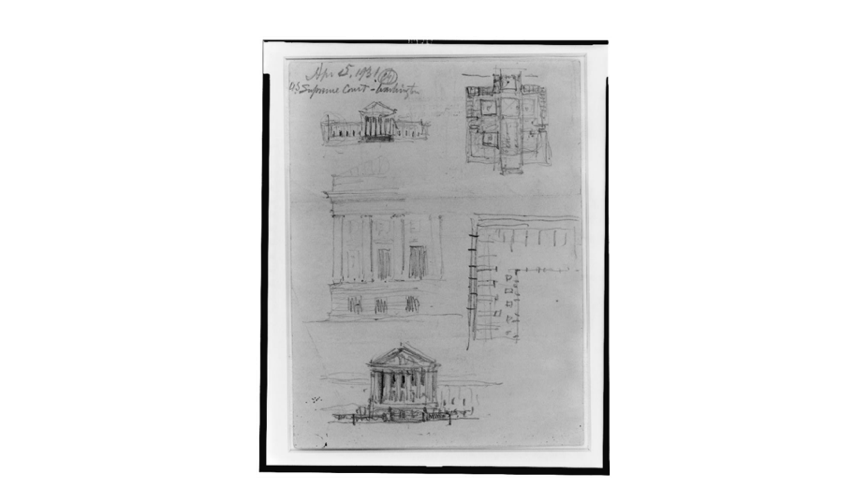
Cass Gilbert’s “Study sketch and elevation plans” of the United States Supreme Court41Cass Gilbert, [United States Supreme Court, Washington, D.C. Study sketch elevations and plans], in Photo, Print, Drawing, Libr. Cong. (Apr. 5, 1931), https://loc.gov/item/90708653/ [perma.cc/G7JX-L5CX].
Taft never saw the physical realization of those plans—he died two and a half years before the building’s cornerstone was laid.42Taft died in March of 1930, and President Herbert Hoover laid the building’s cornerstone in October of 1932. See Supreme Court Building, Architect of the Capitol, https://aoc.gov/explore-capitol-campus/buildings-grounds/supreme-court/supreme-court-building [perma.cc/QXZ9-J4XV].
As Post poignantly tells it, Taft only just missed Gilbert’s last note to him, which read: “I shall always think of you as the real author of the project and the one to whose vision we shall owe a suitable housing for the Supreme Court of the United States.”43P. 563 (quoting Letter from Cass Gilbert to William Howard Taft (Feb. 4, 1930) (Taft Papers)).
It is because of Taft that the Court “could fully control its own space” and be seen as an independent, coequal, branch of government (p. 564). In recognition of all that Taft did to secure the Court’s standing through its building, his likeness graces it. On the West Pediment—visible as one enters the main entrance to the Supreme Court building—there are nine figures, representing various virtues within the law.44Off. of the Curator, U.S. Sup. Ct., The West Pediment, https://supremecourt.gov/about/WestPediment8-10-2009_Final.pdf [perma.cc/MP9T-A96K] (last updated Aug. 10, 2009).
Among them, at the far right, is Chief Justice John Marshall, representing Research Past.45Id.
And at the far left, one will see a young William Howard Taft, memorialized for the future as Research Present.46Id.
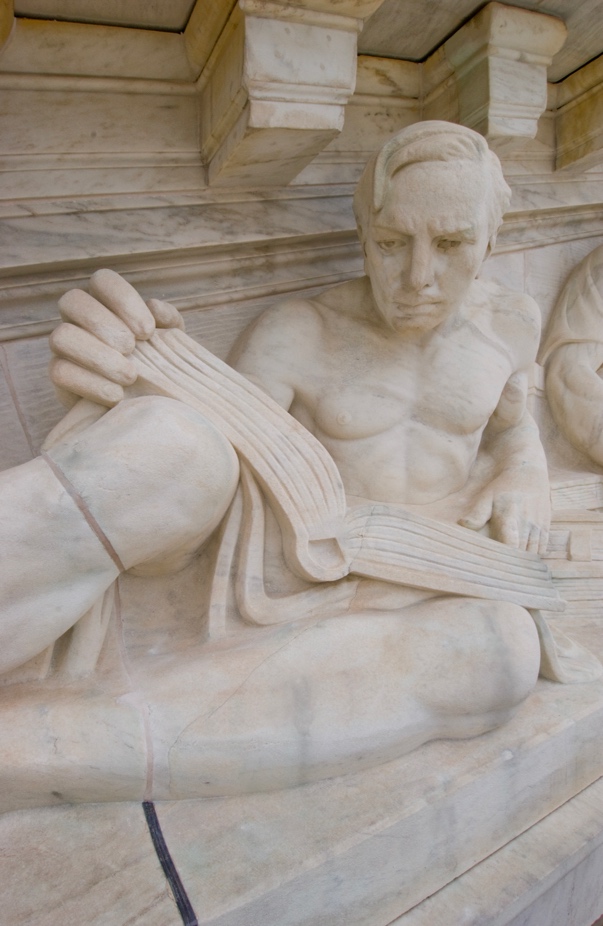
Carved Figure of Willian Howard Taft on the West Pediment47Research Present (William H. Taft) (photograph), in Supreme Court of the United States: Self-Guide to the Building’s Exterior Architecture 6 (2022), Collection of the Supreme Court of the United States, https://supremecourt.gov/visiting/ExteriorBrochure_Web_FINAL_May2022.pdf [perma.cc/TBT4-79N5] (depicting the sculpture of William H. Taft in the West Pediment).
B. The Judges’ Bill
Just as Taft remade the outside of the Court—the physical structure visible to the public—he remade its inner workings as well. Students of the federal courts no doubt know that “[t]he appellate jurisdiction of the Supreme Court has two branches, mandatory and discretionary.”48Mark Tushnet, The Mandatory Jurisdiction of the Supreme Court – Some Recent Developments, 46 U. Cin. L. Rev. 347, 347 (1977).
But it was not always thus. Before Taft’s time, the mandatory branch overtopped the discretionary one.
Indeed, for its first hundred years, the Court had no formal say over which cases it would hear49Edward A. Hartnett, Questioning Certiorari: Some Reflections Seventy-Five Years After the Judges’ Bill, 100 Colum. L. Rev. 1643, 1649–50 (2000) (providing a history of the Court’s discretionary jurisdiction). Of course, it has long been recognized that the Court has various doctrinal tools at its disposal to avoid deciding certain matters before it, including standing, ripeness, and the like. See Alexander M. Bickel, Foreword: The Passive Virtues, 75 Harv. L. Rev. 40, 40 (1961); David L. Shapiro, Jurisdiction and Discretion, 60 N.Y.U. L. Rev. 543, 543 (1985).
—a state that became increasingly problematic in the 1880s when the Court had fallen a full three years behind on its caseload (p. 477). Relief came in the form of the Circuit Court of Appeals Act of 1891 (generally known to us as the Evarts Act), which created the modern-day courts of appeals and then authorized the Court to decide (via the discretionary writ of certiorari) which cases to decide from the newly formed appellate courts.50See Act of Mar. 3, 1891, ch. 517, 26 Stat. 826; P. 477.
The Court’s docket crisis quickly abated, but the equilibrium was short lived (p. 477). In the words of Taft himself, “[a]fter thirty-five years . . . [the Supreme] Court’s business had again grown beyond its capacity, and a hearing could not be had for cases not advanced out of their order until more than a year after their filing.”51Taft, The Jurisdiction of the Supreme Court Under the Act of February 13, 1925, supra note 8, at 2. As for the cause of the increase, as Jonathan Sternberg writes, “two major events dramatically increased the number of cases before the federal courts: World War I and the dual passage of the Eighteenth Amendment and the Volstead Act, which implemented nationwide Prohibition.” Jonathan Sternberg, Deciding Not to Decide: The Judiciary Act of 1925 and the Discretionary Court, 33 J. Sup. Ct. Hist. 1, 8 (2008).
This was the state of the Court that Taft inherited when he became Chief Justice in the summer of 1921.
As Post describes in his chapter “Reshaping the Supreme Court,” Taft quickly sprang into his “judicial reformer” mode (p. 477). No sooner had the Justices come together for the new term than Taft created a committee composed of Justices William Day and James Clark McReynolds (and soon after Willis Van Devanter) to draw up a bill to “reform” the Court’s jurisdiction.52Hartnett, supra note 49, at 1662. Though there was some question about whether Justice Van Devanter was also a member of the committee at first, Post notes that he was not. P. 483 (“Contradicting Van Devanter’s 1927 recollection, Taft does not refer to Van Devanter as involved in the bill’s initial formulation.”). But that said, Van Devanter ultimately did join the drafting effort. P. 483.
By the spring of 1922, that committee had drafted what would become known as the Judges’ Bill (on account of its authorship). Taft, himself, presented this bill to the House Judiciary Committee.53See Hartnett, supra note 49, at 1663; p. 480.
The Judges’ Bill was ultimately signed into law in February of 1925, transforming the Court’s docket by authorizing the Justices to largely decide what to decide.54Act of Feb. 13, 1925, ch. 229, 43 Stat. 936; p. 484.
The majority of cases would come to the Court only after a party had successfully petitioned for review (via a writ of certiorari), with the Court’s discretionary jurisdiction now far exceeding its mandatory jurisdiction.
Although any one of the judicial reforms that Taft helped usher through would be considered a significant legacy, it is hard to overstate the import of this one. As then-Chief Justice Earl Warren wrote of Taft in 1958: “His outstanding contribution is, perhaps, his constant advocacy of judicial reform and Court reorganization, giving it discretionary power to take up only the most important cases. The calendar becomes manageable. The two-year backlog is wiped out, and the foundation laid for current calendars to this day.”55Earl Warren, Chief Justice William Howard Taft, 67 Yale L.J. 353, 361 (1958).
But as Post lays out, the Judges’ Bill did far more than enable the Supreme Court to keep pace with its caseload. By giving the Justices discretion over what cases to take up, the Bill transformed the Court from a standard appellate tribunal to an institution at the apex of the federal judiciary with the ability to oversee those courts below it.56See p. 477–79 (citing William H. Taft, Delays and Defects in the Enforcement of Law in this Country, 187 N. Am. Rev. 851, 851–52 (1908)).
In an address delivered over a decade before becoming Chief Justice, Taft likened the Supreme Court to state courts of last resort—“It is to be presumed that the Supreme Courts in the course of their decisions on general law will lay down with reasonable accuracy principles with sufficient clearness to enable the inferior courts to dispose of cases involving similar principles.”57Taft, Delays and Defects in the Enforcement of Law in this Country, supra note 56, at 852. Taft’s article was based on an address delivered to the Civic Forum in New York on April 28, 1908. Id. at 851.
But that was not all; Taft had more to say about the Court’s “important jurisdiction”: “The highest function of the Supreme Court of the United States is the interpretation of the Constitution of the United States, so as to guide the other branches of the Government and the people of the United States in their construction of the fundamental compact of the Union.”58Id. at 852.
The Judges’ Bill operationalized this idea, transforming the Court from an appellate body that wrote opinions for the parties appearing before it to one that wrote opinions for the nation (pp. 665–66). This transformation, which took the Court from resolving individual disputes to acting as the “proactive supervisor of federal law” prompted fundamental questions about the institution’s authority and legitimacy—questions we have continued asking ever since.59Pp. 665–66 (“Insofar as the Court was a simple final appellate tribunal, its authority could rest securely . . . . The modern Court, having thoroughly assimilated the implications of the Judges’ Bill, plainly looks to quite different sources of authority to sustain a legitimacy that must justify much more than resolving disputes between particular parties.”).
The “foundation laid” for the Court to this day.
C. The Conference of Senior Circuit Judges (the Judicial Conference of the United States)
Taft had a strong hand in remaking the federal judiciary vis-à-vis the High Court’s supervisory role over the law (and therefore lower courts), but he also refashioned the federal judiciary from an administrative perspective. The court system that Taft had been a part of when a judge on the Sixth Circuit Court of Appeals was fragmented. There was no consistent way of bringing together judges to solve common problems60See John J. Parker, The Integration of the Federal Judiciary, 56 Harv. L. Rev. 563, 563 (1943) (“Prior to 1922 there was no integration of the administrative features of the federal courts . . . there was no common forum in which the judges could meet to exchange ideas or to advance suggestions for improving the work in which they were engaged.”).
—problems that, at the time, often related to caseloads.
As I have detailed elsewhere, early on the federal courts experienced difficulties with judges falling behind on their work (say, due to illness or an increase in filings), which was quite serious in a district of only one or two judges.61See Marin K. Levy, Visiting Judges, 107 Calif. L. Rev. 67, 74–91 (2019) (tracing the history of the practice of visiting judges).
Over time, Congress authorized the practice of “sitting by designation”—that is, permitting a judge of one district or circuit to visit a court in another to provide caseload relief—but there were limits on when visits could happen and who could be “borrowed.”62See id. Specifically, over a span of one hundred years, Congress expanded the practice of sitting by designation but retained certain limitations. In 1814, Congress first permitted a single judge to visit a single court. See id. at 78; Act of Apr. 9, 1814, ch. 49, 3 Stat. 120. In 1850, Congress then permitted, in the event of “[s]ickness or other [d]isability of the [j]udges of the [d]istrict [c]ourts,” the circuit judge of the circuit in which the distressed district judge served to designate another district judge within that same circuit to hold court (or else the Chief Justice of the United States would so designate). Levy, supra note 61, at 80–82; Act of July 29, 1850, ch. 30, 9 Stat. 442. In 1852, Congress then expanded this scheme to situations in which local assistance was needed for workload relief. Levy, supra note 61, at 82; Act of April 2, 1852, ch. 20, 10 Stat. 5. Then in 1907, Congress provided that if it was “impracticable” to appoint a judge of a district within the same circuit in the event of illness or disability, the Chief Justice could “designate and appoint the judge of any other district in another circuit to hold said courts.” Levy, supra note 61, at 84; Act of Mar. 4, 1907, ch. 2940, 34 Stat. 1417. In other words, before Taft became Chief Justice, there was local assistance for disabled judges, local assistance for workload relief, “foreign” assistance for disabled judges, but not “foreign” assistance for workload relief—leaving a clear gap in the scheme. See Levy, supra note 61, at 85.
Specifically, federal judges could sit by designation on other courts in the event that a judge was ill or facing disability, but the matter was more complicated if the court was simply overworked—only judges within the same circuit could take up that task.63See Levy, supra note 61, at 85.
In short, this was not a fully united judiciary.
Taft sought to change that. Concerns about the state of the judiciary—in particular, a disorganized and overburdened judiciary—were with him when he left the White House. Back in 1914, Taft laid out his vision for a reformed federal judiciary which included, inter alia, that authority:
be conferred upon the head of the Federal judicial system, either the Chief Justice, or a council of judges appointed by him . . . to consider each year the pending Federal judicial business of the country and to distribute Federal judicial force of the country through the various districts and intermediate appellate courts.64P. 449 (quoting William H. Taft, The Attacks on the Courts and Legal Procedure, Ky. L.J., Oct. 1916, at 14–15).
Taft eventually got much of what he wanted. A mere three days after his confirmation in 1921, Taft outlined legislation to the Attorney General to further unify the federal courts (p. 449). What eventually passed into law—the Act of September 14, 192265Act of Sept. 14, 1922, ch. 306, 42 Stat. 837.
—was “a major triumph” (p. 451). It formally created the “Conference of Senior Circuit Judges,” over which the Chief Justice would preside.66Id.; p. 451.
It further permitted the Chief Justice to “transfer district judges to where they were most needed”—on account of illness or an overabundance of judicial business, thus fully expanding the use of visiting judges.67See ch. 306, 42 Stat. 837; see also p. 451; Levy, supra note 61, at 89–91. There were, however, two provisos to the visiting scheme: “The senior circuit judge of the ‘lending’ circuit had to consent to the transfer, and the senior circuit judge of the ‘borrowing’ circuit had to certify their need.” Levy, supra note 61, at 90.
Post, quoting then-Professors Felix Frankfurter and James M. Landis, writes that “[i]t marked . . . ‘the beginning of a new chapter in the administration of federal courts.’ ”68P. 451 (quoting Felix Frankfurter & James M. Landis, The Business of the Supreme Court of the United States – A Study in the Federal Judicial System: VI. The Conference of Senior Circuit Judges, 40 Harv. L. Rev. 431, 456 (1927)).
There is just one detail to add to Post’s telling of the origins of the Conference of Senior Circuit Judges. As Taft’s new vision for the federal judiciary was coming into focus, he took to one idea that proved unworkable.69To be clear, there were several items on Taft’s wish list that did not come to pass in his lifetime. As Post notes, before his time as Chief Justice, Taft had called for, inter alia, the merger of law and equity and the rules of procedure to be in control of the Supreme Court or a “Council of Judges” appointed by the Supreme Court. P. 449 (quoting Taft, The Attacks on the Courts and Legal Procedure, supra note 64, at 14–15). Both came to pass after Taft’s death, with the Rules Enabling Act of 1934, Ch. 652, 48 Stat. 1064 (codified at 28 U.S.C. §§ 2071–2077) and the Federal Rules of Civil Procedure, which went into effect in 1938 (and which famously declared in Rule 2 that henceforth “[t]here is one form of action—the civil action,” thereby abolishing the distinction between actions at law and suits at equity). Federal Rules of Civil Procedure, U.S. Cts., https://uscourts.gov/forms-rules/current-rules-practice-procedure/federal-rules-civil-procedure [perma.cc/9RS4-ZMXF]; Fed. R. Civ. P. 2.
In addition to wanting to increase the ease with which judges could visit other courts, Taft thought that there should be “judges at large,”70Adequate Machinery for Judicial Business, 7 A.B.A. J. 453, 454 (1921). To be sure, Post does note Taft’s interest in “district judges at large.” P. 462 n.30.
or what he termed a “flying squadron of judges.”71See William Howard Taft, Possible and Needed Reforms in the Administration of Justice in the Federal Courts, in American Bar Association, Report of the Forty-Fifth Annual Meeting 250, 250–51 (1922).
These judges, untethered to a particular district, would be “assigned by the senior circuit judge” (today the Chief Judge72The concept of the “senior circuit judge” originates with the Evarts Act, § 3, 26 Stat. 826, 827 (1891), though the term was replaced by “chief judge” in 1948. See Act of June 25, 1948 (1948 Act), ch. 646, § 1 (amending § 45 of the Judicial Code), 62 Stat. 869, 871. For a discussion of the original phrase and when it was exchanged, see Levy & Newman Marin K. Levy & Jon O. Newman, The Office of the Chief Circuit Judge, 169 U. Pa. L. Rev. 2425, 2431 (2021).
) to “any district in the circuit where needed and by the Chief Justice to any district in any other circuit.”73Taft, Possible and Needed Reforms in the Administration of Justice in the Federal Courts, supra note 71, at 454.
In this vision, federal judges would be completely fungible—and national (as opposed to local) in nature.
Taft never did get his “flying squadron of judges”—the proposal was a political non-starter as it threatened to “upset established patronage arrangements”74Walter F. Murphy, Chief Justice Taft and the Lower Court Bureaucracy: A Study in Judicial Administration, 24 J. Pol. 453, 458 (1962); see also Judith Resnik & Lane Dilg, Responding to a Democratic Deficit: Limiting the Powers and the Term of the Chief Justice of the United States, 154 U. Pa. L. Rev. 1575, 1617–18 (2006).
and there were concerns about “carpetbag judges.”7562 Cong. Rec. 204 (1921) (statement of Rep. Stevenson).
(Behind that, there were concerns that the out-of-town judges would have differing views on matters such as prohibition and segregation76See Fish, supra note 4, at 33; 2 Fed. Jud. Ctr., Debates on the Federal Judiciary: A Documentary History 192–93 (Daniel S. Holt ed., 2013).
). Nevertheless, Taft’s proposal is an important part of the record. Post writes that “[i]n less than nine years, Taft changed the nature of federal courts, transforming them from a collection of independent judges into a coherent branch of the federal government overseen by the chief justice” (p. xxxv). This is certainly true, and yet it is worth appreciating that Taft’s vision was not only of a unified court system but also of unified and interchangeable judges to populate it. It is also worth appreciating not just how much of his extraordinary vision was realized, but also the few ways in which his efforts fell short.
II. Assessing the Judiciary Today
Having laid out three of Taft’s most significant reform efforts, which together transformed the federal judiciary, we may ask how the courts are faring today. Specifically, looking at the central contributions of Taft’s a century on, this Part considers, inter alia, (1) access to the Supreme Court’s building and proceedings, (2) the success of the Court’s near complete control over its own docket, and (3) the functioning of the judiciary’s policymaking structure. At each turn, The Taft Court proves a valuable reference point for these considerations. Finally, this Part takes up Taft’s larger vision—the federal judiciary as a national entity—and how much it holds today.
The Supreme Court Building
At first blush, it would seem that there is little to say about the Supreme Court building in the present day. Excepting some renovations—including the restoration of the famed West Pediment—the building at One First Street remains essentially the same structure that was erected nine decades ago.77The Supreme Court’s west front façade, including the West Pediment, was restored just over a decade ago—the project was completed in 2013. Supreme Court Façade Restoration – West, Architect of the Capitol, https://aoc.gov/what-we-do/projects/supreme-court-facade-restoration-west [perma.cc/5JCC-WJGE]. A similar project, to restore the remaining three facades, was completed in 2018. Supreme Court Façade Restoration – North, South and East, Architect of the Capitol, https://aoc.gov/what-we-do/projects/supreme-court-facade-restoration-north-south-and-east [perma.cc/L2HB-XWS3].
But we can conceive of the building in larger terms, and consider access and transparency around court proceedings, as well as the ways in which the Justices have increasingly become cloistered in modern times.
By these lights, the Court has made some important gains. Again, as students of the federal courts no doubt know, there has long been a debate about whether the Court is sufficiently transparent—including whether there should be “cameras in the courtroom.”78See, e.g., Nancy S. Marder, The Conundrum of Cameras in the Courtroom, 44 Ariz. St. L.J. 1489, 1495–527 (2012) (surveying the arguments of those who favor cameras in the courtroom and those who oppose them). This is not to say that “cameras in the courtroom” is the only instantiation of the larger debate around transparency. Notably, scholars of late have shone a light on the nature of some of the Court’s deliberations—specifically, its use of the so-called “Shadow Docket.” See Stephen Vladeck, The Shadow Docket: How the Supreme Court Uses Stealth Rulings to Amass Power and Undermine the Republic (2023); see also Thomas P. Schmidt, Orders Without Law, 122 Mich. L. Rev. 1003 (2024). I leave this topic in the able hands of others.
(Who can forget Justice David Souter’s line—“I can tell you the day you see a camera come into our courtroom, it’s going to roll over my dead body.”79On Cameras in Supreme Court, Souter Says, ‘Over My Dead Body,’ N.Y. Times (Mar. 30, 1996), https://nytimes.com/1996/03/30/us/on-cameras-in-supreme-court-souter-says-over-my-dead-body.html [perma.cc/WA2E-A5DL].
) And while cameras have not made their way in, live audio feeds have made their way out. Starting in May 2020 when the Court shifted to telephonic proceedings during the pandemic, livestreamed oral arguments have replaced the earlier practice of posting argument recordings at the end of each week.80Mark Walsh, Supreme Court Still Reluctant to Allow Livestreaming of Opinion Announcements, A.B.A. J. (June 20, 2024, 3:25 PM), https://abajournal.com/web/article/supreme-court-still-reluctant-to-allow-livestreaming-of-opinion-announcements [perma.cc/T7AM-SWQR].
There have been yet additional innovations. Two decades ago, transcripts of oral argument were posted to the Supreme Court’s website ten to fifteen days after they were complete;81Oral Argument Transcripts, Sup. Ct. of the U.S. (Sept. 28, 2004), https://supremecourt.gov/publicinfo/press/pressreleases/pr_09-28-04 [perma.cc/BXH2-WAPG].
today, transcripts of oral argument are posted on the same day the argument is heard by the Court.82Argument Transcripts, Sup. Ct. of the U.S., https://supremecourt.gov/oral_arguments/argument_transcript/2023 [perma.cc/R94C-ZJ6X].
This is not to say that there are no gains that could be made—indeed, there has been a recent push for livestreaming opinion announcements.83Walsh, supra note 80 (quoting Professor Steve Vladeck) (“[Permitting livestreaming of opinion announcements] seems like a relatively low-cost move that would not only dramatically increase the public transparency of one of the court’s most significant acts, but also make it easier for the justices—both in the majority and in the dissent—to speak directly to the American people”).
But the larger point is that this relatively conservative institution has recently shifted some of its practices in significant ways to increase the public’s visibility of its proceedings—a shift that seems largely to the good.84It is worth noting that the forebearer of some of the gains in transparency around the Court’s proceedings is arguably Taft himself. The Chief Justice saw to it that the design of the Supreme Court building included for the first time special accommodations for the press. P. 589 n.178.
But there have also been some losses—ways in which the present moment has caused what feels like a distancing between the Justices and the public. There is the indelible image, following the leak of the majority opinion in Dobbs v. Jackson Women’s Health Organization,85Dobbs v. Jackson Women’s Health Org., 142 S. Ct. 2228 (2022).
of the Court with metal fencing around the building.86Rebecca Shabad & Fiona Glisson, ‘Nonscalable’ Fence Erected Outside Supreme Court Amid Abortion-Related Protests, NBC News (May 5, 2022, 9:20 AM), https://nbcnews.com/politics/supreme-court/non-scalable-fence-erected-supreme-court-abortion-related-protests-rcna27452 [perma.cc/F4EC-F3QJ]. This calls to mind an earlier moment in history when the Court decided to close its front doors to the public, who now must enter through a side door. Justice Breyer (joined by Justice Ginsburg) authored a dissent, of sorts, lamenting the Court’s decision as “[t]o many members of the public, this Court’s main entrance and front steps are not only a means to, but also a metaphor for, access to the Court itself.” Justice Breyer, Statement Concerning the Supreme Court’s Front Entrance, J. Sup. Ct. U.S., October 2010, at 831, 831. He then concluded that he hoped at some point in the future the Court’s main entrance could be restored, “as a symbol of dignified openness and meaningful access to equal justice under law.” Id. at 832. With thanks to Tom Schmidt for the connection.
And while the Justices already had been given security details, that security increased in the wake of the Dobbs leak.87Ed O’Keefe, Supreme Court Justices Get Increased Security After Roe v. Wade Leak: “The Risk is Real,” CBS News (May 6, 2022, 7:44 AM), https://cbsnews.com/news/supreme-court-justices-security-roe-v-wade-abortion [perma.cc/RK68-A27Q].
In an interview with the Wall Street Journal in the spring of 2023, Justice Samuel Alito said that he is “driven around in basically a tank, and [he’s] not really supposed to go anyplace by [him]self without the tank and [his] members of the police force.”88James Taranto & David B. Rivkin Jr., Opinion, Justice Samuel Alito: ‘This Made Us Targets of Assassination,’ Wall St. J. (April 28, 2023, 2:06 PM), https://wsj.com/articles/justice-samuel-alito-this-made-us-targets-of-assassination-dobbs-leak-abortion-court-74624ef9 [perma.cc/J3B3-KE7G]. Twenty years ago, Justice David Souter was assaulted while out on a run in Washington—a random attack that is impossible to imagine today as we would first have to imagine a Justice out jogging, alone and in public. (Thankfully the Justice experienced only “minor injuries” and was soon back at home.) Justice Souter Is Attacked While Jogging, N.Y. Times (May 2, 2004), https://nytimes.com/2004/05/02/us/justice-souter-is-attacked-while-jogging.html [perma.cc/KLL2-VGXK].
The article then added that Deputy U.S. Marshals “guard the justices’ homes 24/7.”89Taranto & Rivkin Jr., supra note 88.
Congress further authorized protection of immediate family members of the Justices and other officers of the Court.90Supreme Court Police Parity Act of 2022, Pub. L. No. 117-148, 136 Stat. 1288.
Post recounts that while still housed in the Old Senate Chamber, the justices “often strolled through the public halls, and the procession from the robing room to the courtroom proper was a twice-daily spectacle which tourists always tried to see” (pp. 564–65). By contrast, in the new building, the Justices were “screened off”—Gilbert ensured that the Justices’ comings and goings were beyond public view (p. 565). Post distills this change by observing that “[i]n the new courthouse, law became spectacle, detached from ordinary human interaction” (p. 565). Today we may well worry that the present moment has caused the Justices to become too removed, too cloistered, and about the effect that this has all had on them and their work.
B. The Judges’ Bill
Turning now to the Judges’ Bill, we can start by observing that when enacted and soon thereafter, the move to hand the Justices control over their docket was generally successful. As noted earlier, the Court was quickly able to become “current” with its cases, and has remained so ever since.91See Warren, supra note 55 and accompanying text. In modern times, the Court concludes the work of the term before it recesses, at the end of June or early July. See Supreme Court Procedures, U.S. Cts., https://uscourts.gov/about-federal-courts/educational-resources/about-educational-outreach/activity-resources/supreme-1 [perma.cc/9YRB-L9GC]. By contrast, during Taft’s days on the Court, some cases held over for several terms. See, e.g., McGrain v. Daugherty, 273 U.S. 135 (1927) (argued Dec. 5, 1924 and decided Jan. 17, 1927); Myers v. United States, 272 U.S. 52 (1926) (argued Dec. 5, 1923, reargued Apr. 13, 14, 1925, and decided Oct. 25, 1926).
And Congress made further inroads in this direction in 1988 by doing away with appeals as of right from state court decisions, leaving the Court with very little in the way of cases they must decide.92See Act of June 27, 1988, Pub. L. No. 100-352, 102 Stat. 662. According to Linda Greenhouse, the Act came about “[a]t the Justices’ urging” and though the category of cases the Court had been required to hear “was small,” it “did add some cases the Court would not otherwise have accepted.” Linda Greenhouse, Case of the Shrinking Docket: Justices Spurn New Appeals, N.Y. Times, Nov. 28, 1989, at B6, https://nytimes.com/1989/ 11/28/us/case-of-the-shrinking-docket-justices-spurn-new-appeals.html [perma.cc/M9FE-YS85]. The Act ended all mandatory jurisdiction apart from cases that come from three-judge district courts. 28 U.S.C. § 1253.
Again, this Taft reform would seem to have achieved its aim.
But the picture may look somewhat different today, when the caseload is at its lowest point in modern times. By one account, the Roberts Court averaged seventy-six decisions (including per curiam opinions) from the 2005 to 2017 terms—that is “less than one-third the decisional average for the 1926 and 1930 Taft Courts.”93Meg Penrose, Overwriting and Under-Deciding: Addressing the Roberts Court’s Shrinking Docket, 72 S.M.U. L. Rev. F. 8, 8–9 (2019).
The Court’s most recent term ended with opinions in only sixty cases.94Opinions of the Court – 2023, Sup. Ct. of the U.S., https://supremecourt.gov/opinions/slipopinion/23 [perma.cc/9XV5-2ECX].
To be sure, scholars and commentators have been drawing attention to the Court’s “shrinking docket” for some time.95Over a decade ago, scholars and commentators began observing a contracting docket. In an article titled “The Case of the Plummeting Supreme Court Docket” in 2009, Adam Liptak noted that the court had reached a “modern low” of seventy cases in the October 2007 Term. Adam Liptak, The Case of the Plummeting Supreme Court Docket, N.Y. Times (Sept. 28, 2009), http://nytimes.com/2009/09/29/us/29bar.html [perma.cc/72K4-REG4]. For academic takes on the phenomenon, see, for example, Owens & Simon, supra note 15; David R. Stras, The Supreme Court’s Declining Plenary Docket: A Membership-Based Explanation, 27 Const. Comment. 151 (2010).
But the trendline has been steady, and the current low water mark is striking.
Moreover, this trend is linked to a more recent phenomenon—though the Court is hearing fewer cases, more opinions are coming down at the very end of the term.96Adam Liptak, Supreme Court’s Leisurely Pace Will Produce Pileup of Late June Rulings, N.Y. Times (June 19, 2024), https://nytimes.com/2024/06/14/us/politics/supreme-court-rulings-june.html [perma.cc/39SZ-SGNR] (“The Supreme Court has been moving at a sluggish pace in issuing decisions this term, entering the second half of June with more than 20 left . . . . That is not terribly different from the last two terms, when the pace at which the court issued decisions started to slow.”).
As Adam Liptak noted in June 2024, “[t]he court’s pace has slackened even as the size of its docket in argued cases has dropped to levels not seen in many years.”97Id.
This bunching led to concerns, among them that mistakes could more easily find their way into opinions.98See Kimberly Strawbridge Robinson, Supreme Court Workload Backloaded as Justices Hear Fewer Cases, Bloomberg L. (Aug. 19, 2024, 4:45 AM), https://news.bloomberglaw.com/us-law-week/supreme-court-workload-backloaded-as-justices-hear-fewer-cases [perma.cc/5TSX-R9XV] (“Much of the US Supreme Court workload is increasingly bunching up toward the end of the term”); Steve Vladeck, 88. The Cleanup Conference, One First (July 1, 2024), https://stevevladeck.com/p/88-the-cleanup-conference [perma.cc/V267-C7J6] (“When the Court leaves this many divisive and important rulings to be decided in such a short window, it is simply inevitable that the justices, and the Court’s staff, will make more mistakes.”).
(And it is not for nothing that the Court made corrections to four sets of opinions on one of the final days of the term.99See Adam Liptak, In a Volatile Term, a Fractured Supreme Court Remade America, N.Y. Times (July 2, 2024), https://nytimes.com/2024/07/02/us/politics/supreme-court-term-decisions.html [perma.cc/DA4D-EJ4D] (“There was a sense of disarray as the term ended. On Wednesday, the court briefly posted and then promptly withdrew an abortion decision that would not be formally issued until the next day. On Thursday, it made 13 separate corrections to four sets of opinions.”); see also Alison Durkee, Supreme Court Corrects EPA Opinion After Gorsuch Confuses Laughing Gas with Air Pollutant, Forbes (June 28, 2024, 5:59 AM), https://forbes.com/sites/alisondurkee/2024/06/28/supreme-court-corrects-epa-opinion-after-gorsuch-confuses-laughing-gas-with-air-pollutant [perma.cc/DEC2-FR8P] (noting in particular how the Supreme Court issued a corrected version of the majority opinion in Ohio v. EPA to replace references to “nitrous oxide” (laughing gas) with “nitrogen oxide” (an air pollutant)).
).
So, what should be done about the Court’s docket? Some say nothing—that the Court is exercising a kind of judicial minimalism (if not in outcomes, in number of areas of law affected).100Writing of the Court’s contracting docket in 2009, Judge J. Harvie Wilkinson III made the case that, “[t]he dangers of deciding are often vastly greater than the dangers of letting the political branches and the lower courts wrestle a question through.” J. Harvie Wilkinson III, If It Ain’t Broke . . ., 119 Yale L.J. Online 67, 68 (2010), https://yalelawjournal.org/pdf/840_egpccc2c.pdf [perma.cc/TT7R-D6WY]. Borrowing the typology of Professor Tom Schmidt, we would call this “prudential minimalism.” Thomas P. Schmidt, Judicial Minimalism in the Lower Courts, 108 Va. L. Rev. 829, 850 (2022) (“While decisional minimalism is concerned with how judges fashion opinions, prudential minimalism involves techniques for avoiding or limiting judicial involvement in the first place.”).
Perhaps. But if we return to Taft’s vision of the Court—as the body at the apex of the judiciary, interpreting the Constitution and providing guidance to the courts below—we should be concerned that some areas of law seem neglected.101For example, Professor Orin Kerr has noted the absence of Fourth Amendment cases from the Court’s docket in recent terms. See, e.g., Orin Kerr (@OrinKerr), X (Sept. 13, 2022, 2:43 PM), https://web.archive.org/web/20241003212051/https://x.com/OrinKerr/status/1569758759379148802 [perma.cc/QEB6-W2FU] (highlighting how there were “many circuit splits on how the Fourth Amendment applies” and yet no Fourth Amendment cases on the Court’s docket that term or the one prior).
At the very least, there should be conversations about the Court’s docket one hundred years after the Judges’ Bill—particularly to consider whether it is taking “enough” cases and of the right sort.102On this latter point, some scholars have urged the Court to take more routine cases. See Daniel Epps & William Ortman, The Lottery Docket, 116 Mich. L. Rev. 705 (2018).
Finally, there is something to be said about hearing directly from the Court on this matter. When the Court parts ways with a prior decision, we generally hear why (in the form of an opinion).103Indeed, we occasionally hear from a member of the Court when it decides not to take up a case (in the form of a dissent from the denial of certiorariTrib).
We may wish for the same when it comes to judicial administration. Are the justices making a conscious decision to contract the docket, and if so, why? Taft was not only a great reformer of the judiciary but a great communicator about the judiciary as well.104At times, Taft was criticized for speaking quite so openly about the judiciary, and in particular about his designs on law reform. But Taft pushed right back:
I venture to think that there are some things that a judge may speak of and may discuss in public and not use a judicial opinion for the purpose. The subject is that of law reform. From the earliest traditions of the English bench from which we get our customs, the judges of the highest courts of Great Britain have taken an interest in and a part in the formulation of legislation for bettering the administration of justice.
P. 505 (quoting William Howard Taft, Address to the New York County Bar Association (Feb. 19, 1922) (Taft Papers)). Simply remarking upon the decisions around judicial administration—say, at a Circuit Conference or in one of the Chief Justice’s Year-End Reports on the Federal Judiciary—would seem well within the pale. For a more general discussion of when it is appropriate for judges to weigh in on potential changes to the courts, see Daniel Epps & Marin K. Levy, Judicial Reform from the Inside Out, 101 Notre Dame L. Rev. (forthcoming 2025).
It is perhaps time for the justices to take another page from his book and speak directly about the decisions they are making about what cases to take up.
C. The Conference of Senior Circuit Judges (the Judicial Conference of the United States)
The Judicial Conference of the United States has grown up considerably from the Conference of Senior Circuit Judges that was born a century ago. The early Conference was composed of just nine judges—one from each circuit—who came together to report on the “judicial business” of their courts and to advise the Chief Justice on possible improvements in judicial administration.105Act of Sept. 14, 1922, ch. 306, § 2, 42 Stat. 837, 838 (current version at 28 U.S.C. § 331 (2000)).
But the Conference quickly experienced significant changes, including to its membership. New circuit judges were added to the Conference as new circuits were added to the federal judiciary.106See Fed. Jud. Ctr., Judicial Conference of the United States: Members, https://fjc.gov/history/administration/judicial-conference-united-states-members [perma.cc/LS7H-55C6] (showing, inter alia, the addition of a judge from the Tenth Circuit in 1929, the D.C. Circuit in 1938, the Eleventh Circuit in 1982, and the Federal Circuit in 1983).
And then, in 1957, district judges joined the Conference for the first time.107Act of Aug. 28, 1957, Pub. L. No. 85-202, 71 Stat. 476.
A few decades later, the Chief Judge of the Court of International Trade followed suit.108Act of Oct. 14, 1986, Pub. L. No. 99-466, 100 Stat. 1190.
Today’s Conference has grown to twenty-six judges who sit alongside the Chief Justice as the presiding officer.109See Judicial Conference of the United States: March 2024, U.S. Cts., (2024), https://uscourts.gov/sites/default/files/jcus_members_2024-mar-3.pdf [perma.cc/28E8-DRCF].
But that is not all—acting as the secretary of the Conference is the Director of the Administrative Office of the U.S. Courts—the agency within the judiciary, formed in 1939,110See Act of Aug. 7, 1939, ch. 501, 53 Stat. 1223, 1223.
that supports and provides counsel to the Conference and its many committees.111Judicial Administration, U.S. Cts., https://uscourts.gov/about-federal-courts/judicial-administration [perma.cc/JM4F-BTGM].
Those committees have changed significantly in the last hundred years as well. Post notes that at its first meeting (a mere three months after the 1922 Act was passed), the Conference began dividing its work into various committees (p. 453). After discussing the marked increase in cases before the federal judiciary (largely due to a flood of new prohibition cases),112 Jud. Conf. U.S., Report of the Judicial Conference: Memorandum of First Two Meetings Convened on December 28, 1922 and September 26, 1923 1, https://uscourts.gov/sites/default/files/1922-12and1923-09_0.pdf [perma.cc/VR39-QDJX].
five committees were authorized, including the “Committee on Need and Possibility of Transfer of Judges” and the “Committee on Recommendations to District Judges of Changes in Local Procedure to Expedite Disposition of Pending Cases and to Rid Dockets of Dead Litigation.”113Id. at 2.
(Apparently the Conference favored descriptive over concise committee names.) More committees were added over time and some existing committees died out.114Judicial Conference of the United States: Committees (Chronological), Fed. Jud. Ctr., https://fjc.gov/history/administration/judicial-conference-united-states-committees-chronological [perma.cc/L9ED-DYCD].
Today, the Judicial Conference has twenty committees in all (not including its advisory, ad hoc, and sub-committees), covering such topics as the budget, codes of conduct, court administration and case management, financial disclosure, information technology, and security.115 U.S. Courts, About the Judicial Conference, supra note 16.
Much has changed in the intervening years, including the challenges the Court faces. Gone are the days when prohibition filings were the most pressing matter across the judiciary. Today’s third branch faces scrutiny over the handling of judicial misconduct complaints,116Carrie Johnson, Judicial System Fails at Policing Workplace Misconduct, Study Finds, NPR (July 17, 2024 3:25 PM), https://npr.org/2024/07/17/nx-s1-5042340/judges-misconduct-self-policing-report [perma.cc/6GJL-MWBX]; Fed. Jud. Ctr. & Nat’l Acad. Pub. Admin., Enhancing Efforts to Coordinate Best Workplace Practices Across the Federal Judiciary (2024), https://fjc.gov/sites/default/files/materials/56/NAPA_FJC final 0701_0718.pdf [perma.cc/XTM5-9Z5Z].
and the lack of a binding code of conduct for the Supreme Court.117See Joe Biden, Opinion, My Plan to Reform the Supreme Court and Ensure No President is Above the Law, Wash. Post (July 29, 2024 5:00 AM), https://washingtonpost.com/opinions/2024/07/29/joe-biden-reform-supreme-court-presidential-immunity-plan-announcement [perma.cc/DE8B-EENQ] (calling for, inter alia, enforceable ethics rules and term limits for Supreme Court Justices).
Given such changes and challenges, one may wonder if the Conference’s current structure is best. On this point, it is worth noting that in December of 1986, the Chief Justice created a committee to study the operation of the Conference and its committees.118 Jud. Conf. U.S., Report of the Proceedings of the Judicial Conference of the United States 57 (1987) [hereinafter Jud. Conf. of the U.S.].
The work of that group resulted in a “major restructuring” of the Conference committees.119Judicial Conference of the United States Timeline, Fed. Jud. Ctr., https://fjc.gov/judicial-conference-united-states-timeline [perma.cc/E5SA-3XL5]. Specifically, “[t]he Conference ended the formal distinction between general, standing, and special committees. The Conference continued thirteen of the existing committees, dissolved five of them, and created seven new committees, three of which were formed out of subcommittees of the former Court Administration Committee.” Fed. Jud. Ctr., supra note 114; see Jud. Conf. of the U.S., supra note 118, at 57–59. Additionally, “[t]he Conference also established a policy whereby every five years, each committee must recommend to the Executive Committee whether it should be continued or abolished, with supporting justification.” Fed. Jud. Ctr., supra note 114; see Jud. Conf. of the U.S., supra note 118, at 60.
Perhaps it is time—one hundred years after Taft set the Conference in motion, and nearly forty years after its last major “tune-up”—to see if the Conference’s administration can be improved again.
Apart from its organizational structure, there are questions about the Conference’s authority. In 2024, the Conference attempted to tackle one of the most significant policy questions facing the federal judiciary in modern times—how to curb “judge shopping” or the ability of litigants to file in certain divisions within districts, knowing that their case will be assigned to a particular judge. The Conference tried to solve the problem by announcing a policy in March, which told district courts that they “should apply district-wide” (as opposed to division-wide) assignment of certain kinds of cases, including civil actions that are seeking to bar or mandate nationwide enforcement of a federal law.120 Jud. Conf. Comm. on Ct. Admin. & Case Mgmt., supra note 17, at 1.
While some courts quickly sought to follow the letter of the policy, just as quickly others pushed back. The Chief Judge of the Northern District of Texas stated in a letter later that month: “The district judges of the Northern District of Texas met on March 27, 2024, and discussed case assignment. The consensus was not to make any change to our case assignment process at this time.”121Letter from David C. Godbey, supra note 18, at 1.
Any stronger solution will now have to come from the Rules Committee or from Congress. This is not the national system that Taft envisioned.
Stepping back, Taft, even before holding the Office of Chief Justice, saw the federal judiciary as a single entity, with judges who were—or should be—national officers. Indeed, the premise of his proposed “flying squadron of judges” was that judges need not be tied down geographically—a judge from New York could just as easily decide a case by designation on the Ninth Circuit Court of Appeals as he could on the Second. In the words of Taft, each judge was a “cog in the machine” that is our federal court system.122P. 452 (quoting Letter from William Howard Taft to Ewing Cockrell, J. (May 5, 1927) (Taft Papers)).
Yet also plainly present in the federal judiciary are geographically based districts and circuits with geographically tied judges. They have their own local and circuit rules, and even their own cultures.123See, e.g., Zachary D. Clopton & Marin K. Levy, Local Rules, 111 Va. L. Rev. (forthcoming 2025) (providing an overview of the local rules of all ninety-four district courts and the circuit rules of all thirteen courts of appeals).
Some may feel that they have needs when it comes to how cases should be assigned—needs based upon the geography of where they sit—and so far, they can follow those preferences. Ours is also very much a system of judicial federalism.124See Marin K. Levy, State Representation on the Courts of Appeals (forthcoming) (considering the geographic ties of the courts of appeals, including the norm by which each state is “represented” with a certain number of seats on each circuit, based on the relative population of each in-circuit state).
It is worth appreciating these tensions between the national and local and considering whether the current arrangement, one hundred years on, has struck the right balance. For The Taft Court is not only a book about making law for a divided nation; it also raises fundamental questions about how to create a system of administration over different—and sometimes divided—courts.
Conclusion
Ultimately, and in the words of Robert Post, “[w]e do not tend to remember great judicial reformers, but instead to honor judges who craft striking opinions or who convey deep jurisprudential vision” (pp. 7–8). The Taft Court proves why we should improve our collective memory, as it simultaneously helps us do just that. It reminds us how one man reshaped the Supreme Court, inside and out, and reshaped the federal judiciary along with it. A century after so many of Taft’s accomplishments, Post’s own triumph offers a fitting occasion to reflect on all that the Chief Justice did and consider what work remains for the judicial reformers of today.
* Professor of Law, Duke University School of Law. With thanks to Robert Post and Thomas Schmidt for insightful comments on earlier drafts. Thanks as well to Elena Schultz, Grace Vedock, and the other wonderful editors of the Michigan Law Review for exceptional editorial assistance. Any errors and solecisms are, of course, my own.
