
Source & Solidarity
Trademark law has become the new frontier of unionbusting. Companies like Trader Joe’s, Starbucks, and Medieval Times have brought unprecedented suits against their employee unions for trademark infringement in relation to their organizing activities. This sort of litigation puts courts in the difficult position of reconciling trademark protection with unionization rights. Their attempts to apply standard trademark doctrines in this context reveal a deeper problem: Current trademark law is incoherent when applied to labor unions.
This incoherence stems from a disconnect between current trademark law and the original purpose behind its application to labor unions. This Article recovers that basis by tracing the evolution from pre–Lanham Act denial of trademark protection to unions, through sui generis state statutory protection, to modern federal collective and certification marks.
Through a historical analysis of union names and labels and their protection, I demonstrate that trademark law applies to labor unions on a fundamentally different normative basis than standard trademark doctrines. Unlike conventional trademarks that indicate the source of goods or services, union names and insignia are instruments of labor solidarity. They combine political association with economic action to advance workers’ collective interests. Contemporaneous with their proliferation, union labels were commonly understood to be “weapons” unions deployed in “warfare” against employers. Unions used them to agitate for unionization and coordinate boycotts, rather than merely indicate source. Congress embraced this understanding when it extended trademark protection to union marks.
Courts currently struggle with union trademark disputes because they have not yet recognized that unions are (and were regarded by Congress to be) characteristically different than standard trademark producers. Labor solidarity is the core normative basis for bringing union names and insignia within trademark law’s scope. Courts do not need to force union marks into ill-fitting standard trademark doctrines focused on consumer confusion. Instead, their analysis of these disputes should be guided by the value of labor solidarity. Labor solidarity, as a beacon, illuminates what is truly at stake and how courts can target harm in ways consistent with trademark law’s historical accommodation of labor interests.
This reframing has immediate practical importance following the Ninth Circuit’s decision that Trader Joe’s United infringed the Trader Joe’s trademark, Starbucks’s ongoing suit against the Starbucks Workers Union, and similar emerging cases. If courts ground trademark analysis in labor solidarity rather than source indication, they can adapt existing doctrines to protect legitimate union organizing while preventing actual consumer deception. Trademark law can then serve its intended function, rather than become a tool for union suppression.
Introduction
Labor organization in America is experiencing a renaissance. Though overall union membership continues to decline,1Union Members Summary, U.S. Bureau of Lab. Stat. (Jan. 28, 2025), https://bls.gov/news.release/archives/union2_01282025.htm [perma.cc/L4XF-LL42].
workers are increasingly forming new unions. In 2022, the National Labor Relations Board (NLRB) saw a 53 percent increase in union representation petitions⎯the highest number of petitions since 2016⎯followed by a 35 percent increase in 2024.2Union Petitions Up 35%, Unfair Labor Practices Charge Filings Up 7% in the First Half of Fiscal Year 2024, NLRB (Apr. 9, 2024), https://nlrb.gov/news-outreach/news-story/union-petitions-up-35-unfair-labor-practices-charge-filings-up-7-in-the [perma.cc/B4HJ-BS28]; Unfair Labor Practices Charge Filings Up 16%, Union Petitions Remain Up in Fiscal Year 2023, NLRB (Apr. 7, 2023), https://nlrb.gov/news-outreach/news-story/unfair-labor-practices-charge-filings-up-16-union-petitions-remain-up-in [perma.cc/Y7HP-C8C7].
Employees across a wide range of job sectors have successfully organized, including workers at major corporations like Amazon, Trader Joe’s, Apple, and REI;3 Amazon Lab. Union IBT, https://amazonlaborunion.org [perma.cc/SU4B-DCJD]; About Us, Trader Joe’s United, https://traderjoesunited.org/about [perma.cc/8EDS-Z7R8]; While Apple Delays at the Bargaining Table, CWA-Represented Workers in Oklahoma City Vote to Strike, Commc’ns Workers of Am. (Aug. 12, 2024), https://cwa-union.org/news/releases/while-apple-delays-bargaining-table-cwa-represented-workers-oklahoma-city-vote-strike [perma.cc/G2VA-HSPN]; Nate Wolf, REI Workers Look to Shake Up Co-op’s Board Amid Push for a First Contract, Nonprofit Q. (Jan. 29, 2025), https://nonprofitquarterly.org/rei-workers-look-to-shake-up-co-ops-board-amid-push-for-a-first-contract [perma.cc/EB24-7WGN].
student workers at numerous universities;4 William A. Herbert, Jacob Apkarian & Joseph van der Naald, Nat’l Ctr. for the Study of Collective Bargaining in Higher Educ. & the Pros., 2024 Directory of Bargaining Agents and Contracts in Institutions of Higher Education 17 (2024), https://research-data.hunter.cuny.edu/ncscbhep/2024DirectoryofBargainingAgentsandContractsinInstitutionsofHigherEducation.pdf [perma.cc/D8PZ-639N].
healthcare workers;5Samantha Wildow, Labor Unions Are a Growing Trend in Health Care Industry, Dayton Daily News (Nov. 19, 2024), https://web.archive.org/web/20260123013506/https://daytondailynews.com/local/labor-unions-are-a-growing-trend-in-health-care-industry/XPGJGAHR5BFMLPBXVKCCKABMGI/.
school employees;6Olina Banerji, Principals’ Unions Are on the Rise. What Are Their Demands?, Educ. Week (July 15, 2024), https://edweek.org/leadership/principals-unions-are-on-the-rise-what-are-their-demands/2024/07 [perma.cc/SCG6-K4RF].
and others. And, as Diana Reddy has documented, public approval of labor unions surged to 71 percent in 2022, up from an all-time low of 48 percent in 2009.7Diana S. Reddy, After the Law of Apolitical Economy: Reclaiming the Normative Stakes of Labor Unions, 132 Yale L.J. 1391, 1394 (2023).
Union organization efforts are often hard-fought. Consistent with historical labor campaigns, many unions formed since 2022 have engaged in strikes and filed complaints with the NLRB over their employers’ unionbusting tactics.8News: Help Majority Staff Report on Starbucks, U.S. Senate Comm. on Health, Educ., Lab. & Pensions (Mar. 26, 2023), https://help.senate.gov/dem/newsroom/press/news-help-majority-staff-report-on-starbucks [perma.cc/6VWE-4XKY]; John Logan, Corporate Union Busting in Plain Sight, Econ. Pol’y Inst. (Jan. 28, 2025), https://epi.org/publication/corporate-union-busting [perma.cc/M3NX-4Y9T]; Celine McNicholas, Margaret Poydock & Marc Edayadi, Employers Regularly Engage in Tactics to Suppress Unions, Econ. Pol’y Inst.: Working Econ. Blog (Mar. 28, 2023), https://epi.org/blog/employers-regularly-engage-in-tactics-to-suppress-unions-examples-at-starbucks-amazon-and-google-illustrate-employers-anti-union-playbook [perma.cc/S9T9-HGWZ]; Eli M. Rosenberg, As Major Companies Shut Down Stores with Active Union Drives, Workers File More Complaints of Retaliation, NBC News (Nov. 4, 2022), https://nbcnews.com/business/corporations/worker-complaints-alleging-anti-union-shutdowns-surge-organizing-rcna55057 [perma.cc/72EG-UME2].
But, since 2022, the character of the fight has changed.
In 2022 and 2023, Trader Joe’s,9Trader Joe’s Co. v. Trader Joe’s United, No. 23-cv-05664, 2024 WL 305697, at *1–2 (C.D. Cal. Jan. 12, 2024), rev’d, 150 F.4th 1040 (9th Cir. 2025).
Starbucks,10Complaint at 1–2, Starbucks Corp. v. Serv. Emps. Int’l Union, No. 23-cv-00068 (S.D. Iowa Oct. 18, 2023).
and Medieval Times11Medieval Times U.S.A., Inc. v. Medieval Times Performers United, 695 F. Supp. 3d 593, 597–98 (D.N.J. 2023).
sued their employee unions for trademark infringement based on the unions’ use of the companies’ names and/or logos. Trader Joe’s asserted that Trader Joe’s United unlawfully sold merchandise with the union’s logo, which depicted the phrase “Trader Joe’s” in a font and color similar to the company’s trademark, against a similar circular background.12Trader Joe’s United, 2024 WL 305697, at *2.
Starbucks sued Starbucks Workers United over its use of the Starbucks name and a similar logo in social media posts expressing political viewpoints.13Complaint, supra note 10, at 2.
Medieval Times complained that the Medieval Times Performers Union unlawfully used the employer’s name, color scheme, and Middle Ages–themed imagery in its sale of merchandise and other publicization efforts.14. Medieval Times U.S.A., Inc., 695 F. Supp. 3d at 597–98.
Starbucks voluntarily dismissed, then refiled, its trademark dispute with its union;15Dismissal Without Prejudice, Starbucks Corp. v. Workers United, No. 23-cv-00068 (S.D. Iowa Jan. 31, 2025); Complaint, Starbucks Corp. v. Workers United, No. 26-cv-00054 (S.D. Iowa June 18, 2026).
the New Jersey district court dismissed Medieval Times’s case because consumer confusion was unlikely;16Medieval Times U.S.A., Inc., 695 F. Supp. 3d at 603.
and the Ninth Circuit held Trader Joe’s United likely infringed Trader Joe’s mark.17See Trader Joe’s Co. v. Trader Joe’s United, 150 F.4th 1040, 1054 (9th Cir. 2025).
The discord between these recent decisions, evident in their divergent outcomes and reasoning despite applying materially identical tests, arises from the ill fit between current trademark doctrines and labor unions’ names and insignia.
For instance, the District Court of New Jersey found consumers were unlikely to mistakenly believe Medieval Times Performers Union is affiliated with or endorsed by Medieval Times, citing the different stylized fonts and colors of the union logo, the union’s lack of intent to cause confusion, and the “union context” of the dispute.18Medieval Times U.S.A., Inc., 695 F. Supp. 3d at 601–02.
In the court’s view, “[w]here . . . a labor union uses an employer’s trademark as part of communications about the employer’s labor practices, courts have often held that that is unlikely to cause confusion.”19Id. at 601–03.
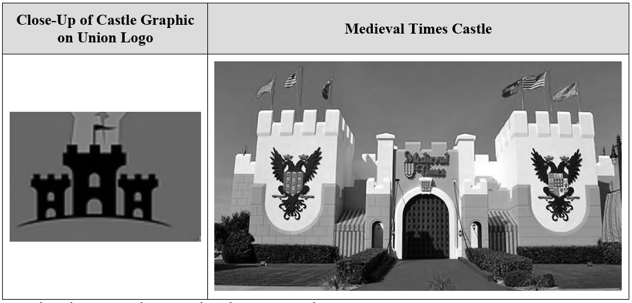
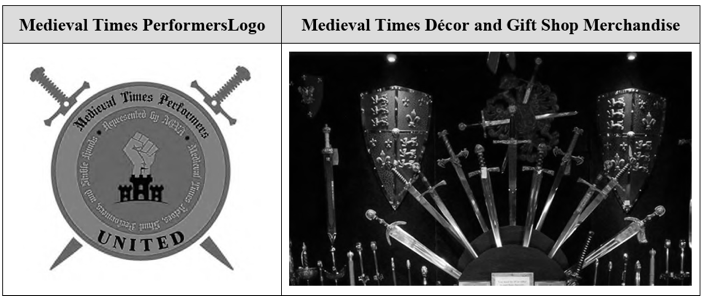
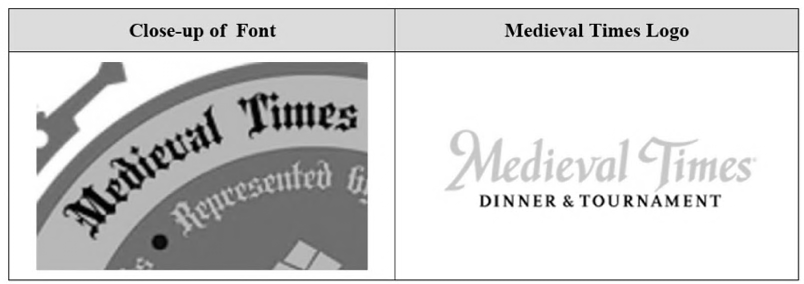
Just like Medieval Times’s trademark suit against its employees’ labor union, the suit against Trader Joe’s United involved distinguishable logos and use of the union’s logo in merchandise sales. Yet the Ninth Circuit reached the opposite conclusion on the likelihood of confusion. It found that both Trader Joe’s and Trader Joe’s United sell reusable tote bags and a range of other nongrocery merchandise, the parties’ marks are “strikingly similar,” and online consumers may be diverted to the union’s online store if they search for “Trader Joe’s tote bags.”20Trader Joe’s Co., 150 F.4th at 1049–54.
The union context had no apparent effect on its analysis.21Id. at 1052 (suggesting the union context may only matter insofar as a reasonable consumer perceives the difference in appearance between the parties’ marks).
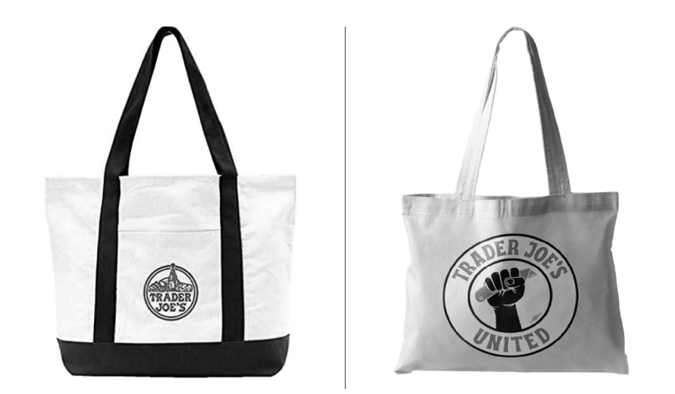
Left: Trader Joe’s Tote Bag; Right: Trader Joe’s United Tote Bag22Trader Joe’s Co. v. Trader Joe’s United, No. 23-cv-05664, 2024 WL 305697, at *2 (C.D. Cal. Jan. 12, 2024), rev’d, 150 F.4th 1040.
Trader Joe’s, Starbucks, and Medieval Times were not the first to sue labor unions for trademark infringement. Businesses have sued labor unions for using the businesses’ logos to protest management,23E.g., Brach Van Houten Holding, Inc. v. Save Brach’s Coal. for Chi., 856 F. Supp. 472, 474 (N.D. Ill. 1994); WHS Ent. Ventures v. United Paperworkers Int’l Union, 997 F. Supp. 946, 948 (M.D. Tenn. 1998).
and unions have sued each other over the exclusive use of a name.24E.g., Stanislaus Custodial Deputy Sheriffs’ Ass’n v. Deputy Sheriff’s Ass’n of Stanislaus Cnty., No. CV F 09-1988, 2010 WL 2218813, at *1 (E.D. Cal. June 1, 2010); Dist. 50, United Mine Workers. v. Int’l Union, United Mine Workers, 412 F.2d 165, 166–67 (D.C. Cir. 1969).
In one case, a local deputy sheriff’s union sought to enjoin another union from using a similar name to solicit other law enforcement officers.25Stanislaus Cnty., 2010 WL 2218813, at *1.
But these earlier cases diverged in outcome and reasoning on materially similar disputes and did not provide any sensible framework for courts to follow when applying trademark law to labor unions. One court saw a labor union’s use of a business’s logo in connection with its protest as a commercial activity actionable under the Lanham Act—which extended trademark protection to union marks.26See Brach, 856 F. Supp. at 476; infra Section III.C.
Another court saw it as political speech that was not actionable under that same Act.27See WHS Ent. Ventures, 997 F. Supp at 951.
I contend this incoherence is the result of a failure by courts to appreciate the distinct basis on which trademark law applies to labor unions.
This Article is the first to interrogate how the history of labor union protection under trademark law can guide application of that law today. Prior to the passage of the Lanham Act, labor unions’ names and insignia were denied trademark protection because they did not signal any goods’ source,28See infra Section III.A.
and thus did not qualify as trademarks. At that time, it was uncommon for labor unions to use employers’ names within their own names; they instead referred to the whole trade (e.g., Cigar Makers International Union, United Hatters, or Amalgamated Lithographers of America).29See infra notes 81–85 and accompanying text.
Labels were unions’ primary “marks,” which members applied to signify that their goods were made with union labor—if their employer met certain labor demands.30See infra notes 104, 120–122 and accompanying text.
In unionists’ estimation, labels were “weapons” they deployed in their “warfare” against business enterprises.31See infra notes 80, 90 and accompanying text.
They served simultaneous political and economic purposes, consistent with the normative basis for unions in general.32See infra notes 112–127 and accompanying text.
Superficially, union labels signaled goods were union-made.33See infra note 104 and accompanying text.
But those signals were used primarily to agitate for unionization, or to urge patrons to boycott a business until management ceded to the union’s demands.34See infra notes 124–128 and accompanying text.
Union labels may have been a signal of source in a loose sense⎯loose because the enterprise, not the union, was considered the source of goods for trademark purposes.35See W.A. Martin, Union Labels, 42 Am. L. Rev. 511, 513 (1908); see also People v. Streep, 126 N.Y.S. 172, 174–75 (N.Y. Ct. Spec. Sess. 1910).
But any source signal function was merely an instrument to foment labor solidarity.36See infra notes 112–128 and accompanying text.
Once it was clear union marks would not be protected as trademarks, labor leaders agitated for sui generis state statutory protection. At the turn of the twentieth century, state-level union label acts proliferated.37See infra Section III.B.
States protected union names and labels from others’ unauthorized use, understanding them as organizing and bargaining devices, not trademarks.38See infra Sections III.A–B.
Union names were not a central concern during the promulgation of state “quasi-trademark” protection for unions, though contemporaneous case law reflects disputes over names between unions, and between unions and nonunion imitators.39See McVey v. Brendel, 22 A. 912, 913 (Pa. 1891); see also Weener v. Brayton, 25 N.E. 46, 46–47 (Mass. 1890).
Rather, state law protection was driven by the successful implementation of union labels.40See, e.g., Starr Hoyt Nichols, Another View of the Union Label, 165 N. Am. Rev. 431, 441–42 (1897).
When Congress expanded trademark law to include protection for collective and certification marks, it was motivated to protect union names and labels, though neither were trademarks.41See infra notes 214–215, 283–286 and accompanying text.
Congress did not consider labor organizing to be a “service” such that union marks would be service marks (a direct analog to trademarks on goods),42See infra notes 286–306 and accompanying text.
nor did it entertain the idea that union marks are trademarks for the promotional novelties unions commonly distributed. But ever since federal law came to protect union names and labels, courts have struggled to discern exactly how trademark law applies to them if they are not trademarks.
I contend the core, normative basis for trademark law’s application to labor unions is labor solidarity. That is to say, courts should not conceive of unions’ names and insignia as source indicators⎯they are not. The protection of “goodwill” (however ill-defined)43See Apostolos Chronopoulos, Goodwill Appropriation as a Distinct Theory of Trademark Liability: A Study on the Misappropriation Rationale in Trademark and Unfair Competition Law, 22 Tex. Intell. Prop. L.J. 253, 256 (2014); see also Robert G. Bone, Hunting Goodwill: A History of the Concept of Goodwill in Trademark Law, 86 B.U. L. Rev. 547, 583–89 (2006).
may be a better framing, but unions’ names and insignia embody a characteristically different form of goodwill than trademarks. They do not stand for the quality of the union’s service or its members’ goods,44See infra notes 114–115 and accompanying text. Law and economics scholars might attempt to encompass labor solidarity within the scope of a consumer’s self-interested decisionmaking by regarding support for union labor as a “credence quality.” That is, a product quality that cannot be verified immediately post purchase or without “the use of surrogate sources of information.” Peter S. Menell & Suzanne Scotchmer, Intellectual Property Law, in 2 Handbook of Law and Economics 1473, 1541–42 (A. Mitchell Polinsky & Steven Shavell eds., 2007). However, as Mark Sagoff has explained in the context of environmental law, absorbing explicitly other-regarding values into an economic framework commits a category mistake⎯it treats “concepts as if they belong to one logical type or category, when they actually belong to another.” Mark Sagoff, Economic Theory and Environmental Law, 79 Mich. L. Rev. 1393, 1411 (1981). Unlike consumers’ private preferences, “[p]ublic ‘preferences’ do not involve desires or wants, but opinions or beliefs. They state what a person believes is best or right for the community . . . as a whole.” Id. Labor solidarity, which is explicitly and overtly a matter of opinion as to what’s good for society, is a value the public might hold, not a consumer preference.
but rather for workers’ and the public’s sentiment toward labor’s cause of improving workers’ conditions.45See infra notes 123–127 and accompanying text.
Nor are unions’ use of names, labels, and employers’ names purely expressive;46Cf. Rochelle Cooper Dreyfuss, Expressive Genericity: Trademarks as Language in the Pepsi Generation, 65 Notre Dame L. Rev. 397, 419–20 (1990) (providing a framework for evaluating the expressiveness of trademarks). See generally Maia Hentges, Comment, The First Amendment and Trademark Law: A Conflict of Rights, 28 Marq. Intell. Prop. & Innovation L. Rev. 205 (2024) (evaluating the expressive components of trademarks within the context of First Amendment scrutiny).
they advance political purposes through commercial devices.47It is possible that other organizations⎯especially political and civic associations⎯share many of these characteristics. However, none of the congressional debates on collective and certification marks reflect any concern for political or civic associations’ lack of trademark protection. Rather, throughout the debates, congresspeople and witnesses repeatedly raised concern over how new protections would apply to labor unions, to the point that the relevant provisions were drafted to make clear that labor unions, in particular, would be covered. See infra Part III.
Labor solidarity should be courts’ beacon when navigating union trademark disputes, but that does not mean courts should endeavor to reach an outcome that “most” or “best” supports labor solidarity. Rather, labor solidarity should color how courts understand the dispute in front of them⎯what exactly is at stake, how to ascertain “harm,” et cetera. It orients analysis rather than specifying an outcome. And, importantly, unlike the current jumbled state of trademark jurisprudence on unions, it should render trademark analyses legible and normatively moored.
This Article proceeds as follows: Part I presents a brief history of labor unions and the normative grounds for their existence and legal protection. I draw from Diana Reddy’s work on the normative stakes of labor unions,48Reddy, supra note 7.
as well as my earlier work on labor unions’ political goals pursued through economic action.49Sari Mazzurco, Democratizing Platform Privacy, 31 Fordham Intell. Prop. Media & Ent. L.J. 792 (2021).
Part I also introduces the historic importance of union names and labels to further unions’ political–economic pursuits.
In Part II, I demonstrate the inscrutability of labor union trademark disputes since the Lanham Act. I begin with an overview of the major doctrines at play in trademark protection, infringement, and defenses to infringement. Then, I evaluate and compare several contemporary trademark cases involving labor unions. Courts reach inconsistent results in trademark suits between employers and unions, as well as among unions, despite overarching factual similarities. I contend courts bungle union trademark disputes because they fail to appreciate the congressional intent behind extending trademark law to labor unions in the first instance.
Part III recovers and contextualizes the basis on which trademark law applies to labor unions. I explain why pre–Lanham Act trademark law failed to protect unions and how sui generis state statutory protection emerged and provided an alternative regulatory regime. Congressional debates over the Lanham Act throughout the 1930s and 1940s reveal Congress’s intent to adapt trademark law to accommodate labor interests. Congress knew union marks did not qualify as trademarks; it extended trademark protection to labor unions in an act of labor solidarity. Part III concludes with a corrective: When resolving union trademark disputes, courts should be guided by Congress’s understanding of union marks and its intent in affording them protection.
Finally, in Part IV, I return to archetypal trademark disputes involving labor unions. I chart out how courts should analyze disputes involving various typical parties and fact patterns, in light of Congress’s understanding of the purpose of union names and labels and its distinct reason for protecting unions’ names and labels⎯labor solidarity. These disputes include employers’ suits over unions’ use of employers’ trademarks, suits between unions over who has the right to use a particular name, and suits between unions and nonunion third parties with similar names or marks. This Part aims to alleviate the uncertainty courts face as they continue to apply trademark law to labor unions by grounding their analyses in a normative basis derived from the law’s historical development.
I. Labor Unions and Their Names and Labels
Trademark law scholarship, to date, has not reckoned with the character and purpose of labor unions and their chosen names and identifying insignia. In the Progressive Era, unions formed as voluntary associations among workers to counteract employer power over the workplace. Their aims were and continue to be both political and economic. They seek worker participation in workplace decisionmaking to secure dignity, a living wage, and sanitary and safe working conditions. Their greatest asset is the size of their membership. They aspire to represent their full target constituency, whether it is all workers in a particular industry or at a particular work site. Unions’ names and their uses of labels and other insignia correspond to their political representational function—union names identify in the broadest possible terms their target constituency, and their labels and insignia apprise potential members and the public at large about their unionization effort.
A. Why Unions Exist
Labor unions are political–economic organizations formed by workers to represent workers’ interests in employer–employee dealings.50What Unions Do, AFL-CIO, https://aflcio.org/what-unions-do [perma.cc/87AF-H2MJ].
As Diana Reddy describes, beginning in the late 1800s and early 1900s, unionists sought to organize workers to confront employers’ political domination in the workplace.51Reddy, supra note 7, at 1396, 1398; Mazzurco, supra note 49, at 822 (“Employers were able to set wages and other conditions of labor—including hours, time off, fringe benefits, and health and safety precautions—and they were incented to set these terms at their lowest cost.”).
The Second Industrial Revolution created a “labor problem” that vexed Americans between the 1870s and the Great Depression. Recurrent vicious disputes between workers and employers, massive corporate mergers, and a growing sense of social injustice created an increased demand for labor organization.52Nelson Lichtenstein & Howell John Harris, Introduction: A Century of Industrial Democracy in America, in Industrial Democracy in America: The Ambiguous Promise 2, 3 (Nelson Lichtenstein & Howell John Harris eds., 1993).
In this context, the concept of “industrial democracy” emerged: Workplaces should be democratically governed, so workers would not be at the mercy of employers’ unilateral decisions. Unionists asserted that workers’ quality of life and decisional freedom were a collective moral imperative to be achieved through industrial democracy.53Reddy, supra note 7, at 1396.
According to Reddy, “the redistribution of power, wealth, and dignity in the workplace [was] its own normative good.”54Id. at 1433.
Workers could achieve freedom and equality in the workplace by engaging in concerted economic action⎯collective bargaining.55See Steven L. Willborn, Industrial Democracy and the National Labor Relations Act: A Preliminary Inquiry, 25 B.C. L. Rev. 725, 726–27 (1984).
Industrial democracy borrowed heavily from political democracy,56Mazzurco, supra note 49, at 821.
and its advocates (especially its champion, Eugene V. Debs) asserted that workers should have the opportunity to participate in workplace governance.57Id.; Lichtenstein & Harris, supra note 52, at 4.
Industrial democracy, as initially conceived, included various methods to improve workers’ autonomy, but unionization soon eclipsed other methods.58Lichtenstein & Harris, supra note 52, at 4.
As I have written in earlier work, ideal labor unions channel and represent workers’ interests against employers, counteract a power imbalance between employers and workers, and enable workers to influence the terms and conditions of their labor.59Mazzurco, supra note 49, at 827.
Unions began as private, voluntary associations that workers joined to concentrate their power and increase their ability to control their lives.60Reddy, supra note 7, at 1409.
Practically, they sought to control who, and how many, got to work in a particular industry; the terms and conditions of their labor, beyond wages; the goods they would make; and for whom they would make them.61Id. at 1406.
Workers attained bargaining power against an employer when their union was large enough that the threat of strike would force employers to negotiate with them.62Id.; see Mazzurco, supra note 49, at 836.
Though unions can be described in economic terms (mainly disparagingly, as “cartels”),63See, e.g., U.S. Chamber of Com., Cartel Bargaining, Ballot Initiatives, and “Industrial Democracy” (2024), https://uschamber.com/assets/documents/USCC-White-Paper-Union-Tactics.pdf [perma.cc/U9FV-TN3A].
and though they engage in economic action (i.e., bargaining with employers over labor terms),64Mazzurco, supra note 49, at 821.
they pursue simultaneous economic and political ends. Their goals span higher wages, better working conditions, and establishing worker “voice,” control, and self-determination.65Id. at 836; Willborn, supra note 55, at 725; Lichtenstein & Harris, supra note 52, at 4; Reddy, supra note 7, at 1398.
For labor unions, the economic and the political cannot be disentangled, and the economic act of collective bargaining is instrumental to achieving both.
Reddy writes that the political principles that spurred early unionization have been lost as normative stakes.66See generally Reddy, supra note 7.
The National Labor Relations Act, promulgated during the New Deal, represented unions’ value as chiefly macroeconomic.67See id. at 1412. Reddy writes that the NLRA’s focus on unions’ macroeconomic value is reflected in its preamble.
Policymakers believed increased worker bargaining power would raise consumer incomes, and thus aggregate demand, stimulating economic growth.68Id. (citing Steven Fraser, Labor Will Rule: Sidney Hillman and the Rise of American Labor 330 (1991)).
The Act’s conceptualization of unions set in motion a series of legal and political setbacks for unions, primarily because categorization as economic actors denied them recognition⎯and protection⎯as political actors.69Id. at 1395–96. Reddy defines “political” as “ideas and actions oriented toward shaping group decision-making through normative claims about what should be (as opposed to factual or empirical claims about what is or will be).” Id. at 1396 n.10. Her construction is not limited to electoral or party politics. Id. Elizabeth Sepper, James D. Nelson, and Charlotte Garden diverge from Reddy’s characterization of judicial decisions about the legitimacy of labor unions’ practices. They assert that the same line of judicial decisions establishes that courts do not view labor unions as expressive associations because their association serves an economic function in employer–worker relations. Elizabeth Sepper, James D. Nelson & Charlotte Garden, Expressive Association at Work, 124 Mich. L. Rev. 977, 1003–04, 1026 (2026). Partly on that basis, they argue that employers should not be able to claim legitimately that their workplace behavior is expressive and beyond the reach of employment and discrimination laws. Id. at 1026.
For instance, in International Ass’n of Machinists v. Street, the Supreme Court ruled the Railway Labor Act prohibited unions from charging members for their “political” expenditures⎯they could only charge for their “economic” expenditures.70Int’l Ass’n of Machinists v. Street, 367 U.S. 740, 767 (1961); Reddy, supra note 7, at 1419.
The NLRA may have hamstrung the salience of unions’ political purposes within labor law, but the values of participation, control, and self-determination are still pursued within contemporary unions. The Amazon Labor Union, for instance, successfully unionized a six-thousand-employee Amazon warehouse in New York in 2022, and it continues to campaign for unionization at other work sites.71Max Zahn, Amazon and Starbucks Workers Led a Union Resurgence in 2022. Will It Last?, ABC News (Dec. 22, 2022), https://abcnews.go.com/Business/amazon-starbucks-workers-led-union-resurgence-2022/story?id=95090198 [perma.cc/53YR-4JXH].
The organizers’ campaign emphasizes worker dignity and self-determination.72See Amazon Lab. Union IBT, supra note 3; Alina Selyukh, Amazon Workers Vote Against Unionizing a North Carolina Warehouse, NPR (Feb. 17, 2025), https://npr.org/2025/02/15/nx-s1-5298055/amazon-union-vote-north-carolina-warehouse-workers [perma.cc/6EAE-MET5]; Ramishah Maruf & Auzinea Bacon, Amazon Workers at North Carolina Warehouse Vote Against Unionizing, CNN (Feb. 15, 2025), https://cnn.com/2025/02/15/business/amazon-workers-reject-north-carolina-union/index.html [perma.cc/72RY-F9EJ].
They argue warehouse workers deserve a voice in determining workplace conditions, and they raise alarm about workplace surveillance, safety, and the dehumanizing aspects of the work.73Annie Palmer, Amazon “Anti-Union Propaganda,” Employee Surveillance Loom Over Labor Vote at North Carolina Warehouse, NBC News (Feb. 14, 2025), https://nbcnews.com/business/business-news/amazon-anti-union-propaganda-employee-surveillance-north-carolina-rcna192278 [perma.cc/3WKT-5S5Y]; Kim Kelly, Whole Foods Workers Win First-Ever Union, Defying Amazon (Updated), In These Times (Nov. 22, 2024), https://inthesetimes.com/article/whole-foods-union-philadelphia [perma.cc/AX45-8FTX].
The Apple Retail Union, formed at a Maryland store in 2022, also calls for “a real seat at the table and a voice at work to hold the tech giant accountable.”74 Apple Retail Union, https://appleretailunion.org [perma.cc/7NVZ-56QP].
Likewise, Starbucks Workers United (SWU), formed in 2021, at one point described its work as “building a movement to have a real voice in determining and sharing [Starbucks’s] success.”75 Starbucks Workers United, https://web.archive.org/web/20250703082732/https://sbworkersunited.org/; Our Story, Starbucks Workers United, https://sbworkersunited.org/our-story [perma.cc/2RQ9-M2ED].
As one SWU organizer put it, “[they] just want a democratic workplace.”76John Logan, “We Just Want a Democratic Workplace”: Can the NLRB Protect Starbucks’ Pro-Union Workers?, LAWCHA (Apr. 13, 2022), https://lawcha.org/2022/04/13/democratic-workplace-nlrb-starbucks [perma.cc/JN2W-KS7N].
B. The Importance of Names and Labels for Unions
Early labor unions’ names and labels⎯their identifiers most analogous to trademarks⎯served the political functions of unions more than their economic ones. Union names at the turn of the twentieth century consisted mostly of bland descriptions of the trade plus a reference to unionization.77See, e.g., Ernest R. Spedden, The Trade Union Label 18, 20–21 (1910) (listing unions in existence between 1885 and 1908).
Unlike trademarks, their purpose was to identify the character of the association, not the source of any product, in a straightforward and commonsense way. Their composition did not occupy unionists’ attention. Instead, unionists devoted more energy and resources to the development and successful use of union labels.78See id. at 19. See generally John Graham Brooks, The Trade-Union Label, in Dep’t Lab. Bull., H.R. Doc. No. 55-206, at 197 (Carroll D. Wright & Oren W. Weaver eds., 1898); Nichols, supra note 40; Martin, supra note 35.
These were physical labels that union members would attach to goods they made, under certain union-specified conditions, to signify that the goods were made by union labor.79Martin, supra note 35, at 513.
Contemporaneous union literature trumpeted union labels as “weapons” to be deployed in industrial “warfare.”80Brooks, supra note 78, at 197, 206; Spedden, supra note 77, at 14; Nichols, supra note 40, at 431–32, 434; Walter MacArther, First Prize Essay, in The Union Label: Its History and Aims Prize Essays 1, 5 (1915) [hereinafter The Union Label Prize Essays]; see Public Baking Co. v. Stern, 215 N.Y.S. 537, 538 (Sup. Ct. 1926).
The union names that first proliferated in the late 1800s were mostly attached to trade unions⎯meaning, unions organized to represent workers in a particular trade or industry, rather than employees of a particular employer or “shop.”81See Henry R. Seager, Company Unions vs. Trade Unions: Presidential Address Delivered at the Thirty-Fifth Annual Meeting of the American Economic Association (Dec. 27, 1922), in 13 Am. Econ. Rev. 1, 1, 5 (1923); Spedden, supra note 77, at 21.
Their names typically followed a basic formula of the trade plus a reference to unionization.82See Spedden, supra note 77, at 21.
These included the Cigar Makers International Union, the United Hatters of North America, The United Garment Workers of America, and dozens of others.83Id. at 12–13, 17, 18, 20–21.
“Locals,” suborganizations located in a particular city or at a particular workplace,84Robin Baker, Laura Stock & Valeria Velazquez, The Roles of Labor Unions, in Occupational and Environmental Health 699, 701 (Barry S. Levy, David H. Wegman, Sherry L. Baron & Rosemary K. Sokas eds., 6th ed. 2011).
typically appended a number to the union name to designate their locality. For instance, Machinists’ Union No. 68 denoted the national union’s San Francisco organization.85Brown v. Hook, 180 P.2d 982, 983–84 (Cal. Dist. Ct. App. 1947).
Historically, union names were consistent with unions’ status as voluntary associations and their aspirations to organize entire industries. They signaled to workers, employers, and the public that the association was among workers in a particular industry, and that unionization was, at least, underway. As early as the 1970s, some unions adopted one employer’s name within the union’s own name. For example, in 1976, workers at IBM organized under the name “IBM Workers United”86Colette Perold, Case Study, Pre-Majority Unionism: Alliance@IBM, Emergency Workplace Org. Comm. (Mar. 24, 2026), https://workerorganizing.org/premajority-unionism/case-studies/allianceibm/ [perma.cc/78ZM-5ZSN].
and, in 1989, staff at Harvard University formed the “Harvard Union of Clerical and Technical Workers.”87Our History and Principles, HUCTW: Harvard Union of Clerical and Technical Workers, https://huctw.org/about-us/our-history [perma.cc/AK9C-JGJK].
Since then, a number of independent unions of graduate student workers incorporate the relevant university’s name, such as the Harvard Graduate Students Union and the Columbia Postdoctoral Workers.88 Harvard Graduate Students Union, https://harvardgradunion.org [perma.cc/E3SM-LQ3K]; Columbia Postdoctoral Workers, https://columbiapostdocunion.org [perma.cc/K8WA-US79].
And, since 2022, a handful of unions of retail and warehouse workers formed under specific employers’ names, such as Amazon Labor Union, Apple Retail Union, and Trader Joe’s United.89Alina Selyukh, Amazon’s Struggling Union Joins Forces With the Teamsters, NPR (June 18, 2024), https://npr.org/2024/06/18/g-s1-4989/amazon-union-teamsters-join-forces [perma.cc/8FXZ-4DQM]; Apple Retail Union, supra note 74; Noam Scheiber, Trader Joe’s Workers at a Massachusetts Store Form a Union, a Milestone in the Chain, N.Y. Times (July 28, 2022), https://nytimes.com/2022/07/28/business/trader-joes-union.html [perma.cc/N5B6-DXT3]. See generally Heidi Shierholz, Margaret Poydock & Celine McNicholas, Unionization Increased by 200,000 in 2022, Econ. Pol’y Inst. (Jan. 19, 2023), https://epi.org/publication/unionization-2022 [perma.cc/9PXF-Q39P].
While union names can serve some economic purpose in that they warn employers of potential collective bargaining efforts, their functions and aims are primarily political. They serve as shorthand for a particular form of representation that would empower workers to participate in workplace decisionmaking. Unions’ bland, categorical names served a purpose distinct from firms’ names, which are crafted to generate commercial goodwill. Historically, union names were of minor importance to labor unions relative to their labels.
Union labels, first used by the Cigar Makers in 1874, were meticulously planned, governed, and deployed as unions’ “weapon” in their fight against “unfair” employers.90Brooks, supra note 78, at 197–98; Spedden, supra note 77, at 14–15, 64.
From their inception, union labels were implemented to achieve the noneconomic goals of unions. The Cigar Makers International Union (CMIU) first conceived of a union label to serve its overt, and reprehensible, racist purpose.91Paul Duguid, A Case of Prejudice? The Uncertain Development of Collective and Certification Marks, 86 Bus. Hist. Rev. 311, 319–21 (2012); see MacArther, supra note 80, at 4.
In the early 1870s, San Francisco experienced a wave of Chinese immigration, and local cigar firms began to employ their labor.92See Duguid, supra note 91, at 319–21.
The CMIU was immediately hostile to their employment, and it designed and promoted a white label on cigars to indicate they were made by white labor.93Brooks, supra note 78, at 198; P.H. Shelvin, Second Prize Essay, in The Union Label Prize Essays, supra note 80, at 9, 10.
The labels included a racial epithet to appeal to and stoke public anti-Chinese sentiment.94Duguid, supra note 91, at 321; Shelvin, supra note 93, at 10; Martin, supra note 35, at 531–32.
Responding in part to a lawsuit asserting the label violated public morals, the CMIU shifted its use of the union label from racial disparagement to promoting cigars made with union labor.95. McVey v. Brendel, 22 A. 912, 914–15 (Pa. 1891); Spedden, supra note 77, at 25 n.1.
Other unions began to adopt their own labels in 1885 and thereafter to distinguish member-made goods.96Brooks, supra note 78, at 202–04; Spedden, supra note 77, at 17–21.
For example, the United Hatters of North America attached their label under the lining band of member-made hats,97Brooks, supra note 78, at 202.
and the Printers spawned the union “bug,” a minuscule label that appeared at the bottom of publications they printed.98Lincoln Cushing, Proposal for Inclusion of Union Label Description in Bibliographic & Archival Cataloging, 21 Progressive Libr., Winter 2002, at 18, 20, 22.
Union labels typically included the name of the labor union, along with a statement like “union made,” and sometimes with the number of the local whose members made the good.99 Spedden, supra note 77, at 24–25.
By 1900, the CMIU had distributed nearly one billion labels, and dozens of other unions in diverse trades adopted their own label.100Duguid, supra note 91, at 323; Spedden, supra note 77, at 20–21.
Unions also frequently distributed souvenirs and novelties, like pencils, calendars, buttons, matchboxes, and cards, to familiarize the public with their label.101 Spedden, supra note 77, at 67–68.
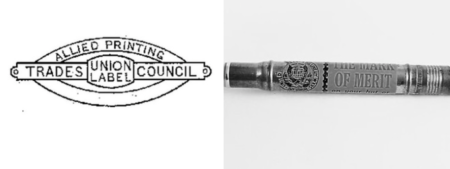
Left: Union Label of Allied Printing Trades Council;102Image of Allied Printing Trades Council Union Label, Allied Label, https://alliedlabel.org [perma.cc/AY3B-CMGC].
Right: United Hatters Promotional Pen with Union Label103Photograph of a United Hatters, Cap & Millinery Workers Union Promotional Pencil, eBay, https://ebay.com/itm/116548948300 [perma.cc/UX34-VS8E].
Once popularized, union labels were commonly understood to signify that products bearing them were made with union labor.104 Spedden, supra note 77, at 24–25; Brooks, supra note 78, at 205–06; Schroeder v. Lotito, 577 F. Supp. 708, 711 (D.R.I. 1983); Nichols, supra note 40, at 433; Martin, supra note 35, at 511.
However source-indicative this statement may sound, for labor unions, it was a mere instrument to achieve larger political aims.105See infra notes 120–130 and accompanying text.
Labor unions would claim publicly that the label stands for “excellence in workmanship” to appeal to consumers,106 Spedden, supra note 77, at 24–25; Chas D. Hemming, Third Prize Essay, in The Union Label Prize Essays, supra note 80, at 17, 20; Shelvin, supra note 93, at 12–13.
but as a contemporaneous Department of Labor bulletin concluded, labels did not bear any relationship to product quality.107Brooks, supra note 78, at 205–06; see also Spedden, supra note 77, at 19, 71–72.
Instead, unions promoted labeling as a method to strengthen the union.108Brooks, supra note 78, at 205–15; Nichols, supra note 40, at 431–34. See generally The Union Label Prize Essays, supra note 80.
As the Department of Labor put it, the label “is, like the strike or the boycott, an instrument of warfare.”109Brooks, supra note 78, at 206.
Accompanying propaganda confirmed the unions’ political intentions for adopting labels.110See generally The Union Label Prize Essays, supra note 80.
The label would enlist the public to support labor in its organizational and bargaining activities.111MacArther, supra note 80, at 1–3.
Once union labels were in place and publicized, unions could urge the public to practice labor solidarity by only buying goods bearing the union label.112See id.
If the public then buys more labeled goods or refrains from purchasing unlabeled goods, employers would be forced to rely on union labor and, accordingly, bargain with unions.113Id. at 5–6.
That unions used labels to persuade the public to align with unions politically was well understood from the beginning.114See Brooks, supra note 78, at 206–07.
Walter MacArther explained in an American Federation of Labor publication that the label “facilitates organization by increasing the demand for the products of organized workers. It constitutes recognition of the union by making certain the recognition of union products. . . . It makes the strike unnecessary by making compliance with union conditions an advantage in business.”115MacArther, supra note 80, at 5–6.
The Social Reform Club of New York wrote, contemporaneously, that the union label “unite[s] [consumers] with the workers in their struggle” to improve their wellbeing.116Brooks, supra note 78, at 207.
Unions were certainly interested in the label’s capacity to increase wages (sometimes framed as “combating specific forms of competition”117 Spedden, supra note 77, at 16–17.
) and its guarantee of “humane treatment” and “reasonable and fair conditions.”118Id. at 24–25; MacArther, supra note 80, at 7–8.
Unionists described these ends as purchasers’ “moral duty,” and thought they ought to appeal to “everyone who loves fair play, self-help, and equal chances for all.”119MacArther, supra note 80, at 6–8; Hemming, supra note 106, at 20; Brooks, supra note 78, at 207.
As such, unions’ utilization of their labels underscores their function as an economic device to achieve political ends. First, within unions, labels were subject to extensive yet fluid governance. National unions would require locals to furnish members with labels to apply to member-made goods, subject to certain conditions.120Brooks, supra note 78, at 200–03; Spedden, supra note 77, at 37–38, 58.
Common conditions included requiring employers to operate a “closed shop” (i.e., only use union labor), sometimes across all of the employers’ business locations; imposing restrictions on labor-saving devices like efficiency-improving machinery; and setting particular sale prices for the goods.121 Spedden, supra note 77, at 52–59.
The union member was only authorized to apply the label if the employer met these conditions.122 Id. at 16–17.
Practically, the only way an employer could meet these conditions was by bargaining with the relevant labor union over these and other terms, like wages, hours, and work conditions. Unlike contract terms between an employer and a labor union, the label’s governance was a matter internal to the union and subject to its unilateral amendment. Courts would decline to intervene in disputes over union refusals to authorize an employer’s use of a label, following a general rule of noninterference with the government of voluntary associations.123Raych v. Hadida, 130 N.Y.S. 346, 348–49 (Sup. Ct. 1911); Engel v. Walsh, 101 N.E. 222 (Ill. 1913).
Functionally, this meant there were never any fixed terms that would entitle an employer to use a union label; the label was uniquely suited as a vehicle for labor control over workplace decisionmaking.
Second, labor unions showcased union labels when they called for public boycotts of businesses that either sold nonunion goods or did not employ union labor.124E.g., Seubert, Inc. v. Reiff, 164 N.Y.S. 522, 523–24 (Sup. Ct. 1917); Cushman’s Sons, Inc. v. Amalgamated Food Workers’ Bakers, Local No. 164, 215 N.Y.S. 401, 401 (Sup. Ct. 1926).
For example, the United Hatters engaged in public education campaigns on authentic and spurious use of union labels under the call-to-arms, “Don’t Buy a Hat WITHOUT THE LABEL.”125Lawlor v. Merritt, 63 A. 639, 640 (Conn. 1906).
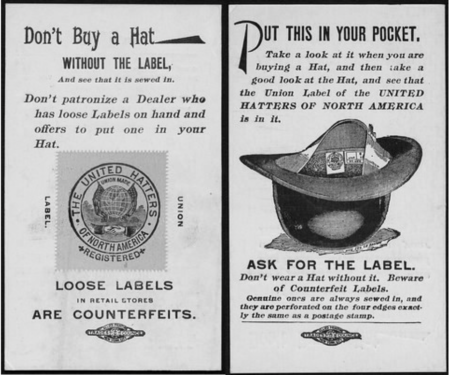
United Hatters Advertising Cards126Photographs of United Hatters Advertising Cards, in 19th Century American Trade Cards, Bos. Pub. Libr., https://digitalcommonwealth.org/search/commonwealth:gf06g774v [perma.cc/99VM-KTNU].
When the Bakery and Confectionery Workers picketed a New York bakery to urge unionization, they handed out placards that advertised the union label and requested sympathizers to only purchase bread displaying the label.127Engelmeyer v. Simon, 265 N.Y.S. 636, 638–39 (Sup. Ct. 1933).
Similarly, when the Furniture Workers attempted to unionize a particular business, they distributed circulars to passersby stating the business was nonunion, and urging, “PLEASE BUY FURNITURE BEARING THE UNION LABEL: HELP US MAINTAIN THE AMERICAN STANDARD OF LIVING!”128Mitnick v. Furniture Workers Union, Local No. 66, 200 A. 553, 554 (N.J. Ch. 1938).
In other words, unions overtly used the union label in boycotts as a mechanism to achieve labor solidarity, rather than as a source signal or an assurance of product quality.
Third, some unions were able to secure the political and economic support of states through union labels. Around the turn of the twentieth century, several states and cities passed laws requiring the union label on all public printing. These laws, while seemingly technical, had the broader effect of restricting all government printing purchases to union shops,129Brooks, supra note 78, at 204; Nichols, supra note 78, at 442; Shelvin, supra note 93, at 11–12; Amalithone Realty Co. v. City of New York, 295 N.Y.S. 423, 425 (Sup. Ct. 1937), aff’d, 297 N.Y.S. 262 (App. Div. 1937).
putting nonunion printers at a significant competitive disadvantage. Not only did these laws communicate the government’s support for unionization, but they also applied the government’s purchasing power to materially aid unionization. The New York court, applying New York City’s public printing law, explained that the law would result in an “immediate cost in dollars and cents” that is outweighed by the “fair assurance that the products have been manufactured under conditions in accord with our present day social consciousness.”130Amalithone, 295 N.Y.S. at 425.
Unions’ implementation of labels mirrors their political–economic character. It is true that unions used labels in markets (i.e., they relied on consumer purchasing decisions) to foment economic action (i.e., employer–union bargaining). However, unions’ goals vis-à-vis the public and employers were decidedly political. Union labels were a way for unions to enlist consumers as allies; they entreated consumers to purchase union-made goods as an expression of solidarity, not because of product quality.131See supra notes 104–119 and accompanying text.
And contemporary sources indicate union labels hardly ever correlated with increased wages for union labor.132See Brooks, supra note 78, at 206.
Still, irrespective of individual economic gain, unions campaigned for union labels to secure a voice in workplace decisions. Participation was inherently valuable to labor unions because it established their legitimacy, both as representatives of workers and as employers’ negotiating partners. As for labor unions in general, the economic and political contours of union labels are intimately intertwined.
II. Modern Trademark Law and Labor Unions
Trademarks serve as a shorthand for the source of a good or service. They signal to consumers that a particular product comes from a particular producer, allowing consumers to patronize the producers whose products they prefer. Modern trademark doctrines mainly flow from this idea of what trademarks are and what they do. But when these doctrines are applied to labor unions, they break down. Courts evaluating disputes with materially the same facts reason through them in drastically different manners and reach divergent outcomes. That is because unions’ identities and the purpose behind their names and insignia are characteristically different than expectations undergirding standard trademark doctrines. In this Part, I introduce basic trademark doctrines before evaluating how courts have applied them (poorly) to union trademark disputes since the Lanham Act.
A. The Trademark Lifecycle
Trademarks are words, symbols, and other perceptible features that signal the source of a good or service.133See 15 U.S.C. § 1127.
Trademark law primarily protects trademarks from infringement⎯others’ unauthorized use of a mark in a manner that is likely to confuse consumers about either the source of goods or services or the trademark owner’s sponsorship, endorsement, or affiliation with the unauthorized user.134See, e.g., Mark P. McKenna, The Normative Foundations of Trademark Law, 82 Notre Dame L. Rev. 1839, 1840–45 (2007).
In the conventional account of trademark law, the law’s beneficiaries are characterized as either “consumers” or “producers.”135See, e.g., U.S. Pat. & Trademark Off. v. Booking.com B.V., 140 S. Ct. 2298, 2302 (2020) (quoting Park ’N Fly, Inc. v. Dollar Park & Fly, Inc., 469 U.S. 189, 198 (1985)); Stacey L. Dogan & Mark A. Lemley, The Merchandising Right: Fragile Theory or Fait Accompli?, 54 Emory L.J. 461, 479 n.74 (2005); Jennifer E. Rothman, Navigating the Identity Thicket: Trademark’s Lost Theory of Personality, the Right of Publicity, and Preemption, 135 Harv. L. Rev. 1271, 1289 (2022).
Consumers and producers are two sides of the same coin⎯economic actors with straightforward economic interests. Consumers must be protected from source confusion, so they can make preference-satisfying purchasing decisions; producers must be protected from other producers’ confusing uses of their marks, so they may maximize their wealth.136Michael Grynberg, Trademark Litigation as Consumer Conflict, 83 N.Y.U. L. Rev. 60, 64–65 (2008); Jeremy N. Sheff, Marks, Morals, and Markets, 65 Stan. L. Rev. 761, 765 (2013).
Defenses to trademark infringement are generally exceptions from infringement liability designed to promote competition or free expression.137See generally Jake Linford, An Information Theory of Intentional Trademark Infringement, 62 Hou. L. Rev. 275 (2024) (defending the use of intent in trademark litigation and tying that in part to completive and expressional values).
For each stage of the trademark lifecycle⎯protection, infringement, and defenses⎯courts engage in fact-specific analyses, which are often multifactor inquiries into aspects like a mark’s characteristics, use by the claimed owner, use by third parties, and recognition among consumers. The vast majority of these inquiries are judicial doctrine built around basic, broad language in the statutory text. In this Section, I provide a baseline account of each stage’s doctrine before establishing how the unique character of unions and their marks defy straightforward application of those doctrines.
1. Protection
For a mark to qualify for the law’s protection, it must be distinctive and used in commerce.138See, e.g., Int’l Bancorp, LLC v. Societe des Bains de Mer et du Cercle des Etrangers a Monaco, 329 F.3d 359, 363 (4th Cir. 2003).
Barton Beebe has explained that distinctiveness encompasses two considerations: first, whether the mark is sufficiently different from other marks to be capable of association with a particular producer; and second, whether the mark signals the producer as source.139Barton Beebe, Search and Persuasion in Trademark Law, 103 Mich. L. Rev. 2020, 2026–29 (2005).
The Lanham Act contains a broad distinctiveness requirement,140See 15 U.S.C. §§ 1052, 1125.
and courts typically follow the Abercrombie spectrum to evaluate the distinctiveness of word marks.141See, e.g., Shivam Adarsh, Elliott Ash, Stefan Bechtold, Barton Beebe & Jeanne Fromer, Automating Abercrombie: Machine-Learning Trademark Distinctiveness, 21 J. Empirical Legal Stud. 826, 829–30 (2024).
It classifies marks into four categories: arbitrary or fanciful, suggestive, descriptive, and generic.142Abercrombie & Fitch Co. v. Hunting World, Inc., 537 F.2d 4, 9–11 (2d Cir. 1976).
Arbitrary, fanciful, or suggestive marks do not describe an attribute of the goods sold under the mark, and they are considered inherently source-distinctive.143E.g., Two Pesos, Inc. v. Taco Cabana, Inc., 505 U.S. 763, 768 (1992).
Descriptive marks describe some quality of a good (e.g., Creamy Butter), and they must acquire distinctiveness to be protected.144Id. at 769.
A descriptive mark acquires distinctiveness when it gains secondary meaning: Consumers understand the mark describes some quality of the good, but also that the mark signals the producer as source.145Each circuit typically employs its own multifactor test to determine whether a mark has acquired secondary meaning, as reflected in factors such as advertising, sales, evidence of attempts to copy the mark, and customer surveys. See, e.g., E.T. Browne Drug Co. v. Cococare Prods., Inc., 538 F.3d 185, 199 (3d Cir. 2008).
Generic marks are disqualified from protection because they are considered categorically incapable of signaling the source of goods or services.146E.g., U.S. Pat. & Trademark Off. v. Booking.com B.V., 140 S. Ct. 2298, 2303 (2020).
They are the words commonly used to identify the type of good or service (e.g., “Tennis Shoes”).147See, e.g., Schwan’s IP, LLC v. Kraft Pizza Co., 460 F.3d 971, 975 (8th Cir. 2006) (finding “brick oven” for frozen pizza to be generic).
In contrast to their approach to word marks, courts use several tests to evaluate design marks’ distinctiveness.148Amazing Spaces, Inc. v. Metro Mini Storage, 608 F.3d 225, 240–47 (5th Cir. 2010).
These tests generally concern whether a design is comprised of basic shapes, is commonly used in the relevant industry, or is ornamental and capable of signaling source.149See Seabrook Foods, Inc. v. Bar-Well Foods, Ltd., 568 F.2d 1342, 1344 (C.C.P.A. 1977).
The Lanham Act also requires marks to be “use[d] in commerce” to be eligible for protection.15015 U.S.C. § 1051.
Use in commerce means use in the ordinary course of trade (that is, not just to reserve a right in the mark).15115 U.S.C. § 1127.
Alexandra Roberts explains use must be as a mark to signal source, rather than for some other purpose.152Alexandra J. Roberts, Trademark Failure to Function, 104 Iowa L. Rev. 1977, 2043 (2019).
Some marks “fail[] to function” as trademarks because they are informational statements (e.g., “EVERYBODY VS. RACISM”), which consumers are unlikely to receive as source signals.153In re GO & Assocs., LLC, 90 F.4th 1354, 1355, 1358 (Fed. Cir. 2024).
Currently, trademark law protects multiple types of marks, including standard trademarks (which originally meant marks applied to goods); service marks (which signal the source of a service); trade dress (i.e., product design and product packaging); collective marks (which identify members of an organization, such as a union); and certification marks (which certify some quality or attribute of a good or service).154See generally 15 U.S.C. §§ 1051, 1053, 1054, 1125(a)(3).
Service marks and trade dress are close analogs to trademarks because they involve marks that signal source, but collective marks and certification marks are different.
Collective marks are marks used by the members of a “cooperative, an association, or other collective group or organization” to indicate membership in the organization.15515 U.S.C. § 1127.
They include “marks indicating membership in a union.”156Id.
In addition to unions, organizations such as chambers of commerce, industry groups, and agricultural cooperatives employ collective marks, which they register for their members to use.157See J. Thomas McCarthy, 1 McCarthy on Trademarks and Unfair Competition § 4:9 (5th ed. 2023).
The collective is the entity that owns the mark, and it typically does not sell goods or services under it, but it is not precluded from doing so.158Collective Mark Applications, U.S.P.T.O., https://uspto.gov/trademarks/apply/collective-mark-applications [perma.cc/FZ42-WEWG]; see Roush Bakery Prods. Inc. v. F.R. Lepage Bakery Inc., 13 U.S.P.Q.2d (BNA) 1045, 1051 (T.T.A.B. 1989) (“[W]e no longer believe that the anti-use-by-owner rule is applicable to collective marks.”).
Certification marks are used to certify some quality or characteristic of a producer’s goods or services, including “that the work or labor on the goods or services was performed by members of a union.”15915 U.S.C. § 1127.
Any certification entity (like organic food certifiers, fair trade certifiers, and others) may obtain a certification mark.160 McCarthy, supra note 157, §§ 19:91, 19:94.
Unlike collective mark owners, certification mark owners are prohibited from using the mark directly on goods or services.161See 15 U.S.C. § 1064(5)(B)–(C).
They may only (and, actually, must) permit qualifying third parties to use the mark on their own goods or services.162Id.
They are also required to file a copy of their certification standards as part of their registration.16337 C.F.R. § 2.45(a)(4)(i)(B).
As Section III.D explains in greater depth, Congress added collective marks and certification marks to the Lanham Act in part due to its desire to protect union marks. However, aside from some distinct registration requirements, current trademark doctrine treats collective and certification marks no different than standard trademarks. That is to say, courts both afford them the full scope of trademark protection and apply routine trademark infringement analysis to them, despite the characteristically different purposes of union marks.
2. Infringement
A trademark is infringed when an unauthorized third party uses it in a manner that is likely to confuse consumers about a good or service’s source or about the affiliation between the mark owner and the third party.164There are also other forms of infringement, including dilution and cybersquatting, that are beyond the scope of the Lanham Act. See 15 U.S.C. §§ 1125(c)–(d).
The law’s protection against infringement is commonly thought to protect consumers from unintentional purchases and producers from lost sales.165See, e.g., Dustin Marlan, Is the Word “Consumer” Biasing Trademark Law?, 8 Tex. A&M L. Rev. 367, 369 (2021) (quoting Iancu v. Brunetti, 139 S. Ct. 2294, 2306–07 (2019) (Breyer, J., concurring in part and dissenting in part)); Qualitex Co. v. Jacobson Prods. Co., 514 U.S. 159, 164 (1995).
Actionable confusion may occur before, after, or at the point of sale.166See Select Comfort Corp. v. Baxter, 996 F.3d 925, 932 (8th Cir. 2021) (distinguishing initial-interest confusion as that which creates initial customer interest as a result of the confusion, even though no actual sale has yet occurred); Mastercrafters Clock & Radio Co. v. Vacheron & Constantin-LeCoultre Watches, Inc., 221 F.2d 464, 466 (2d Cir. 1955) (distinguishing postsale confusion as confusion that arises after the point of sale, which may cause reputational harm to the mark holder due to others reasonably believing the goods or services originated from the holder).
Irrespective of the theory or timing of confusion, courts employ the same multifactor inquiries to assess the likelihood of consumer confusion.167See, e.g., Polaroid Corp. v. Polarad Elecs. Corp., 287 F.2d 492, 495 (2d Cir. 1961); AMF Inc. v. Sleekcraft Boats, 599 F.2d 341, 348–49 (9th Cir. 1979).
Common factors include the similarity of the plaintiff’s and defendant’s marks, strength of the plaintiff’s mark, relatedness of the parties’ goods or services, likelihood the plaintiff will “bridge the gap” and begin offering the defendant’s goods or services, evidence of actual confusion, the defendant’s intent in adopting the mark, and purchaser sophistication.168See supra cases cited in note 167.
Courts typically give some factors greater consideration depending on the case’s context and need not weigh all factors equally.169See, e.g., Checkpoint Sys., Inc. v. Check Point Software Techs. Inc., 269 F.3d 270, 280 (3d Cir. 2001).
3. Defenses
Not all unauthorized uses of a trademark infringe. Defenses to trademark infringement, which except certain third-party uses from liability, are designed to promote fair competition and free expression. They include noncommercial use, nominative fair use, descriptive fair use, and the Rogers test for expressive works.
Noncommercial uses of trademarks are often thought to be beyond the scope of trademark law.170See, e.g., Mark A. Lemley & Mark P. McKenna, Scope, 57 Wm. & Mary L. Rev. 2197, 2208 (2016).
They involve situations where the third party is not using the mark for commercial purposes.171See id.
For example, gripe and fan websites, where people write about their experiences with a particular product or mark owner and include the relevant mark, are considered noncommercial uses.172See, e.g., People for Ethical Treatment of Animals v. Doughney, 263 F.3d 359, 362–63 (4th Cir. 2001); Cornette v. Graver, 473 F. Supp. 3d 437, 449–53 (W.D. Pa. 2020).
Nominative fair use applies when a defendant uses the plaintiff’s mark to refer to the plaintiff, even if the defendant’s ultimate goal is to identify itself or its product.173New Kids on the Block v. News Am. Publ’g, Inc., 971 F.2d 302, 308–09 (9th Cir. 1992).
A number of circuits have adopted a nominative fair use defense.174Id.; Century 21 Real Estate Corp. v. Lendingtree, Inc., 425 F.3d 211, 222 (3d Cir. 2005); Int’l Info. Sys. Sec. Certification Consortium, Inc. v. Sec. Univ., LLC, 823 F.3d 153, 167–68 (2d Cir. 2016).
These circuits ask whether (1) the trademark is necessary to describe the plaintiff’s product or service, (2) the defendant uses only as much of the mark as is reasonably necessary, and (3) the defendant’s use suggests the trademark holder’s sponsorship or endorsement.175New Kids, 971 F.2d at 308.
How much use of a mark is “reasonably necessary” is highly context-dependent and can often be elusive.176See Cairns v. Franklin Mint Co., 292 F.3d 1139, 1154 (9th Cir. 2002); Earth, Wind & Fire IP, LLC v. Substantial Music Grp. LLC, 720 F. Supp. 3d 1261, 1274–75 (S.D. Fla. 2024).
Descriptive fair use is the only fair use defense that comes directly from statutory text.177Compare 15 U.S.C. § 1115(b)(4), with 15 U.S.C. §§ 1051–1127 (describing defenses).
It is only available when the defendant does not use the mark at issue as its own mark.17815 U.S.C. § 1115(b)(4).
Instead, it protects a defendant’s use of the plaintiff’s mark to describe the defendant’s goods or services,179See, e.g., Fortune Dynamic, Inc. v. Victoria’s Secret Stores Brand Mgmt., Inc., 618 F.3d 1025, 1041–43 (9th Cir. 2010).
often invoked when the plaintiff’s mark is descriptive (e.g., Creamy Butter), and the defendant seeks to use the same term only descriptively (e.g., Thrive Farm extra creamy butter).180See, e.g., Solid 21, Inc. v. Breitling U.S.A., Inc., 96 F.4th 265, 276–78 (2d Cir. 2024).
Many courts apply the test laid out in Rogers v. Grimaldi (or some version of it) when the defendant uses the plaintiff’s mark in a work of creative expression, such as a novel, film, video game, or artwork, among others.181Rogers v. Grimaldi, 875 F.2d 994, 999–1000 (2d Cir. 1989); see Anthony Zangrillo, Note, The Split on the Rogers v. Grimaldi Gridiron: An Analysis of Unauthorized Trademark Use in Artistic Mediums, 27 Fordham Intell. Prop. Media & Ent. L.J. 385, 403–20 (2017).
In Rogers, the Second Circuit acknowledged that there are circumstances in which conventional trademark purposes must be balanced against other values, such as free speech. Creative uses are not automatically immunized from liability. Rather, they are afforded a heightened liability standard. The defendant’s use is only infringing if it is not artistically relevant to the defendant’s expressive work, or if the defendant explicitly misleads as to the source or content of their work.182Rogers, 875 F.2d at 999–1000.
In Jack Daniel’s Properties v. VIP Products LLC, the Supreme Court held that the Rogers test only applies when the defendant does not use the mark at issue as a source identifier.183Jack Daniel’s Props., Inc. v. VIP Prods. LLC, 143 S. Ct. 1578, 1587 (2023).
These trademark doctrines primarily respond to a dynamic between producers and consumers, where consumers seek out certain products and rely on producers’ marks to distinguish one’s goods from others’ goods. Producers may have legitimate reasons for using others’ marks (nominative, descriptive, or artistic), or their use may be an illegitimate misappropriation of others’ goodwill. Labor unions—and their names and insignia—do not fit neatly into this dynamic. They are not producers in the sense that they do not put goods on the market; and they have a greater political than economic connection to consumers. Still, labor unions do use marks (their own and others’) in various ways, and when they are parties in trademark suits, courts apply the standard suite of trademark doctrines to them.
B. Post–Lanham Act Labor Union Trademark Cases
Recent and ongoing suits between Starbucks, Medieval Times, and Trader Joe’s and their respective employee unions are not the first union-related trademark disputes courts have faced. But, unfortunately, earlier union trademark opinions do not serve as helpful precedent. Since the Lanham Act’s passage in 1946, courts have grappled with federal trademark disputes both between different unions and between unions and their employers. The theme that emerges across these cases is inconsistency. Courts evaluating analogous disputes reach contrary results on both the scope of the Lanham Act’s application and the outcome of likelihood of confusion analyses.
Comparison of two, factually analogous, employer-versus-union cases displays courts’ radically different approaches to trademark analyses. In Brach Van Houten Holding, Inc. v. Save Brach’s Coalition for Chicago, an Illinois court considered a union’s use of its employer’s logo as part of a protest to be an actionable “use in commerce” because the union provided a commercial service to its members.184Brach Van Houten Holding, Inc. v. Save Brach’s Coal. for Chi., 856 F. Supp. 472, 475–76 (N.D. Ill. 1994).
By contrast, in WHS Entertainment Ventures v. United Paperworkers International Union, a Tennessee court held that the same act was not a use in commerce because the union’s protest was to further its position in a labor dispute, even though negotiating on behalf of members may be construed as the union’s “service.”185WHS Ent. Ventures v. United Paperworkers Int’l Union, 997 F. Supp. 946, 950–51 (M.D. Tenn. 1998).
In Brach, Teamsters Local 738 banded together with other organizations to protest the closure of Brach’s candy factory in Chicago.186Brach, 856 F. Supp. at 474.
Brach’s sued the coalition for its use of a version of the company’s logo in the coalition’s promotional materials, which appeared between “SAVE” and “Coalition for Chicago.”187Id. at 475.
The coalition’s activities were informational⎯it criticized the management at Brach’s and advocated for the plant to remain open.188Id. at 474–76.
As a threshold matter, the court held that the Save Brach’s coalition’s activities were within the Lanham Act’s scope because the coalition’s “work on behalf of its members’ interests constitutes a ‘service’ within the meaning of the Lanham Act.”189Id. at 475–76.
The court proceeded to hold that the coalition’s use of the Brach’s logo would likely cause confusion about the company’s sponsorship, giving little weight to the critical character of the coalition’s message.190Id. at 476.
In WHS, the United Paperworkers distributed flyers at the Wildhorse Saloon; the flyers contained a parody of the Saloon’s logo, listing the establishment’s health violations and the words “UPIU Special Projects.”191WHS Ent. Ventures v. United Paperworkers Int’l Union, 997 F. Supp. 946, 948 (M.D. Tenn. 1998).
The Union was not in a labor dispute with the Saloon but with a different business that had a common owner with the Saloon’s manager.192Id.
Doubtless, the United Paperworkers distributed the flyers on behalf of its members’ interests. Even so, the court held their activity was beyond the Lanham Act’s scope⎯the union did not use the Saloon’s trademark for the “sale or advertising of a service.”193Id. at 949–50.
It did not distribute the flyers to attract new members or solicit donations. The court recognized that the Union used the flyers to further its position in a labor dispute,194Some may distinguish WHS from Brach on grounds that the United Paperworkers were in a bona fide labor dispute with their employer at the time of their hand billing. Even so, neither they nor Save Brach’s were in any labor dispute with the employer they were protesting. That is to say, neither is definitively protected labor activity for the purpose of labor law.
and the act of negotiating on behalf of members is a service the Union provides, but its leafletting was “too far removed” from the Union’s services to be covered by the Lanham Act.195Id. at 949–50.
Rather, its leafletting was better understood as free expression.196See id. at 950–52.
Courts have likewise resolved disputes between unions differently depending on whether they perceive the union’s organizing efforts as a commercial service or as an associational activity. In one case, a number of members of the Stanislaus Custodial Deputy Sheriffs’ Association (a local police union) disaffiliated and formed their own union, the Deputy Sheriff’s Association of Stanislaus County. Both unions sought to represent the same workers⎯deputy sheriffs in Stanislaus County⎯in negotiations with their government employer.197Stanislaus Custodial Deputy Sheriffs’ Ass’n v. Deputy Sheriff’s Ass’n of Stanislaus Cnty., No. CV F 09-1988, 2010 WL 2218813, at *1–2 (E.D. Cal. June 1, 2010).
The court held that the splinter union’s name was actionable as trademark infringement because it competed with the former union for membership. That act, in the court’s view, was a “commercial use” of the former union’s mark.198Id. at *8–9.
The court then engaged in a routine likelihood of confusion analysis in which it found that the unions’ organizing efforts were “competing services.”199Id. at *10–11.
In another case, the United Mine Workers of America terminated its affiliation with a particular local, District 50, and demanded it cease using the “United Mine Workers” in its name.200Dist. 50, United Mine Workers v. Int’l Union, United Mine Workers, 412 F.2d 165, 167 (D.C. Cir. 1969).
The court acknowledged that the two organizations competed to organize the same workers after their split, but it declined to prohibit District 50’s continued use of the name. Not only were the two unions clearly opposed to one another, but District 50 had used its full name for over thirty years and organized thousands of workers under it. The name continued to represent the association of its members.201Id. at 167–69.
These post–Lanham Act cases applying trademark law to labor unions provide courts with little guidance on how to approach future, analogous cases. Courts seem to perceive a binary issue: Either the labor union, engaging in standard union activity, is providing a “service” the Lanham Act may govern, or it is expressing a viewpoint and providing representation. Any argument that one court got it wrong would face an equally compelling counterargument that the other court erred.
C. Modern Trademark Law’s Ill Fit with Labor Unions
The source of courts’ inconsistency likely is not error, but a deeper incongruence between modern trademark law and labor unions. Trademark law routinely proceeds from a set of assumptions about what marks do, why entities use trademarks, why third parties use others’ protected marks, and the harm infringement inflicts on trademark owners. Labor unions unsettle many of these assumptions.
First, labor unions’ intertwined political and economic missions set them apart from trademark law’s conventional “producer”⎯an entity that uses its mark to signal the source of the goods or services that it puts on the market.202See McKenna, supra note 134, at 1843; Sheff, supra note 136, at 762. That is not to say labor unions are the only type of organization characteristically different from trademark law’s standard “producer.” For example, political or civic associations (like Mothers Against Drunk Driving or the Democratic Political Party) have distinct, overriding noneconomic missions.
One commonly accepted justification for trademark law is that it protects producers’ goodwill, which Barton Beebe describes as “the reputation of the firm and its products and the probability, based on this reputation, that consumers will continue to patronize the firm in the future.”203 Barton Beebe, Trademark Law 18 (11th version 2024) (ebook).
Jurists and scholars typically imagine trademark law’s producer as a “firm,” as within neoclassical economics.204See Michele Bee & Maxime Desmarais-Tremblay, The Birth of Homo Œconomicus: The Methodological Debate on The Economic Agent from J.S. Mill to V. Pareto, 45 J. Hist. Econ. Thought 1, 2–3 (2023); Milton Friedman, The Social Responsibility of Business Is to Increase Its Profits, N.Y. Times (Sep. 13, 1970), https://nytimes.com/1970/09/13/archives/a-friedman-doctrine-the-social-responsibility-of-business-is-to.html [perma.cc/6MG5-8FGW].
The producer, as a firm, has a singular goal: to maximize wealth.205Friedman, supra note 204; McKenna, supra note 134, at 1859.
Trademarks and their legal protection serve that goal by aiding producers’ ability to channel sales to themselves.206McKenna, supra note 134, at 1859; Rothman, supra note 135, at 1289.
While labor unions share producers’ goal of wealth maximization by seeking higher wages, they simultaneously pursue other goals that cannot be reduced to wealth or disregarded as secondary or immaterial (e.g., voice/participation, dignity, self-determination, control, health and safety).207See Mazzurco, supra note 49, at 827; Lichtenstein & Harris, supra note 57, at 4; Reddy, supra note 7, at 1398.
Law protects trademarks because they signal source.208See infra note 214.
Yet labor unions’ names and insignia are not strictly source signals since they also identify a particular type of association.209See supra Section I.B. Moreover, labor unions do not have any affirmative right to place their union label on anything. They must negotiate with employers to reach a mutual agreement in which (1) the employer allows the union member to use its label on the employer’s union-made wares; and (2) the union allows the employer to use the union label on the employer’s union-made wares.
The association’s labor organizing and bargaining activities are certainly a “service” to workers in a colloquial sense, but they are equally political acts taken to cultivate workers’ participation in workplace governance. And, practically, union names are bad trademarks. Courts have recognized that union names formulated in a certain manner, such as Machinists’ Union or United Electrical, Radio and Machine Workers of America, are generic terms.210Brown v. Hook, 180 P.2d 982, 991–92 (Cal. Dist. Ct. App. 1947); Fitzgerald v. Block, 87 F. Supp. 305, 306 (E.D. Pa. 1949).
The Supreme Court’s decision in United States Patent and Trademark Office v. Booking.com did not change that result.211U.S. Pat. & Trademark Off. v. Booking.com B.V., 140 S. Ct. 2298 (2020).
In that case, the Court held a trademark, on the whole, might not be generic even though it is comprised entirely of individually generic terms.212Id. at 2305–07.
What matters is whether consumers understand the full mark to signal source. Even so, most union names, in their entirety, would still be generic. Machinists’ Union directly describes what it is⎯a union of machinists. Under current trademark doctrine, these names would be regarded as categorically incapable of signaling source.213See id. at 2303.
They function better as associational names because they describe in as broad terms as possible the composition of their membership. The same applies when a labor union’s name refers to a particular employer. Amazon Labor Union, for example, is a union of Amazon workers. Its name describes the full class of its potential membership.
Union labels may be symbols of source in a loose sense (i.e., as an indication goods are union-made), but only as an instrument for labor solidarity. Much like labor unions are bad “producers” for trademark law purposes, union labels are lousy source symbols. Trademarks are supposed to signal a product’s source, even if the identity of the source is unknown.214Qualitex Co. v. Jacobson Products Co., 514 U.S. 159, 162 (1995) (quoting 15 U.S.C. § 1127); see also McCarthy, supra note 157, § 3.9.
Not only do union labels not say anything about a product’s quality,215See supra note 44.
but they also can’t indicate who made the particular product⎯it could have been manufactured by workers employed by any number of businesses.216See McVey v. Brendel, 22 A. 912, 914 (Pa. 1891).
By contrast, they are fairly good as political propaganda, in that they advise the public on how to ascertain whether one is taking an action that supports labor. Further, union labels are far less effective at increasing workers’ wealth217See supra note 132 and accompanying text.
(as one may conceive a functioning trademark should financially benefit the producer) and far more effective at getting unions a seat at the table.
The reason for a union’s choice of name and insignia is also relevant when the union is the accused infringer. There are two potentially applicable defenses that would protect the union’s decision to incorporate an employer’s name into its own: descriptive fair use and nominative fair use. Descriptive fair use protects a defendant’s use of the plaintiff’s mark to describe the defendant’s goods, but it is unavailable when the defendant is using that mark as its own.21815 U.S.C. § 1115(b)(4).
If a union’s name is its mark, then Starbucks Workers United, for example, could not argue it uses “Starbucks” to truthfully describe itself. Nominative fair use applies when a defendant uses a plaintiff’s mark to describe the plaintiff’s goods or services, even if the defendant’s goal is to describe the defendant’s own goods or services.219See New Kids on the Block v. News Am. Publ’g, Inc., 971 F.2d 302, 308 (9th Cir. 1992).
It is technically available when the defendant uses the plaintiff’s mark within the defendant’s own mark, but no courts have held as much.220See Toyota Motor Sales, U.S.A., Inc. v. Tabari, 610 F.3d 1171, 1179–80 (9th Cir. 2010).
And a court could reasonably find the use of “Starbucks” within the union’s name to be more than “reasonably necessary,”221See Playboy Enters., Inc. v. Welles, 279 F.3d 796, 802 (9th Cir. 2002) (“The second part of the nominative use test requires that ‘only so much of the mark or marks may be used as is reasonably necessary to identify the product or service[.]’ ”) (quoting New Kids, 971 F. Supp. 2d at 308).
even if the union could have operated as Workers United and identified Starbucks as the relevant employer some other way. Even though there is an actual connection between the employer and the union⎯the union is, or aspires to be, comprised of the employer’s employees⎯trademark law defenses do not definitively insulate unions from liability when they incorporate employers’ names or insignia into their own.
Common theories of trademark infringement also, for the most part, fit unions poorly, whether they are the accused infringer or the infringed. Employers are likely to sue unions for confusion as to sponsorship or affiliation.222See, e.g., Trader Joe’s Co. v. Trader Joe’s United, 150 F.4th 1040, 1045–47 (9th Cir. 2025).
However, as a matter of labor law, employers are prohibited from sponsoring unions.223National Labor Relations Act § 8(a)(2), 29 U.S.C. § 158(a)(2).
The probability of confusion on that score would depend on consumers’ awareness of that prohibition. Suits between unions may proceed on a straightforward “passing off” theory224See Camco Mfg., Inc. v. Jones Stephens Corp., 391 F. Supp. 3d 515, 527 (M.D.N.C. 2019); Fletcher’s Original State Fair Corny Dogs, LLC v. Fletcher-Warner Holdings LLC, 434 F. Supp. 3d 473, 492–93 (E.D. Tex. 2020) (citing Westchester Media v. PRL USA Holdings, Inc., 214 F.3d 658, 666 (5th Cir. 2000)).
⎯that consumers will mistakenly believe defendant union’s “services” come from plaintiff union, because of their similarity in name or insignia. If plaintiff union has a weak mark in the first instance, trademark law would not afford it strong protection against defendant union’s similar (but not identical) mark, even if the unions directly compete for the same membership.225See Michael Grynberg, Thick Marks, Thin Marks, 67 Case W. Rsrv. L. Rev. 13, 18–22 (2016); Barton Beebe & C. Scott Hemphill, The Scope of Strong Marks: Should Trademark Law Protect the Strong More Than the Weak?, 92 N.Y.U. L. Rev. 1339, 1347–50 (2017).
Also, barring a competing union from using a similarly generic name would significantly hinder its ability to engage in labor law–protected activities. By contrast, suits by unions against third parties who use their insignia without authorization are more coherent trademark infringement suits. This would include, for example, a printer who uses a counterfeit “union bug” on its nonunion print jobs.226. See Schroeder v. Lotito, 577 F. Supp. 708, 712 (D.R.I. 1983); accord Lopresti v. Spectrum Press, Inc., No. 00 CIV. 2842, 2001 WL 1568434, at *3 (S.D.N.Y. Dec. 5, 2001); Lacey ex rel. Graphic Commc’ns Int’l Union v. Big Impressions, Inc., No. 04CV00184, 2005 WL 1773679, at *3–4 (E.D. Ark. July 7, 2005).
In those cases, the third party’s unauthorized use of union insignia could plausibly suggest the union was “affiliated” with the third party, irrespective of any likelihood of source confusion.
Labor union trademark disputes⎯whether with employers, other unions, or unrelated third parties⎯also defy conventional trademark law theories of harm. The harm that justifies a trademark owner’s right of action is potential revenue loss, because consumers will confuse the owner with an infringer or become less able to identify the owner’s goods through its mark.227See sources cited supra note 136.
In trademark disputes between unions, this harm is probably most salient when one union loses members to another similarly named union. But this notion of harm depends on a strained understanding of what unions are. They are not businesses competing to make sales; they are organizations of workers seeking to bargain collectively with employers.228See supra note 50 and accompanying text.
They are concerned with diminished bargaining power, not lost revenue. Disputes between employers and unions have even less to do with lost patronage. Employers’ concept of harm is more akin to impersonation⎯that the public will think the employer expressed the union’s message.229Compare First Amended Complaint at 2–3, Starbucks Corp. v. Workers United, No. 23-cv-00068 (S.D. Iowa Nov. 10, 2023) (arguing that the union’s use of the employer’s name “has misled many customers to believe . . . that [the employer] was the source of . . . the viewpoints put out by [the union]”), with N.Y. Penal Law § 190.25 (McKinney 2026) (setting forth liability for criminal impersonation), and Cal. Penal Code § 529(a) (West 2026).
Unions, on the other hand, stand to lose bargaining power associated with the size of their membership if employers or third parties make confusing uses of their names or insignia.
If we take trademark doctrine as it is today, there is no clear place for labor unions. Collective marks and certification marks, which explicitly encompass union marks, are subject to standard trademark doctrines. However, nearly every aspect of trademark law seems inscrutable when at least one of the parties in the dispute is a labor union. One answer may be that the game is not worth the candle⎯trademark law just should not apply to labor unions. Another possible answer is that trademark law should cognize labor unions solely in their economic capacity as routine commercial actors. But, as the analysis above indicates, the result might be that trademark law still does not apply to unions. That probably would not be palatable to employers or to labor unions, both of whom seek to protect their marks.230See WHS Ent. Ventures v. United Paperworkers Int’l Union, 997 F. Supp. 946, 948 (M.D. Tenn. 1998); In re Retail Clerks Int’l Protective Ass’n, 149 F.2d 153, 154–55 (C.C.P.A. 1945).
Further (and, perhaps, more importantly), if courts decided trademark law simply did not apply to labor unions, they would be defying Congress’s expressed intent to include labor unions within the Lanham Act’s scope, notwithstanding their characteristic differences.23115 U.S.C. § 1127.
III. Labor Unions’ Path to Protection
Courts attempt to apply standard trademark doctrines to labor unions despite the vast differences in how and why unions, in contrast to other trademark holders, use names, labels, and other insignia. Congress, by contrast, was aware of the unique character of union marks when it afforded them federal trademark protection through the Lanham Act. In this Part, I reconstruct the path to the Lanham Act’s expansion of trademark law to cover union marks. The history reveals courts’ refusal to apply trademark law to labor unions because their names and insignia were not trademarks, a wave of sui generis state law aimed at protecting unions’ names and marks to further the labor cause, and a Congress aware that union marks do not signal source yet intent on protecting them anyway to serve unions’ interests.
The Lanham Act ultimately indexed union marks as two distinct and new kinds of marks: collective marks and certification marks. The Act, however, did not provide any further guidance on how union marks fit within the scheme of trademark protection.232Nor does the Lanham Act elaborate how other types of marks (like service marks and trade dress) fit within the scheme of trademark protection. See 15 U.S.C. § 1053 (protecting service marks); 15 U.S.C. § 1052 (neglecting to distinguish between how different types of marks ought to be protected). Courts have attempted to interpret how trademark doctrines apply to these marks considering their differences from standard trademarks. See, e.g., Christian Louboutin S.A. v. Yves Saint Laurent Am. Holding, Inc., 696 F.3d 206, 219–22 (2d Cir. 2012).
Courts’ inconsistent application of standard trademark doctrines likely reflects their best efforts to fill in the details. But the history of trademark law’s application to labor unions, so far neglected in accounts of trademark law, may be the antidote to the Lanham Act’s residual uncertainty.233See infra Sections II.B–C.
I conclude this Part with insights on how this history should direct courts’ analyses in the current wave of trademark disputes involving labor unions.
A. Union Marks’ Early Exclusion from Trademark Protection
Prior to the Lanham Act’s promulgation, the rough consensus among federal and state courts was that union names and labels were not eligible for protection as trademarks.234See Carson v. Ury, 39 F. 777, 780 (C.C.E.D. Mo. 1889); Cigar-Makers’ Protective Union v. Conhaim, 41 N.W. 943, 945 (Minn. 1889); McVey v. Brendel, 22 A. 912, 912–13 (Pa. 1891).
Federal statutory protection was limited to persons engaged in business who adopted and used trademarks on their wares.235Martin, supra note 35, at 518; McVey, 22 A. at 913–14.
Collectives⎯organizations of individuals connected through some common affiliation⎯were not considered to be in “business” with one another, and thus did not qualify for protection.236McVey, 22 A. at 914.
State courts routinely denied to labor unions statutory and common law trademark protection.237See Cigar-Makers’ Protective Union, 41 N.W. at 945; McVey, 22 A. at 913. A few courts either assumed (without reasoning) that a labor union had a protectable trademark in its label, or decided that though the union’s label was not technically a trademark, it should be protected from imitation for policy reasons. See Ury, 39 F. at 779. Separately, though unions’ names and labels did not receive trademark protection, courts sometimes allowed unions to sue label imitators for unfair competition. The common law unfair competition cause of action did not impose the same technical requirements as existed for trademark protection. See Baker v. Master Printers Union, 34 F. Supp. 808, 812 (D.N.J. 1940).
In one of the earliest trademark cases involving unions, Carson v. Ury, a Missouri court found that the Cigar-Makers’ International Union’s label could not be protected as a trademark because it did not function as a trademark.238Ury, 39 F. at 779.
The label did not indicate who, or which firm, made the cigars that bore the label (i.e., it was not a source signal); it did not distinguish one cigar manufacturer’s cigars from another’s (i.e., it was not put to one firm’s exclusive use); and neither the union nor its members could sell the label (i.e., it was not a transferrable business asset). Rather, a worker had the right to use a union’s label only if, and while, they were a member of the union.239Id.
The Minnesota Supreme Court agreed and added that the Cigar-Maker’s label was adopted to indicate membership in a union.240Cigar Makers’ Protective Union, 41 N.W. at 945.
It asserted that unions were not “engaged in manufacture or trade, or . . . formed for any such purpose.”241Id.
Though each member of the union was engaged in business⎯making cigars⎯the members were not in business together.242Id. at 945.
The Pennsylvania Supreme Court crystallized the Minnesota court’s view: The Cigar-Makers’ International Union was not a business organization.243McVey v. Brendel, 22 A. 912, 913–14 (Pa. 1891).
“It neither makes nor sells cigars, but . . . seeks ‘to promote the mental, moral, and physical welfare of its members.’ ”244Id.
The court characterized these goals as “personal and social objects, not commercial ones.”245Id.
Unions’ names were also categorically disqualified from trademark protection. In a Texas case, the United Brotherhood of Carpenters and Joiners of America, Carpenters Union No. 213, sought an injunction to prohibit Carpenters and Joiners Union of Texas from using its corporate name in business.246United Bhd. of Carpenters and Joiners, Carpenters Union No. 213 v. Carpenters and Joiners Union, 110 S.W.2d 1209, 1210 (Tex. Civ. App. 1937).
The defendant was not a labor union.247Id.
It adopted its name in an apparent attempt to mislead the public into thinking it was a labor organization.248Id.
The court held that the bona fide union did not have exclusive rights to use its name because, like most union names, it was comprised of generic terms.249Id. at 1212.
B. State Union Label Acts
After a series of judicial setbacks, labor unions no longer asserted their ability to meet the requirements for state or federal trademark protection.250Duguid, supra note 91, at 326–27.
Instead, they devoted their efforts to state lawmaking. Specifically, they sought sui generis state law to protect labor unions’ names and labels from counterfeiting and imitation.251Id.; Spedden, supra note 77, at 95–96; Martin, supra note 35, at 521–23.
By 1890, twenty states had passed a union label act, and by 1900, nearly all states had adopted one.252Duguid, supra note 91, at 327. There were forty-six states in the union in 1908. D. Clark, Total Number of US States, at the End of Each Year, Since the Declaration of Independence in 1776, Statista (Nov. 28, 2025), https://statista.com/statistics/1043617/number-us-states-by-year/?srsltid=AfmBOor_-M2-lsPxv3ARqS9KDz5LQrmCaqbqHKto0UtU1XRAy662AE0A [perma.cc/F4WC-PAC8].
The Supreme Court remarked in 1922 that “[t]he so-called union label . . . is a quasi trademark to indicate the origin of manufactured product in union labor . . . [and is] . . . protected against pirating and deceptive use by the statutes of most of the States.”253United Mine Workers v. Coronado Coal Co., 259 U.S. 344, 386 (1922).
The vast majority of the state laws had virtually identical provisions. They protected a “person or any association or union of workingmen,” from the counterfeiting, imitation, or unauthorized use of their “label, trade mark, term, design, device, or form of advertisement,” designating goods or services as made by the person, association, or union.254E.g., Cal. Pol. Code §§ 3196–3201 (Deering 1906); Act of Feb. 18, 1932, Pub. L. No. 72-35, 47 Stat. 50, reprinted in D.C. Code Ann. ch. 40, p. 443; Ill. Rev. Stat., ch. 140, §§ 1–7 (1908); N.Y. Laws 1889, ch. 385; 1893, ch. 219.
These labor unions were required to register their labels with the state to gain protection.255See sources cited supra note 254.
Violations of the law were punished with civil and criminal penalties. Officers of the union could sue for an injunction; money damages, including profits; and destruction of counterfeit or imitation labels.256See sources cited supra note 254.
Violations were also misdemeanors punishable by three months to one year imprisonment and/or by a fine of $100 to $200.257See sources cited supra note 254. That amount is worth roughly ,500–,000 in 2026 dollars. See CPI Inflation Calculator, U.S. Bureau of Lab. Stats., https://www.bls.gov/data/inflation_calculator.htm [perma.cc/U4E4-K74R].
Unions did not have to register their names or seals to receive protection against others’ unauthorized use “in . . . the sale of goods or otherwise,” which was a misdemeanor carrying the same criminal penalty as for the unauthorized use of union labels.258See sources cited supra note 254.
State union label laws diverged from one another in some respects. About half of the states codified their act in the Trademarks (or Labels and Marks) chapter of their laws, while roughly a third codified it in their Criminal Law chapters, and the remainder under Labor Law.259See, e.g., sources cited supra note 254.
Irrespective of where the law was codified, nearly all of the laws were standalone sections dedicated to the protection of unions’ names and labels. That is to say, they were not amendments to trademark laws. Also, very few states explicitly endowed unions with exclusive rights in their marks.260See, e.g., sources cited supra note 254.
Early cases against counterfeiters clarified how union label laws intersected with state trademark laws. In two cases, defendants charged with selling goods with false union labels asserted that unions ought to receive no protection because their labels were not trademarks.261State v. Hagen, 33 N.E. 223, 224 (Ind. App. 1893); Schmalz v. Wooley, 41 A. 940, 941 (N.J. 1898).
Both courts agreed that union labels were not trademarks, but determined union label law protected them regardless.262Hagen, 33 N.E. at 225; Wooley, 41 A. at 941.
The New Jersey court, writing in 1898, remarked that the labor union is a “comparatively novel species of relationship,” deserving of the same protection as business associations: “a right of property in a trade-mark designed to distinguish their workmanship from that of other persons.”263Wooley, 41 A. at 941.
In another case, a Georgia court found that the state’s union label act was promulgated to exclusively protect labor unions’ labels, trademarks, and other insignia; it was not a general statute affording protection to all persons or corporations.264Comer v. State, 29 S.E. 501 (Ga. 1897).
Connecticut courts similarly interpreted their state’s statute to require union labels to “announce that the [goods] to which [they are] attached were manufactured by members of the [union],” and not to “import[] that [they] were owned or manufactured or sold by the [union] itself.”265Lawlor v. Merritt, 65 A. 295, 297 (Conn. 1906).
Simply put, union labels that seemed like trademarks⎯indicators of goods’ source⎯would not be protected. Nearly all cases brought under union label laws involved counterfeiting or the unauthorized use of genuine union labels.266See, e.g., Hagen, 33 N.E. at 224; Commonwealth v. Norton, 9 Pa. D. 132, 132 (Pa. Ct. Quarter Sess. 1899); State v. Baur, 272 S.W. 1062, 1063 (Mo. Ct. App. 1925).
No reported cases involved the unauthorized use of a union’s name or badge.
State union label acts proliferated during a period of ferment, with public sentiment increasingly out of sync with federal law. Congress enacted the Sherman Act in 1890 to criminalize combinations in restraint of trade,26715 U.S.C. §§ 1–7 (1890).
and federal courts interpreting the statute held that it applied to labor unions.268E.g., United States v. Workingmen’s Amalgamated Council, 54 F. 994, 996 (C.C.E.D. La. 1893).
In the 1908 Danbury Hatters case, the Supreme Court affirmed a union’s liability under the law for engaging in a peaceful interstate boycott.269Loewe v. Lawlor, 208 U.S. 274, 308–09 (1908). Congress ultimately realigned with labor interests in 1914, when it passed the Clayton Act to withdraw unions’ peaceful activities from the scope of antitrust laws. 15 U.S.C. §§ 12–27.
During this eighteen-year window, the number of state union label acts exploded. While the federal courts ruled against labor unions, reformers in state governments embraced the idea that state law could establish social control over corporate power. Populists, Progressives, urban immigrants, and agrarian reformers helped elect labor-friendly legislators who shared their suspicion of big business and monopolies.270See David Montgomery, The Fall of the House of Labor: The Workplace, the State, and American Labor Activism, 1865–1925, at 287–90, 302–10 (1987); Julie Greene, Pure and Simple Politics: The American Federation of Labor and Political Activism, 1881–1917, at 107–214 (1998).
Progressives, in particular, promoted the idea of “consumer consciousness”⎯that citizens should make purchasing decisions that serve the collective good.271 Lawrence B. Glickman, Buying Power: A History of Consumer Activism in America 158–61 (2009).
The collective good, in their view, included workers’ wellbeing: a living wage, safe and hygienic working conditions, and no child labor.272See id. at 160, 175, 177, 179, 183, 187.
In this climate, the promulgation of state law protecting union names and labels was a low-risk way to support labor interests.
Notably, state union label acts are not historical relics. The vast majority of states that promulgated union label acts in the early twentieth century continue to codify them.273See, e.g., sources cited supra note 254.
Even after the Lanham Act’s passage, labor unions have continued to vindicate their sui generis state rights in suits against entities using their names, labels, and other insignia without their authorization.274See, e.g., Lopresti v. Spectrum Press, Inc., No. 00 CIV. 2842, 2001 WL 1568434, at *3 (S.D.N.Y. Dec. 5, 2001).
C. Congressional Intent in Protecting Union Marks
By the time Congress began working on the Lanham Act in 1938, it was well understood that neither federal nor state trademark law protected unions’ marks.275See supra Section III.A.
As Patent Commissioner Conway Coe told Congress: “[T]hey do not designate origin . . . . They simply designate the groups.”276Hearings on H.R. 9041 Before the Subcomm. on Trade-Marks of Comm. on Pats., 75th Cong. 123 (1938) [hereinafter Hearings, 75th Cong.].
Only state union label acts provided unions rights against the unauthorized use of their marks. Though the most litigious unions were generally successful at vindicating their rights under state law,277See, e.g., Beebe v. Tolerton & Stetson Co., 91 N.W. 905 (Iowa 1902); Bulena v. Newman, 31 N.Y.S. 449 (Sup. Ct. 1894); Carson v. Ury, 39 F. 777 (C.C.E.D. Mo. 1889); Cigar Makers’ Protective Union v. Lindner, 3 Ohio Dec. 244 (Ct. Common Pleas 1895); Cigar-Makers’ Protective Union v. Conhaim, 41 N.W. 943 (Minn. 1889); Commonwealth v. Norton, 9 Pa. D. 132 (Pa. Ct. Quarter Sess. 1899); Commonwealth v. Meads, 29 Pa. Super. 321 (1905); Higgins v. Dakin, 33 N.Y.S. 890 (Gen. Term 1895); McVey v. Brendel, 22 A. 912 (Pa. 1891); Perkins v. Heert, 39 N.Y.S. 223 (App. Div. 1896); Perkins v. Heert, 53 N.E. 18 (1899); Raych v. Hadida, 130 N.Y.S. 346 (Sup. Ct. 1911); State v. Hagen, 33 N.E. 223 (Ind. App. 1893); State v. Niesmann, 74 S.W. 638 (Mo. Ct. App. 1903); Tracy v. Banker, 49 N.E. 308 (Mass. 1898); Vogt v. People, 59 Ill. App. 684 (1895); Weener v. Brayton, 25 N.E. 46 (Mass. 1890).
fighting unauthorized use at the state level was cumbersome and costly.278Duguid, supra note 91, at 326–27.
When Congress expanded trademark protection to “collective marks” and “certification marks,” it drafted definitions to explicitly include union marks, concerned they would otherwise remain excluded from protection.279See infra notes 292–306 and accompanying text.
To be clear, there was more behind the protection of collective and certification marks than concern for unions. Associations and certifying authorities of various stripes sought federal protection for their marks.280See, e.g., Hearings on H.R. 4744 Before the Subcomm. on Trade-Marks of Comm. on Pats., 76th Cong. 51–52 (1939); Bills to Provide for the Registration and Protection of Trade-Marks Used in Commerce, to Carry Out the Provisions of Certain International Conventions, and for Other Purposes: Hearings on H.R. 102, H.R. 5461, and S. 895 Before the Subcomm. on Trade-Marks of Comm. on Pats., 77th Cong. 117 (1941) [hereinafter Hearings, 77th Cong.]; An Act to Provide for the Registration and Protection of Trade-Marks Used in Commerce, to Carry Out the Provisions of Certain International Conventions, and for Other Purposes: Hearings on H.R. 82 Before a Subcomm. of the Comm. on Pats., 78th Cong. 127 (1944) [hereinafter Hearings, 78th Cong.].
Congress first protected collective marks in the Trademark Act of 1920 to comply with treaty obligations that required domestic protection of collective marks, despite the owner’s lack of “an industrial or commercial establishment” (i.e., a business enterprise).281 H.R. Rep No. 78-603 (1943); S. Rep No. 78-1303 (1944); H.R. Rep No. 79-219 (1945); S. Rep No. 79-1333 (1946); Duguid, supra note 91, at 316–17.
The 1920 Act’s protection caused confusion and consternation. Neither congressmen nor trademark practitioners understood what “collective” meant,282Hearings, 77th Cong., supra note 280, at 97.
and industry associations lamented that only foreign associations were entitled to protection, putting American industry at a relative disadvantage.283Hearings, 75th Cong., supra note 276, at 118.
In a statement before Congress, a representative of the Pennsylvania Grade Crude Oil Association aligned industry interests with labor interests, asserting “[t]he present . . . law discriminates unfairly against American trade associations and labor unions.”284Id.
When Congress sought to amend federal trademark law again in 1938, it aimed to address these issues by expanding the scope of trademark protection.285Id. at 130.
Subcommittee hearings on the Lanham Act’s drafts show that Congress took care to ensure the new law would afford union marks protection. However, the path to protection was not always smooth. The first draft of the Act would have included “union labels and the marks of associations” in protection for service marks, and separately protected “collective marks and the marks of associations,” without any reference to labor unions.286Id. at 2.
Edward Rogers, who drafted the text, explained that the service mark definition was meant to afford protection to marks used in conjunction with services that had previously been denied because the mark was not physically attached to merchandise.287Id. at 119.
Ostensibly, he regarded the union label as a service a union provides an employer. Collective marks, Rogers explained, was a term used abroad to refer to agricultural and regional societies.288Id. at 127.
Chauncey Carter, an esteemed trademark lawyer, expressed concern about including associations within the definition of service marks, because “most associations do not themselves use the mark but claim ownership for a restricted use as to their members.”289Id. at 127–28.
It seemed that even if associations were included as eligible to register “service marks,” their marks would fail to qualify for protection.
In November 1941, the subcommittee addressed these concerns when considering a revised text that separately protected “service and certification marks” and “collective and association marks.”290Hearings, 77th Cong., supra note 280, at 2–3.
Neither provision mentioned labor union marks. Rogers explained that “collectives” referred to loose organizations that collaborate to sell something (like a group of independent farmers who together sell their harvest). Moreover,
“Association” was put in there because the labor unions wanted protection for their union labels, which the courts for many years held were not trade-marks, and probably they are technically not certification marks. . . . We wanted to word this section to catch union labels, to catch the marks of collectivists, even if we did not really know what they were . . . .291Id. at 94–95.
Witnesses disagreed over whether union labels would be collective marks or certification marks.292Id. at 99–100.
W.H. Stanley, representing the National Association of Manufacturers (NAM), added that states were already protecting collective marks and union labels, though they were not trademarks. He explained,
The union has no influence whatsoever over the goods; the man belongs to the union, and he can use a union label, and they desire to trade-mark that label so that others cannot copy or use it. It would be a change in this law, it is not a certification mark, they do not certify to anything; you are just a member, and you can use it.293Id. at 100.
He asserted that business associations, like the Association of Commerce, would like to enjoy similar protection.294Id.
Wallace H. Martin, an American Bar Association representative, maintained that union labels would be certification marks: “Whenever you see a union label on anything, it certifies that that product was made by union labor, that is what it means, a certification of just that.”295Id.
By contrast, he asserted that “nobody knows” what “collective mark” means.296Id. at 101.
To make “collective mark” more definite, Henry J. Savage, another representative of the NAM, suggested adding “that the one using the mark is a member of an association, labor union, or other group.”297Id. at 102.
Following the hearings, Martin proposed new language, defining certification mark and collective mark together as:
[A] mark used by the registrant or, if the mark is not registered, by the owner in connection with goods or services to certify or indicate membership in an association or other organization, regional or other origin, material, mode of manufacture, quality, accuracy, or other characteristic of such goods or service or that the work or labor on the goods or service was performed by members of a union or other organization.298Id. at 233.
He contended the language “would clearly take care of union labels,” because a certification mark “may indicate that the goods . . . are made by members of a union.”299Id.
The subcommittee adopted Martin’s language in the next draft of the Act, introduced in June 1942.300 H.R. Rep. No. 77-2283, at 17 (1942).
Congress retained this definition from June 1942 until June 1946. Over those four years, Congress only discussed it briefly in 1944.301See Hearings, 78th Cong., supra note 280.
Senator Claude Pepper asked Daphne Robert, a member of the ABA Trademark Legislation Committee, to explain how the Act would change trademark law. One change she identified was that it would allow the registration of collective and certification marks. When asked to provide an example of these marks, Robert replied: “A union label.”302Id. at 22.
The following day, Elliot Moyer, Special Assistant to the Attorney General, suggested collective marks should be limited to indications of regional origin or work of union labor and submitted a revision to that effect⎯specifically including union work within “collective mark” and eliminating it from “certification mark.”303Id. at 145–46.
The next draft, introduced in July 1946, was ultimately enacted into law.304Lanham Act, Pub. L. No. 79-489, 60 Stat. 427 (1946).
The draft replaced the existing definition of collective marks and certification marks with a hybrid of Moyer and Savage’s suggested revisions.305See Hearings, 78th Cong., supra note 280, at 145–46; A Bill to Provide for the Registration and Protection of Trade-Marks Used in Commerce, to Carry Out the Provisions of Certain International Conventions, and for Other Purposes: Hearings Before the Comm. on Pats., 78th Cong. 37–39 (1943).
Unions were included twice: First, certification marks would include marks that certified “the work or labor on the goods or services was performed by members of a union,” and second, collective marks would include “marks used to indicate membership in a union.”30660 Stat. at 443–44.
In effect, union labels would be protected as certification marks because they certified work was done by union labor; other union marks would be protected as collective marks because unions do not necessarily certify anything or sell any goods or services.
There are three remarkable, yet subtle, aspects of how union marks came to be protected under the Lanham Act. First, unions did not participate in the hearings. No union official, representative, or advocate appeared in person as a witness or submitted testimony by letter. Instead, the participants who pressed for union marks’ inclusion represented various entities, including the American Bar Association, the National Association of Manufacturers, and the Office of the U.S. Attorney General.307See supra notes 280, 301; A Bill To Provide for the Registration of Trade-Marks Used in Commerce, to Carry Out the Provisions of Certain International Conventions, and for Other Purposes: Hearings on S. 895 Before a Subcomm. of the Comm. on Pats., 77th Cong. 4 (1942).
Second, unions are the only type of association explicitly addressed within the definitions.30815 U.S.C. § 1127.
Congress surely knew of other types of associations with representatives at the hearings, including chambers of commerce, industry associations, agricultural cooperatives, and others. The definitions were intended to cover these entities, too, yet Congress took care to ensure unions’ marks would gain protection despite their deficiencies as trademarks and service marks.309See supra note 280.
Third, Congress’s and witnesses’ commitment to protecting union marks was unequivocal and unwavering during a period of time that was otherwise volatile for labor relations and politics. The National Labor Relations Act, enacted in 1935,31029 U.S.C. §§ 151–169.
was a key piece of New Deal legislation, which established workers’ rights to form unions and bargain collectively.311Id. § 157.
Between 1935 and 1941, union membership surged from 6.8 percent to 15 percent of the total civilian labor force.312Leo Troy, Trade Union Membership 1867–1962, 47 Rev. Econ. & Stats. 93 (1965), reprinted in Nat’l Bureau Econ. Rsch., Occasional Paper 92 (1965)
But, by 1938, there was a budding perception that unions were becoming too powerful, and a conservative coalition of Southern Democrats and Republicans seeking to limit New Deal legislation subsequently gained strength in Congress.313Andrew E. Busch, The New Deal Comes to a Screeching Halt in 1938, Ashbrook (May 1, 2006), https://ashbrook.org/viewpoint/oped-busch-06-1938 [perma.cc/TG7S-3QQP]. See generally Florence Peterson, Industrial Relations in 1938, 48 Monthly Lab. Rev. 493 (1939) (describing the state of labor relations, including political opposition and public opinion, in 1938).
The House also established the “Un-American Activities Committee,” which scrutinized what it saw as a radical element within unions.314C.A. Wolski, House Committee on Un-American Activities, in 2 David Bradley & Shelley Fisher Fishkin, Encyclopedia of Civil Rights in America 437–38 (1998).
When the United States officially entered World War II in 1941, unions pledged not to strike,315Work Stoppages: 1940–1949, U.S. Bureau Lab. Stat., https://bls.gov/wsp/factsheets/work-stoppages-decade-1940-to-1949.htm [perma.cc/Q2UP-PEJ5].
and the public generally did not see organized labor as impeding the war effort.316See The American Home Front During World War II: The Economy, Nat’l Park Serv., https://nps.gov/articles/000/wwii-american-home-front-economy.htm [perma.cc/J6S7-BXXH]; Bethany Groff, Analysis: The American Workers’ Responsibility, EBSCO (2021), https://ebsco.com/research-starters/history/analysis-american-workers-responsibility [perma.cc/32B2-RR45]; Supporting the War Effort: At Work, WGBH, https://lsintspl3.wgbh.org/en-us/lesson/imwwii-il-propaganda/12 [perma.cc/S8FL-Z8E6]; Public Opinion 1935–1946, at 879 (Hadley Cantril & Mildred Strunk eds., 1951) (stating only 4 percent of survey respondents agreed that labor unions hampered war efforts).
But, soon after the war ended, public opinion of unions plummeted.317Timothy J. Minchin, A Broad Battle: Public Opinion and the 1945–1946 General Motors Strike, 49 Soc. Hist. 367, 368–69 (2024).
Between 1945 and 1946, over three million workers went on strikes, some of which were long and disruptive. Most Americans began to think that unions had become too powerful and that strikes were selfish and destabilizing318See id. at 386–88.
rather than patriotic sacrifices. In response, Congress passed the Taft-Hartley Act in 1947, which severely restricted labor unions’ rights and hampered their organizing efforts.31929 U.S.C. §§ 141–197; Jack Barbash, Chapter 6: Unions and Rights in the Space Age, U.S. Dep’t Lab., https://dol.gov/general/aboutdol/history/chapter6 [perma.cc/EV77-SRNG].
Somehow, these oscillations in public and political support for labor unions did not shake Congress’s resolve to protect union marks. Congress’s attention to union marks cannot be written off as interest group politics, considering labor did not participate in the Lanham Act hearings in any way. Instead, it seems the Lanham Act⎯a piece of post–New Deal legislation⎯retained vestiges of prolabor social commitments Congress had otherwise abandoned.
D. Union Marks as Collective Marks and Certification Marks
Congress extended trademark protection to unions by specifying that they are entities with cognizable trademark rights320Unions are explicitly included in the definition of a “juristic person,” along with “a firm, corporation, . . . association, or other organization capable of suing and being sued in a court of law.” 15 U.S.C. § 1127.
and that their marks are protectable as collective marks and certification marks.321Id. § 1054.
It also allowed for some flexibility in union marks’ registration, by specifying that collective mark and certification mark applications must conform “as nearly as practicable” to the same registration requirements as trademarks.322Id.
Since the Lanham Act, many unions have indeed registered their marks as collective marks and certification marks. Collective marks, which signal membership in an organization,323Id. § 1127.
would include unions’ names, badges, and other logo-like insignia. There are currently twenty-four active union collective mark registrations (and thirty-six dead/inactive registrations).324For these figures, I analyzed USPTO records by searching the USPTO database for registrations filed by labor unions, downloading them, refining to the list of collective mark registrations, and refining further to only active registrations. Records are on file with the author and the Michigan Law Review.
For instance, the International Union of Bricklayers & Allied Craftworkers registered its name for “indicating membership in a labor union of professional bricklayers and masonry and trowel trade workers.”325INTERNATIONAL UNION OF BRICKLAYERS & ALLIED CRAFTWORKERS, Registration No. 2,150,270.
And the Painters and Allied Trades Union registered its badge for “indicating membership in a labor union of painters and allied trades.”326PAINTERS AND ALLIED TRADES ONE UNION INTERNATIONAL UNION, Registration No. 2,587,563.
Painters and Allied Trades International Union Badge327Id.
Certification marks include marks that certify “that the work or labor on the goods or services was performed by members of a union.”32815 U.S.C. § 1127.
As the legislative history indicates, Congress specifically contemplated that union labels be certification marks. There are currently only seven active certification mark registrations for union labels (and ten dead/inactive registrations).329See supra note 324.
They include, for instance, the Painters and Allied Trades Union label for a range of materials, signs, and surfaces:
International Union of Painters and Allied Trades Union Label330INTERNATIONAL UNION OF PAINTERS AND ALLIED TRADES UNION LABEL, Registration No. 2,749,294.
Though the Lanham Act, by its terms, includes labor union marks as collective or certification marks, the vast majority of active labor union marks are registered as service marks. There are 206 active registrations for service marks in labor unions’ names, slogans, badges, and other insignia.331See supra note 324. There are 230 active registrations in labor unions’ names, slogans, and badges: 190 registrations are for service marks; 21 registrations are for collective membership marks; 3 registrations are for both trademarks and collective membership marks; and 16 registrations are for trademarks and service marks. Unions with trademark registrations list among their goods and services various merchandise they sell including shirts, jewelry, beer mugs, hats, and bumper stickers. Dead marks (which have either been cancelled or abandoned) are similarly distributed. There are 215 dead marks in labor unions’ names, slogans, and badges: 172 are for service marks; 32 are for collective membership marks; 4 are for both service marks and collective membership marks; and 7 are for trademarks and service marks. There are only 7 active registrations for union labels, all of which are for certification marks. There are 25 dead union label marks: 12 for certification marks; 3 are for service marks; and 10 are for trademarks. Id.
For the most part, they list as their services “labor union” or “labor union services.”332See, e.g., ACTS, Registration No. 4,490,663; UAW UNITED AEROSPACE WORKERS, Registration No. 1,345,257.
Unlike collective and certification marks, service marks are a direct analog of trademarks because they identify the source of a service.33315 U.S.C. §§ 1052, 1053, 1127. The reason they are categorized differently is because service providers are technically unable to “attach” a mark to their service, as a producer must “attach” their trademark to their goods to receive protection. To make up for this difference, service marks must be used “in connection with” services in commerce.
Colloquially, one may say a labor union provides a service under its name and insignia, in that it collects dues from members and, in return, collectively bargains with employers on their behalf. Indeed, as Part II shows, some courts perceive labor unions as service providers in precisely this manner.334See supra notes 184–189 and accompanying text.
However, the registration and treatment of union marks as service marks disregards and conflicts with the reason the Lanham Act added protection for collective and certification marks in the first instance⎯that unions’ names and insignia are not source identifiers.335See infra Section II.C.
In the next Section, I explore the practical effect of courts returning to congressional intent in union trademark disputes, which includes a recommendation that they not be regarded or protected as service marks.
E. Recovering Labor Solidarity as a Beacon in Union Mark Disputes
Modern trademark law, as applied to labor unions, is unpredictable because it is normatively unmoored. Though Congress explicitly indexed union marks as “collective marks” and “certification marks” in the Lanham Act,33615 U.S.C. § 1127.
it did not specify how trademark law should apply to union marks, given their distinct character and purpose.337To be clear, the Lanham Act in general does not specify how trademark law should apply to various types of marks. The effect of underspecification, however, is more pronounced for union marks because Congress understood their purpose and value to be so different than other types of marks closer in character to standard trademarks. See supra Section III.C.
In the absence of guidance, courts have taken an all-or-nothing approach to union trademark disputes. They conceive of unions’ acts and marks as either commercial—warranting the application of standard trademark doctrines—or associational and beyond trademark law’s scope.338See supra notes 197–201 and accompanying text.
When courts go on to apply standard trademark doctrines, the doctrines prove to fit quite poorly.339See supra Section II.B.
“Consumer confusion” seems to be the wrong lodestar for trademark disputes involving labor unions.
It is not a coincidence, or judicial fault, that current trademark doctrines do not apply well to labor unions. Their development primarily aimed to address typical disputes between producers over unauthorized uses of their trademarks340See supra note 167; New Kids on the Block v. News Am. Publ’g, Inc., 971 F.2d 302, 308 (9th Cir. 1992); see also Int’l Info. Sys. Sec. Certification Consortium, Inc. v. Sec. Univ., LLC, 823 F.3d 153, 165–67 (2d Cir. 2016).
and to govern the intersection of source identification and free speech.341See Rogers v. Grimaldi, 875 F.2d 994, 999–1000 (2d Cir. 1989); Gordon v. Drape Creative, Inc. 909 F.3d 257, 260–61 (9th Cir. 2018); Louis Vuitton Malletier S.A. v. Haute Diggity Dog, LLC, 507 F.3d 252, 260 (4th Cir. 2007); Mattel, Inc. v. MCA Recs., Inc., 296 F.3d 894, 906–07 (9th Cir. 2002).
The path to federal trademark protection for union marks, until this Article, was an untold history among legal scholars. And this story diverges from the common account of trademark law serving the economic self-interests of consumers and producers.342See supra notes 135–136 and accompanying text.
Congress extended trademark protection to union marks—with the understanding they were not trademarks—to serve unions’ associational and political goals.343See supra Section III.C.
Labor solidarity is one of the Lanham Act’s purposes.
Trademark law can be applied coherently to labor unions when guided by the purpose of labor solidarity. In this Section, I explain, in general terms, how this purpose affects trademark law’s application to labor unions. In Part IV, I identify three archetypal union trademark disputes and detail the different analyses in which courts should engage when resolving those disputes.
1. Eligibility for Protection
Congress specifically protected union marks as collective marks and certification marks because it was keenly aware unions do not sell goods or provide services. The goods they make are never theirs⎯their members just provide labor to make goods that belong to a particular producer.344McVey v. Brendel, 22 A. 912, 913–14 (Pa. 1891); see supra note 293 and accompanying text.
Further, Congress has never considered labor organizing a commercial “service” that unions render to their members. Instead, it consistently regarded unions as voluntary associations of workers⎯the union is the identity of the group, not a business enterprise that provides a service. It included union marks within collective marks to afford them protection, though unions may not sell goods or services.345See supra notes 276, 289, 293 and accompanying text.
The fact that unions routinely distributed promotional novelties to the public also did not seem to transform unions into producers of goods. Rather, Congress likely analogized unions’ “merch” to political advertisements unions distribute to boost support for labor among the public.
Moreover, when Congress expanded trademark protection to union marks, it would have been familiar with the most well-known unions at the time, like the United Auto Workers, the United Electrical Workers, and the International Typographical Union.346James Gregory & Cameron Molyneux, CIO Unions—Mapping Locals and Membership 1938–1949, Univ. of Wash: C.R. & Lab. Hist. Consortium, https://depts.washington.edu/moves/CIO_combined.shtml [perma.cc/FLE2-H6DX].
Until the Lanham Act’s enactment, courts routinely found union names like these were comprised entirely of generic terms and thus did not qualify for trademark protection.347See supra Section III.A.
The Lanham Act requires applications to register collective and certification marks to conform “as nearly as practicable” to trademark registration requirements.34815 U.S.C. § 1054. No court has defined what requirements are “practicable” as applied to collective and certification marks. The USPTO rejected a collective mark application for lack of distinctiveness, suggesting distinctiveness is a practicable requirement for these marks. In re Soc’y of Certified Ins. Couns., No. 75/284,182, 2001 WL 792694, at *2–3 (T.T.A.B. July 12, 2001); see also De Andrade v. Lewis, 215 N.Y.S.2d 120, 121–22 (App. Div. 1961). Leading treatises also contend a collective or certification mark could not be registered if it were confusingly similar to a previously used or registered mark. McCarthy, supra note 157, § 19:101.
Distinctiveness is a core requirement for trademark registration,34915 U.S.C. § 1052.
yet it is entirely misaligned with union names designed to be broad enough to identify an association of an entire industry’s workers.
There are two ways Congress’s explicit protection of union marks, despite their failure as source signals, ought to affect the marks’ eligibility for protection. First, union marks should not be protected as service marks. Consider, for instance, the United Aerospace Workers, which registered its name and acronym as a service mark for “Labor union services.”350UAW UNITED AEROSPACE WORKERS, No. 1,345,257. Some unions provide commercial services to their members, like health insurance plans or pensions. When unions engage in those sorts of practices⎯which are in addition to and distinct from their underlying function of organizing workers⎯they provide a service for which the union might seek a certification mark. However, the generic character of many unions’ names ought to limit their ability to register service marks because standard trademark doctrine would regard them as categorically incapable of signaling source.
Its service mark registration for routine labor organizing activities conflicts with Congress’s intent behind explicitly including labor unions’ marks as collective marks: Labor organizing is not a service. United Aerospace Workers likely should not have qualified for protection as a service mark⎯it is comprised entirely of generic terms and is, on the whole, generic for a union of aerospace workers.351U.S. Pat. & Trademark Off. v. Booking.com B.V., 140 S. Ct. 2298, 2303 (2020).
Rather, UAW should have registered as a collective mark.
Second, the criteria for registration and protection as collective and certification marks should be adapted for unions seeking protection. Congress expressed its intent to protect union marks, though they were not trademarks,352See supra Section III.C.
and the Lanham Act built in flexibility for this unique category.353See 15 U.S.C. § 1054.
Applicable registration criteria should flow from an understanding of why a collective or certification mark is worthy of protection. Congress understood a union’s collective mark to stand for the union’s identity.354See supra notes 276, 289, 293 and accompanying text.
It is a mark “indicating membership in a union,”35515 U.S.C. § 1127.
and so, ostensibly, its protection would maintain the integrity of the group’s identity. Protection would support the mark’s ability to stand for a particular union, much like contemporary antidilution law protects famous marks from uses that “blur” their association with a particular producer.35615 U.S.C. § 1125(c); see Kathleen B. McCabe, Note, Dilution-by-Blurring: A Theory Caught in the Shadow of Trademark Infringement, 68 Fordham L. Rev. 1827, 1851 (2000).
A union certification mark serves a different purpose. It certifies that labor on a particular good or service was performed by members of a union.35715 U.S.C. § 1127.
But, as union label history reflects, “union made” does not say anything about the quality of a good or service; rather, it is a sign the employer is cooperating with a labor union. It’s a statement from the union to consumers that, through their purchase, they are supporting the labor cause.358See supra Section I.B.
A union certification mark’s protection ensures consumers know when they are supporting a particular union.
The character and purpose of union marks and their protection support a major adaptation of registration criteria: Union marks should be protected as collective or certification marks even if they are generic, as long as they have established a particular kind of “secondary meaning.”359Relatedly, courts should apply the “confusingly similar” bar to registration narrowly to bar the registration of identical and virtually identical union marks only. Recall the two rival Stanislaus deputy sheriff unions. Stanislaus Custodial Deputy Sheriffs’ Ass’n v. Deputy Sheriff’s Ass’n of Stanislaus Cnty., No. CV F 09-1988, 2010 WL 2218813 at *1 (E.D. Cal. June 1, 2010). Both names are comprised entirely of generic terms, and the former’s registration shouldn’t bar the latter’s registration. Both seek to describe the full extent of their constituency, consistent with unions’ historical name choices. If the latter obtains secondary meaning, and if Stanislaus deputy sheriffs understand it refers to a particular union, the name shouldn’t be barred from protection. Rather, whether the latter union causes “confusion” among deputy sheriffs should be reserved for an infringement analysis focused on the union’s other statements and actions.
Trademarks are only eligible for registration if they distinguish one’s goods from others’ goods.360See supra notes 138–142 and accompanying text.
Generic marks are denied protection because they are categorically incapable of distinguishing goods.361See U.S. Pat. & Trademark Off. v. Booking.com B.V., 140 S. Ct. 2298, 2303 (2020).
A descriptive mark may be protected if it attains “secondary meaning” (i.e., a source identifying connotation secondary to its primary, descriptive meaning),362See Abercrombie & Fitch Co. v. Hunting World, Inc., 537 F.2d 4, 9–10 (2d Cir. 1976).
but secondary meaning does not save generic marks.363See, e.g., Expoconsul Int’l, Inc. v. A/E Sys., Inc., 755 F. Supp. 1237, 1243 (S.D.N.Y. 1991) (quoting Abercrombie, 537 F.2d at 9).
Despite the generic character of unions’ names and insignia,364See supra Section III.A.
Congress deemed them worthy of protection as collective and certification marks. However, that does not necessarily mean all generic union names and insignia should receive automatic protection. Distinctiveness still matters to the extent it relates to the union’s identity and consumers’ knowledge that they are supporting a union.365See In re United Steel, Paper & Forestry, Rubber, Mfg., Energy, Allied Indus. & Serv. Workers Int’l Union, No. 78815310, 2009 WL 625578, at *9–10 (T.T.A.B. Feb. 27, 2009) (Bucher, J., concurring and dissenting) (crediting steelworkers union’s evidence of acquired distinctiveness through union members’ use of STEELWORKERS to identify their membership in the organization).
To warrant protection as a collective mark, a union should show a tailored form of secondary meaning: that workers within its scope (whether employer-specific or industry-wide) recognize that its name, motto, or insignia identifies a particular union. For certification mark protection, a union should demonstrate that the relevant class of consumers associates its label with labor performed by its members. These changes to the application of genericness standard for union marks should not present any conflict with Booking.com, which admits the potential distinctiveness of compound generic terms.366Booking.com, 140 S. Ct. at 2306–07.
And, practically, these are standards established unions⎯like the United Aerospace Workers⎯should be able to satisfy easily. Upstarts (say, “Allied Air and Space Workers”) could likewise satisfy the standards if they campaign among relevant workers and rally for public support.
2. Infringement
Labor solidarity as a guidepost in union trademark disputes should affect courts’ infringement analyses by identifying the relevant harm, the manner in which consumers are implicated, and the purpose and relevant effect of unions’ actions. That is not to say labor unions should always win (and union–union suits are a toss-up). Rather, foregrounding labor solidarity refines a trademark infringement analysis to target what’s at stake when a trademark dispute involves a labor union.
When an employer sues a labor union for trademark infringement, the employer stands in the position of a typical trademark producer. It is interested in preventing third parties from making unauthorized uses of its mark that are likely to confuse consumers into thinking the producer made the third parties’ goods, or vice versa.367See supra note 136.
Or it seeks to prevent third parties from misleading consumers into thinking the producer sponsored or endorsed the third parties’ goods.368See, e.g., Souza v. Exotic Island Enters., Inc., 68 F.4th 99, 109–10 (2d Cir. 2023).
Unpoliced trademark infringement injures the producer’s goodwill and its revenue, as consumers are diverted away.369See Two Pesos, Inc. v. Taco Cabana, Inc., 505 U.S. 763, 774 (1991).
Unions are atypical “third parties” because their names and insignia are not source indicators to the unions’ members, employers, or consumers.370See supra Section II.C.
When a union incorporates an employers’ name, slogan, or imagery into its own, it does so to establish its relationship to a particular employer.371See supra Section II.C.
Unions also interface with consumers in a characteristically different way than producers, even when they sell promotional items. The union–consumer interaction involves the union’s entreaty to consumers to support union labor and consumers’ reciprocal action.372See supra Section I.B.
This unique relationship suggests consumer source confusion is categorically improbable when a union incorporates an employer’s marks into its own.373See, e.g., Cintas Corp. v. Unite Here, 355 Fed. App’x 508, 510–11 (2d Cir. 2009); Trader Joe’s Co. v. Trader Joe’s United, No. 23-cv-05664, 2024 WL 305697, at *5 (C.D. Cal. Jan. 12, 2024).
If the union is not the source of anything, there is nothing to “pass off” with the use of the employer’s mark. Sponsorship and endorsement confusion are also unlikely, considering there are no employer-sponsored unions in the United States.374National Labor Relations Act § 8(a)(2), 29 U.S.C. § 158(a)(1).
The stakes are dramatically different when a union sues another union for trademark infringement. Both unions are entitled to the same rights and protections in their marks, and for the same reasons. Their names and insignia symbolize their identities as associations of workers in a particular domain; their labels build public support for union labor.375See supra Section I.B.
Neither is concerned with harm to goodwill; the relevant harms are to the integrity of the group’s identity and the ability to foster political favor among consumers. Both rely on broad, generic names for the same purpose: to cover the entirety of the target constituency.376See supra Section I.B.
Unions’ legitimate and longstanding reliance on generic names suggests that only a narrow scope of protection is warranted. In order to allow other unions to use similarly generic names, the scope of protection should be limited to identically or virtually identical names and insignia.377See Blinded Veterans Ass’n v. Blinded Am. Veterans Found., 872 F.2d 1035, 1043–45 (D.C. Cir. 1989).
In a suit between unions over collective mark rights, consumer confusion is entirely inapposite. The plaintiff’s concern would be over the prospect of losing members to another union, not because of “competition” between the unions, but because the defendant assumed the plaintiff’s identity. So, what matters is whether targeted workers are likely to be confused into thinking the plaintiff is the defendant, the defendant is the plaintiff, or the two are joined or affiliated. Union–union certification mark disputes are less likely to occur because, one would expect, the junior union wants consumers to know their purchase supports its cause, and not the senior union’s cause.378See supra Section II.C.
If these disputes were to transpire, the theory of harm would be akin to false endorsement379See ETW Corp. v. Jireh Publ’g, Inc., 332 F.3d 915, 925–26 (6th Cir. 2003); Souza v. Exotic Island Enters., Inc., 68 F.4th 99, 109–10 (2d Cir. 2023).
: that the junior union is confusing consumers into thinking the employer cooperated with the senior union, when it actually cooperated with the junior union.
Finally, union trademark suits against nonunion third parties involve a risk of more pernicious harm. The stakes are largely the same for the union as they are in a union–union trademark suit. But when a nonunion third party uses a union’s name or label, it may either interfere with labor organizing or actively thwart it. For instance, if a costume manufacturer uses “United Aerospace Workers” to brand children’s astronaut costumes, it may impede the mark’s ability to identify the labor union and hamper the union’s ability to organize. This is a form of dilution harm, albeit for a nonfamous mark.380See supra note 356.
This harm is aggravated when a nonunion third party imitates a union’s mark to actively undermine its cause. Consider, for example, if a third party made a branding iron with the UAW mark and sold it to nonunionized aeronautic manufacturers to imprint on their aircraft. Consumers would be misled into thinking their purchase of the aircraft supports union labor when it actually undermines it. However, even in disputes with nonunion imitators, union marks should only receive narrow protection. Third parties, whether benign or malicious, need access to general terms that truthfully describe their goods or services.381See, e.g., Sandra L. Rierson, Toward a More Coherent Doctrine of Trademark Genericism and Functionality: Focusing on Fair Competition, 27 Fordham Intell. Prop. Media & Ent. L.J. 691, 699 (2017).
IV. Starbucks, Source, and Solidarity
Courts need not evaluate union trademark disputes as though they involve standard trademark interests and harms. As Part III demonstrates, Congress was aware that labor unions do not use names and labels as conventional trademarks, and the harms unions experience from infringement diverge from conventional economic harms.382See supra Sections III.C, III.E.2.
Neither of the codified infringement standards38315 U.S.C. §§ 1114, 1125.
require courts to apply the standard likelihood of confusion analysis in all cases, nor does Supreme Court jurisprudence. It is judicial doctrine.384E.g., Polaroid Corp. v. Polarad Elecs. Corp., 287 F.2d 492, 495 (2d Cir. 1961); In re Du Pont DeNemours & Co., 476 F.2d 1357, 1361 (C.C.P.A. 1973).
Likewise, courts crafted the nominative fair use and expressive use defenses;385New Kids on the Block v. News Am. Publ’g, Inc., 971 F.2d 302, 308 (9th Cir. 1992) (nominative fair use); Rogers v. Grimaldi, 875 F.2d, 994, 999–1000 (expressive use).
only descriptive fair use is codified.38615 U.S.C. § 1115(b)(4).
Courts have the latitude to align judicial doctrines with congressional intent in cases involving labor unions. In this Part, I chart out how labor solidarity should affect courts’ analyses in archetypal cases between employer and union, union and union, and union and nonunion third party. For each case type, I suggest adaptations and refinements to existing trademark doctrines and, where appropriate, new defenses tailored to the case’s stakes.
A. Employer–Union Disputes
In recent suits brought by Trader Joe’s, Starbucks, and Medieval Times, the employer plaintiffs allege a range of infringement claims against their employee unions. The Trader Joe’s suit centered on the union’s sale of merch with visually similar logos to those of their members’ employer.387Trader Joe’s Co. v. Trader Joe’s United, No. 23-cv-05664, 2024 WL 305697, at *2 (C.D. Cal. Jan. 12, 2024).
Starbucks’s claimed consumers would believe Starbucks sponsored or endorsed its union’s political tweets.388Complaint, supra note 10, at 1–2.
Medieval Times sued its union for using the employer’s name and imagery in the unions’ name and insignia.389Medieval Times U.S.A., Inc. v. Medieval Times Performers United, 695 F. Supp. 3d 593, 598 (D.N.J. 2023).
As a threshold matter, none of these cases involve a union using its name or insignia as a source indicator. Rather, the unions’ name and insignia represent the identity of the organization.
Courts should apply a presumption against a likelihood of confusion in these cases. Source confusion is unlikely, considering unions are not using employers’ marks as their own source indicators. Sponsorship or endorsement confusion is also unlikely, considering there are no employer-sponsored unions.390National Labor Relations Act § 8(a)(2), 29 U.S.C. § 158(a)(1).
Still, there are some activities a union could engage in that could foster confusion, like spreading a false message about their merch’s source. The offending tote bag in Trader Joe’s does not contain any false message about source.391Trader Joe’s, 2024 WL 305697, at *2.
But imagine if the union’s tote bag included the Trader Joe’s design mark or logo on its inner tag, or on a removable hangtag attached to it. The tote bag no longer promotes public awareness of the union⎯it just substitutes for a genuine Trader Joe’s tote. It would create a risk of consumer confusion without any corresponding labor solidarity gain.
Disputes over political speech do not carry the same risk of consumer confusion, even if the union falsely suggests the employer agrees with or condones its message. In Starbucks, the union tweeted political viewpoints under its union name⎯Starbucks Workers United.392Complaint, supra note 10, at 22.
Imagine if it added “and Starbucks agrees” to its messages, or even tweeted under a more imitative handle, like “Starbucks Coffee.” The harm to Starbucks, ostensibly, is impersonation⎯not consumer confusion about the source of Starbucks’ products or café services. Trademark law does not protect producers from impersonation irrespective of consumer confusion.39315 U.S.C. §§ 1114(1)(a), 1125(1)(a); see infra Section II.A. Note that dilution is not about consumer confusion, but it also is not about impersonation; Barton Beebe, Roy Germano, Christopher Jon Sprigman & Joel H. Steckel, Testing for Trademark Dilution in Court and the Lab, 86 U. Chi. L. Rev. 611, 613 (2019).
Instead, state impersonation laws target this sort of harm.394See N.Y. Penal Law § 190.25 (McKinney 2026); Cal. Penal Code § 529(a) (West 2026).
Courts could apply a presumption against a likelihood of confusion by adapting their multifactor likelihood of confusion analysis to suit the context.395See supra note 167.
For “similarity of the marks,” courts should consider whether the mark the union uses identifies the union or just the employer. For “similarity of goods or services” to favor the employer, the union must be putting out the same good or service as the employer. Evidence of actual confusion must concern the source of the union’s similar good or service. Finally, the union must have acted with the intent to deceive consumers into believing the employer made the good or service at issue. Following this analysis, Trader Joe’s United’s tote should qualify as noninfringing. However, an alternative union tote bag that instead identified Trader Joe’s would infringe.
By itself, this refinement of the standard likelihood of confusion analysis insufficiently protects labor interests from meritless trademark suits. Trademark infringement suits are costly and time-consuming;396See, e.g., Robert G. Bone, Rights and Remedies in Trademark Law: The Curious Distinction Between Trademark Infringement and Unfair Competition, 98 Tex. L. Rev. 1187, 1213–14 (2020).
they divert unions’ resources from organizing and representing their membership. If unions must litigate trademark suits all the way to a decision on the merits, the employer has already achieved a tactical victory. Courts can, instead, cull meritless trademark suits on a motion to dismiss by applying a defense tailored to the employer–union relationship.
One solution might be to expand the nominative fair use defense.397E.g., Swarovski Aktiengesellschaft v. Bldg. # 19, Inc., 704 F.3d 44, 50 (1st Cir. 2013) (recognizing the “underlying principle” of the nominative fair use doctrine); Rosetta Stone Ltd. v. Google, Inc., 676 F.3d 144, 155 (4th Cir. 2012) (refusing to explicitly adopt or decline to adopt the nominative fair use doctrine).
It is unclear whether nominative fair use applies when a defendant uses the plaintiff’s mark as its own,398See Toyota Motor Sales, U.S.A., Inc., v. Tabari, 610 F.3d 1171, 1179–80 (9th Cir. 2010) (noting defendants do not use plaintiff’s mark as their trademark without explaining its effect on the nominative fair use analysis).
and what qualifies as “reasonably necessary” for a defendant to use the mark is highly context dependent.399See, e.g., Toho Co., Ltd. v. William Morrow & Co., 33 F. Supp. 2d 1206, 1211 (C.D. Cal. 1998); Mattel Inc. v. Walking Mountain Prods., 353 F.3d 792, 811 (9th Cir. 2003).
For the nominative fair use defense to eliminate meritless employer suits against unions, courts would have to accept its application even when the union incorporates the employer’s name and imagery into its own. They should also evaluate reasonable necessity by considering unions’ character and purposes. Unions choose their names and insignia to advance their mission: organizing and representing workers in a particular workplace or industry. They must be able to establish a connection in workers’ minds between the union and the relevant employer while also designating their identity as a union. Under this rubric, it is certainly reasonably necessary for a union to incorporate the relevant employer’s name into its name. It should also be reasonable for a union to adopt imagery associated with the employer, as long as the union simultaneously identifies itself as a union.
Alternatively, courts could adopt a new defense that applies specifically to union trademark disputes. It would mirror the Rogers test that applies to non-source-identifying expressive uses of trademarks.400Rogers v. Grimaldi, 875 F.2d 994, 999–1000 (2d Cir. 1989); see Mattel, Inc. v. MCA Recs., Inc., 296 F.3d 894, 902 (9th Cir. 2002) (expanding the Rogers test); see also Parks v. LaFace Recs., 329 F.3d 437, 458–59 (6th Cir. 2003) (modifying the Rogers test).
This defense would balance the Lanham Act value of labor solidarity (rather than speech interests) against consumer and producer economic interests. Courts should first ask whether the defendant is a bona fide labor union, following the National Labor Relation Board’s standards.401Your Right to Form a Union, NLRB, https://nlrb.gov/about-nlrb/rights-we-protect/the-law/employees/your-right-to-form-a-union [perma.cc/FA7A-MDQ3]; 29 U.S.C. § 152(5).
Second, they should ask whether the labor union explicitly misleads as to the source or sponsorship of its goods or services.402See Rogers, 875 F.2d at 1000.
For a labor union to “explicitly mislead,” it must use the employer’s marks without also identifying the union on a good or service the employer also sells. These questions should be easy to answer from pleadings alone and would winnow litigated cases to those that are most likely to cause standard trademark harm.
This test would also comply with recent Supreme Court jurisprudence in Jack Daniel’s.403Jack Daniel’s Props. v. VIP Prods. LLC, 143 S. Ct. 1578, 1587 (2023).
In that case, the Court held that when a defendant uses some version of the plaintiff’s mark as its own source identifier, it does not receive any special First Amendment protection, even if the defendant’s use is simultaneously expressive.404Id.
Unions’ marks categorically are not source identifiers, and so a tailored defense that accommodates labor interests shouldn’t transgress the Court’s new rule.
As a final note, even meritorious cases will warrant limited remedies. The Norris–LaGuardia Act prohibits federal courts from issuing injunctions in cases related to or growing out of labor disputes.40529 U.S.C. § 101–115.
The National Labor Relations Board defines what constitutes a labor dispute.40629 U.S.C. § 152(9).
So, even if Trader Joe’s United infringed the Trader Joe’s mark, the California court could not enjoin the union’s infringement if the infringement occurred in the context of a labor dispute between the two. Only money damages, likely limited to the company’s lost tote sale profits, would result.407See 15 U.S.C. § 1117.
If the parties are not in a labor dispute, courts can enjoin a union’s infringement, but they should do so narrowly. All it takes for a union’s use of an employers’ mark to be noninfringing is for the union to simultaneously identify itself. A narrow mandatory injunction requiring it to do so would address the employer’s confusion-related injury without hampering the union’s ability to foster public support.
B. Union–Union Disputes
Trademark disputes are also likely to arise between rival unions, as they have in the past.408See supra notes 197–199 and accompanying text.
Imagine, for instance, a group of workers at an Amazon warehouse in Mt. Juliet, Tennessee seeking to organize under the name “International Amazon Labor Union” (IALU) takes the necessary steps toward organization at their workplace and with the National Labor Relations Board. The Amazon Labor Union (ALU)⎯an entirely separate union⎯already represents six thousand Amazon workers in Staten Island, New York.409See supra note 71.
Both unions work towards organizing the remainder of Amazon warehouse workers across the country and campaign at those worksites.
ALU may sue IALU for trademark infringement, stating that IALU’s name is confusingly similar to ALU’s name. First, ALU’s name should be protected as its collective mark, even though it is generic on the whole for a union of Amazon workers, as long as workers in its target constituency (i.e., Amazon warehouse workers across the country) generally know it identifies a particular labor union. Second, and relatedly, ALU’s generic name means its trademark protection must be narrow: It cannot prevent others⎯especially other labor unions⎯from using similar generic terms. Unions require access to similar words and insignia to serve their intended organizing function. Only identical or virtually identical third-party marks should be actionable. International Amazon Labor Union should be considered “virtually identical” because it incorporates the entirety of ALU’s name and adds a single (still generic) word. By contrast, Amazon Workers United should not be considered virtually identical because it uses different words, even though it communicates the same idea.
Labor solidarity should frame a court’s likelihood of confusion analysis in this hypothetical dispute between rival unions ALU and IALU. ALU’s mark should warrant only narrow protection because it is a generic mark, and thus necessarily weak.410See Abercrombie & Fitch Co. v. Hunting World, Inc., 537 F.2d 4, 9–10 (2d Cir. 1976).
Third-party union marks should only be actionable if they are identical or virtually identical. Similarity of meaning should not weigh in favor of confusion because both unions’ names must communicate similar meanings. Moreover, the fact that both parties are labor unions should not, in itself, support a finding of confusion (whereas in a routine likelihood of confusion analysis, the defendant’s sale of similar products or services would).
Relevant evidence of actual confusion would be confusion among nationwide Amazon warehouse workers about the identity of IALU. It would show that some percentage of surveyed Amazon workers believe IALU is ALU, ALU is IALU, or the two are joined or affiliated under some parent organization. Further, IALU must have intended to mislead workers into mistaking its identity or affiliation with ALU to support a finding of confusion. Intent to skim members or compete in organizing an open Amazon warehouse should not matter. Finally, “consumer sophistication”411See, e.g., Polaroid Corp. v. Polarad Elecs. Corp., 287 F.2d 492, 495 (2d Cir. 1961).
⎯here, prospective member sophistication⎯will likely vary by industry. Some industries have a long legacy of unionization,412See Patrick Grubbs, Cordwainers Trial of 1806, Encyclopedia of Greater Phila., https://philadelphiaencyclopedia.org/essays/cordwainers-trial-of-1806 [perma.cc/7XQD-8KGJ] (citing Walter Nelles, The First American Labor Case, 41 Yale L.J. 165, 166–70 (1931)) (describing the first labor union dispute between shoemakers in Philadelphia)); see also Diane Ravitch, Why Teacher Unions Are Good for Teachers—and the Public, 30 Am. Educator, Winter 2006, at 6 (describing the long history of teacher unions).
sometimes under a single organization, and their workers are familiar with union names. Unionization campaigns may similarly educate workers in newer fields, like technology, on the identity of different unions in their industry.413See Amazon Division, Int’l Bhd. Teamsters, https://teamster.org/divisions/amazon-division [perma.cc/S4QL-9X3Q]; see also Join IFPTE, Int’l Fed’n Pro. & Tech. Eng’rs, https://joinifpte.org/tech [perma.cc/FZ5W-AAAH]; Our Affiliated Unions, AFL-CIO, https://aflcio.org/about-us/our-unions-and-allies/our-affiliated-unions [perma.cc/8KGM-3CZW].
Low sophistication should require a showing that the target constituency is both inexperienced in organizing and was not otherwise educated about different unions. Overall, a court should only find a defendant union’s name causes a likelihood of confusion if there is either strong evidence of confusion among potential members, or some actual confusion plus intent to mislead. A sophisticated target constituency should outweigh minimal actual confusion, even if the defendant union had the intent to mislead.
It is possible, but less likely, for a certification mark dispute to arise between labor unions. Since certification marks are meant to inform consumers that their purchase strengthens a particular labor union,414See supra Section II.B.
it is in a third-party union’s interest to have a sufficiently distinct certification mark, so consumers can correctly direct their support to it and not a competing union. For example, imagine that both ALU and IALU members stamp “Packed with [UNION NAME] Labor” on the outside of delivery boxes. ALU’s claim would be that IALU’s mark will likely confuse consumers into thinking ALU “endorses” the packing, because it represents workers at that site.
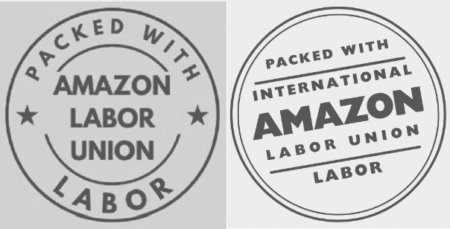
Hypothetical Union Label Stamps for ALU and IALU415Images generated by the Michigan Law Review using Canva.com.
ALU’s stamp should only be protected as a certification mark if it has a secondary meaning among Amazon customers⎯that is, a sufficient proportion of Amazon customers understand that the stamp signals the box was packed by ALU members. It may be difficult for ALU to make that showing considering its generic name. For example, customers may be inclined to think the stamp means any unionized worker packed the box. Even if ALU passes that threshold, its certification mark protection would still be weak because its stamp is a generic name, in an informational statement, with common shapes in an ordinary configuration.416See Seabrook Foods, Inc. v. Bar-Well Foods Ltd., 568 F.2d 1342, 1344 (C.C.P.A. 1977); see also Muddy Bites, Inc. v. Evergreen USA LLC, No. 24-cv-07089, 2025 WL 1079494, at *3 (S.D.N.Y. Apr. 9, 2025).
It should only be protected from other unions’ identical or virtually identical certification marks that are likely to confuse consumers. And, as for a collective mark dispute, similarity of meaning and direct competition (in that the parties are competing labor unions) ought not support a likelihood of confusion.
Actual confusion relevant in a union–union certification mark dispute would be confusion among a particular class of consumers as to the plaintiff union’s endorsement of the good or service. ALU must show some percentage of Amazon customers see IALU’s stamp and mistakenly believe an ALU member packed the box. IALU’s intent would only weigh in favor of a likelihood of confusion if it intended to mislead Amazon customers into thinking an ALU member packed the box. The unlikeliness of this showing, considering IALU’s interest in garnering public support for its organization, is precisely why a certification mark dispute between labor unions is improbable in the first instance. Consumer sophistication would be no different than in a routine likelihood of confusion analysis.417See LVL XIII Brands, Inc. v. Louis Vuitton Malletier S.A., 209 F. Supp. 3d 612, 676–77 (S.D.N.Y. 2016); see also Easy Spirit, LLC v. Skechers U.S.A., Inc., 571 F. Supp. 3d 185, 212–13 (S.D.N.Y. 2021).
Here, retail consumers of relatively inexpensive goods are considered “unsophisticated” and thus more susceptible to confusion.418See, e.g., Virgin Enters. Ltd. v. Nawab, 335 F.3d 141, 151 (2d Cir. 2003).
Ultimately, a likelihood of confusion analysis between unions should center on evidence of actual confusion among consumers. Strong evidence of actual confusion, despite the defendant union’s lack of intent to mislead, may be enough to support liability. If the defendant union had the intent to mislead, some lesser showing of actual confusion should suffice.
Unlike the employer–union disputes in Section III.A, a court is able to award the full range of remedies in a union–union trademark dispute.419See 15 U.S.C. § 1117.
Even so, it should hew to a narrow remedy that addresses the plaintiff union’s injury without unduly constraining the defendant union’s organizational and promotional activities. A mandatory injunction requiring the defendant union to distinguish its marks should suffice. In our hypothetical ALU–IALU dispute, IALU could comply with such an order by changing its name to International Amazon Workers Union, configuring its stamp as a square or rectangle, and changing the color and/or font.
C. Union–Third Party Disputes
Unions may also vindicate their rights in marks against nonunion third-party imitators. Historically, these cases have been against nonunion businesses that either use corporate names similar to existing unions420. See, e.g., United Bhd. of Carpenters and Joiners Carpenters Union No. 213 v. Carpenters and Joiners Union, 110 S.W.2d 1209, 1210 (Tex. Civ. App. 1937); Baker v. Master Printers Union, 34 F. Supp. 808, 810 (D.N.J. 1940).
or labels that imitate union labels421See, e.g., Schroeder v. Lotito, 577 F. Supp. 708, 711–12 (D.R.I. 1983); Bhd. of Painters, Local No. 443 v. United Home Indus. Union, 84 P.2d 1101, 1102 (Okla. 1938).
to mislead consumers into thinking their purchases support union labor. Today, one might imagine two distinct scenarios: one involving a nonunion licensing entity, and another involving a generative AI tool.
The Writers Guild of America (WGA) is a labor union representing over thirty thousand screenwriters nationwide;422David Robb, WGA West Members Paid Record Dues in Year Preceding Strike, Financial Report Shows, Deadline (July 18, 2023), https://deadline.com/2023/07/writers-guild-west-record-dues-paid-2023-annual-report-1235439804 [perma.cc/NTE3-UECP]; WGA East Members at Committee to Protect Journalists Ratify New Union Contract, Writers Guild of Am. E. (Apr. 11, 2025), https://wgaeast.org/wga-east-members-at-committee-to-protect-journalists-ratify-new-union-contract [perma.cc/GN2Z-58UR].
it has won major concessions from entertainment employers through long, disruptive strikes.423Cynthia Littleton, New WGA Contract Explained: AI Is Not a Writer, Solo Scribe Shows Don’t Need Minimum Staff and More, Variety (Sep. 26, 2023), https://variety.com/2023/biz/news/wga-new-contract-strike-ai-writers-room-staffs-residuals-1235736648 [perma.cc/9TSS-MEFD]; Yan Zhuang, Studios and Writers Reached a Deal. Here’s What Happens Next., N.Y. Times (Sep. 25, 2023), https://nytimes.com/2023/09/25/business/wga-writers-strike-deal-explained.html [perma.cc/YV2D-V22L]; Oli Welsh & Austen Goslin, Hollywood Writers’ Strike Is Over as Union Wins Major Concessions from Studios, Polygon (Sep. 27, 2023), https://polygon.com/23883791/writers-strike-wga-end-amptp-agreement-sag [perma.cc/L4SG-7PHJ].
Say a third party sees an opportunity: It creates Writers Guild U.S.A. (WGUSA), a company that owns and licenses the use of a single digital file:
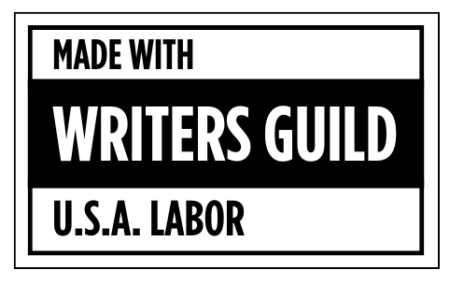
Hypothetical Union Label for WGUSA424Image generated by the Michigan Law Review using Canva.com.
For a small fee, WGUSA will provide any entertainment employer, irrespective of whether they use union labor, a digital copy of the file they can include in their screen credits. Its service is attractive to entertainment employers, who could save money by hiring nonunion labor and still gain public support due to the misapprehension that they do hire union labor.
In this scenario, WGA’s protection should be narrow, as in union–union litigation. Though its mark is generic, it should be protected if WGA can show secondary meaning among screenwriters in the United States (for its collective mark) or among the film and television consumers (for its certification mark). Infringement of its collective or certification mark likewise implicates the same harms as in union–union litigation, but aggravated. If screenwriters mistake WGUSA for WGA, they may abstain from joining any union, falsely believing WGA is a licensing entity, not a labor union. If entertainment consumers believe the WGUSA label means WGA labor was used for screenwriting, employers are disincentivized from hiring union labor and bargaining with unions. Both injuries devastate labor solidarity.
A likelihood of infringement analysis can and should be particularized to this dispute’s stakes. Much of the analysis should parallel union–union disputes: Weak union marks should only receive narrow protection against third parties’ identical or virtually identical marks, and prospective member sophistication will depend on the industry. However, a few elements carry different connotations. In a case like WGA v. WGUSA, the dissimilarity of the entities’ “services” should weigh in favor of a likelihood of harm to WGA. WGUSA’s virtually identical name and label frustrate WGA’s ability to organize and rally public support. Alternatively, evidence of actual confusion should either demonstrate that prospective members are confused about whether WGA is a labor union, or that entertainment consumers mistakenly believe WGUSA’s label means an employer hires WGA members. The nonunion third party’s intent to deceive should weigh in favor of infringement.
Let’s say, instead, a generative AI tool uses the WGA name in its marks: Writers Guild AI (WGAI). Its core function is collaborative, multiuser screenwriting with AI assistance. Users (who either already know one another or meet through the company’s website) form “guilds” and iterate screenplays with one another and with the generator. The generator also produces downloadable full-text screenplays, storyboards, and film clips, all of which are watermarked with its logo:

Hypothetical WGAI Logo425Image generated by the Michigan Law Review using Canva.com.
This alternative scenario presents roughly the same threats to labor solidarity as the first scenario. For a collective mark infringement analysis, evidence of actual confusion would again focus on what WGA is. Here, it would be confusion about whether WGA is an AI company, rather than a labor union. For a certification mark infringement analysis, evidence of actual confusion should show entertainment consumers mistakenly believe the content producer employs WGA labor. Evidence of the latter actual confusion is improbable, however, considering the logo suggests AI rather than human labor was used to make the production (and is even less likely given WGA’s very public hostility to AI426Molly Kinder, Hollywood Writers Went on Strike to Protect Their Livelihoods from Generative AI. Their Remarkable Victory Matters for All Workers, Brookings Inst. (Apr. 12, 2024), https://brookings.edu/articles/hollywood-writers-went-on-strike-to-protect-their-livelihoods-from-generative-ai-their-remarkable-victory-matters-for-all-workers [perma.cc/ZK34-NSF9].
).
The major point of distinction between the two scenarios, though, is the nonunion third party’s intent. The AI company may have intended to compete with unionized screenwriters by improving nonprofessional writers’ abilities to generate good screenplays. That is not the sort of bad intent that supports a likelihood of confusion. WGAI’s use of the WGA name may impede WGA’s labor organizing, but a higher showing of actual confusion may be due if it used the name in good faith.
In either scenario, courts may award the full range of remedies if a nonunion imitator infringes a union’s mark. Still, they should calibrate the remedy to address the character and severity of harm to the union. In the former case, where a nonunion imitator usurps the union’s identity to thwart its organization, a court may enjoin the imitator’s use of the union’s name and require the imitator to disgorge its profits.427See 15 U.S.C. §§ 1116(a), 1117(a).
By contrast, in the latter case, the nonunion uses the union’s name for its generic meaning and competes with union members’ services but lacks the intent to deceive. A narrow, mandatory injunction requiring the AI company to distinguish itself from the union should protect the union from identity or endorsement confusion, without interfering with the AI company’s lawful business.
Conclusion
Union marks are not like traditional trademarks. Union names are broadly worded, general statements that identify an employer or industry and reference unionization. Union labels and other insignia place unions’ names or acronyms in informational phrases in common shapes. None of these marks signal source. Instead, they are union instruments for fostering labor solidarity. Unions’ names signal their organizational aspirations⎯they tell workers and employers that they endeavor to organize a particular worksite or industry. Union labels call on consumers to support union labor for labor’s sake. Congress knew this when it extended trademark protection to union marks in the Lanham Act. It sought to afford unions the benefit of trademark protection, with more flexible registration requirements than standard trademarks.
Courts evaluating trademark disputes involving labor unions seem to have lost sight of this history. Their opinions provide little guidance for courts currently deciding union trademark disputes, reflected in the divergence between the Ninth Circuit’s decision in Trader Joe’s Co. v. Trader Joe’s United and the District of New Jersey’s decision in Medieval Times U.S.A. v. Medieval Times Performers United. What some courts see as associational activity beyond trademark law’s scope, other courts see as commercial conduct within its purview. And in the recent wave of litigation, some courts understand the union context undermines a likelihood of confusion, whereas others refuse to contextualize the dispute in that manner.
Returning to Congress’s intent helps make union trademark cases legible because it identifies the points of distinction between trademarks and union marks, the function of union marks, and the purpose for protecting union marks in the Lanham Act. This Article translates congressional intent and labor history into reconstructed trademark doctrines that courts can apply easily in trademark disputes that involve a labor union. Labor unions may not win all trademark cases. Rather, they and their counterparties will benefit from judicial reasoning that is normatively moored, predictable, and replicable across analogous cases.
* Assistant Professor of Law, SMU Dedman School of Law. I thank, for their exceptional research assistance, Julie Marie Papaj and Christa Reed. I am also grateful to Laura Heymann, Christopher Buccafusco, Rebecca Tushnet, Mark Lemley, Barton Beebe, Gali Racabi, Alvin Antonio Velazquez, Jessica Silbey, and Michael Goodyear for their insightful comments. I would also like to thank David Stein for his help with accessing trademark registrations and participants at the 2025 Intellectual Property Scholars Colloquium for their engagement with my presentation on the Article.
