
Pictures of a Revolution: Administrative Law in a Time of Change
2024 Supplement to State and Federal Administrative Law, Fifth Edition. By Michael Asimow and Ronald M. Levin. 2024. Pp. vi, 70.
2024 Supplement to Administrative Law and Regulatory Policy: Problems, Text, and Cases Ninth Edition. By Stephen G. Breyer, Richard B. Stewart, Cass R. Sunstein, Adrian Vermeule and Michael E. Herz. 2024. Pp. ii, 172.
2024 Teacher’s Update to Administrative Law: Cases and Materials, Ninth Edition. By Ronald Cass, Colin Diver, Jack Beermann and Jennifer Mascott. 2024. Pp. 3, 90.
2024 e- Supplement to Cases and Materials on Legislation and Regulation, Sixth Edition. By William N. Eskridge Jr., James J. Brudney and Josh Chafetz. 2024. Pp. 1, 37.
2024 Update to Cases and Materials on Statutes, Regulation & Interpretation: Legislation and Administration in the Republic of Statute, Second Edition. By William N. Eskridge Jr., Abbe R. Gluck and Victoria F. Nourse. 2024. Pp. ii, 37.
Administrative Procedure and Practice: A Contemporary Approach, Seventh Edition; 2024 Supplement. By William Funk, Sidney Shapiro and Russell Weaver. 2024. Pp. 1, 24.
Summer 2024 Cumulative Updates to Administrative Law: Agency Action in Legal Context, Third Edition. By Robert L. Glicksman, Richard E. Levy and David E. Adelman. 2024. Pp. v, 215.
Summer 2024 Update to Federal Administrative Law: Cases and Materials, Fourth Edition. By Kristin E. Hickman, Richard J. Pierce, Jr. and Christopher J. Walker. 2024. Pp. 1, 27.
2024-25 Supplement to Federal Administrative Law, Ninth Edition. By Gary Lawson. 2024. Pp. 1, 72.
Revised Chapter 5 to Legislation and Regulation: Cases and Materials, Fourth Edition. By John F. Manning and Matthew C. Stephenson. 2024. Pp. 1079, 1335.
2024 Updates for Gellhorn & Byse’s Administrative Law: Cases & Comments, Thirteenth Edition. By Todd D. Rakoff, Gillian E. Metzger, David J. Barron, Anne Joseph O’Connell and Eloise Pasachoff. 2024. Pp. iii, 159.
Summer Update – 2024: Administrative Law Theory and Fundamentals: An Integrated Approach, Second Edition. By Ilan Wurman. 2024. Pp. 1, 38.
Introduction
In a book that Quentin Tarantino once described as “probably one of the best books I’ve ever read in my life,”1Pictures at a Revolution: Five Movies and the Birth of the New Hollywood by Mark Harris, Penguin Random House, https://www.penguinrandomhouse.com/books/295452/pictures-at-a-revolution-by-mark-harris [perma.cc/28ZG-HXB2].
Mark Harris, a well-known film critic, captured something powerful.2 Mark Harris, Pictures at a Revolution: Five Movies and the Birth of the New Hollywood (2008).
Over the course of a decade, a revolution had taken place in Hollywood. Until the mid-1960s, the traditional studio system—creating westerns, war movies, and uplifting musicals like Mary Poppins—dominated the film industry. That system relied heavily on star power and strong conventions on genre and storytelling. But by the end of the decade, something had changed. The tastes of Americans had drifted. And with them, the entire Hollywood industry and its old conventions had changed as well—an era of artistic liberation, personal storytelling, and social consciousness had emerged.
In his book, Pictures at a Revolution: Five Movies and the Birth of the New Hollywood, Harris told this story of change through a particular method. Rather than focusing on a thick history of American cinema, Harris anchored his exposition in the five movies nominated for Best Picture in 1968: Bonnie and Clyde, The Graduate, Guess Who’s Coming to Dinner, In the Heat of the Night, and box-office bomb Doctor Dolittle. Though these movies appeared at first sight to be radically different from each other,3Indeed, Doctor Dolittle could not be more different from Bonnie and Clyde, while The Graduate “was seemingly designed to demolish the values on display” in Guess Who’s Coming to Dinner. Jim Shepard, When Mrs. Robinson Met Dr. Dolittle, N.Y. Times (Feb. 17, 2008), https://www.nytimes.com/2008/02/17/books/review/Shepard-t.html [perma.cc/Z6GT-ZVCA].
Harris suggested that they all indicated something singular and deep about the Hollywood industry and, indeed, the whole “psyche”4 Harris, supra note 2, at 1.
of our nation.
In this Review, we offer to do something similar to Harris’s approach in Pictures at a Revolution. Like American cinema at the end of the 1960s, the field of administrative law is going through a period of dramatic change, even a revolution. As is well known, the Roberts Court has dramatically departed from the previous administrative law “equilibrium.”5See Adrian Vermeule, Portrait of an Equilibrium, New Rambler Rev. (Mar. 4, 2015) (reviewing Daniel R. Ernst, Tocqueville’s Nightmare: The Administrative State Emerges in America, 1900–1940 (2014)), https://newramblerreview.com/images/files/Vermeul-Review-of-Ernst.pdf [perma.cc/SCJ2-TPN5].
The field’s formerly established rules and staple frameworks are increasingly and rapidly being overruled, and more such rules seem vulnerable in the near future.6See infra notes 15–24 and accompanying text.
And, like Harris, we propose to try to make sense of this change, and the current “psyche” of the field of administrative law, by looking closely at representative “pictures” of the field’s transformation. In Harris’s book, the pictures under scrutiny were of course real ones (or at least moving ones). In our case, the “pictures” are metaphorical: we zero in on the 2024 summer supplements of leading administrative law casebooks issued at the end of the 2023 Supreme Court Term.
We recognize of course that legal casebooks and their supplements might not seem like the most exciting materials for a book review. This is so in general but perhaps especially so when they are compared to Hollywood classics like Bonnie and Clyde or The Graduate (Doctor Dolittle, we confess, may be another matter). But despite their apparent dryness, we believe that thinking systematically about casebooks and their supplements is a useful—indeed important—enterprise. After all, legal casebooks are written by some of the field’s leading voices, and they aim to give a complete (if always imperfect and sometimes contentious) survey of the content and dynamics of a particular legal field. Looking closely at casebooks can thus provide an indispensable “window through which we can see the contemporary landscape of legal thought”7Janet Ainsworth, Law in (Case)books, Law (School) in Action; The Case for Casebook Reviews, 20 Seattle U. L. Rev. 271, 274 (1997).
about a particular field, both in general and especially at times when a field is going through a period of dramatic change—let alone a revolution. Further, notwithstanding the occasional critique,8See, e.g., K.N. Llewellyn, On the Problem of Teaching “Private” Law, 54 Harv. L. Rev. 775 (1941); Eric E. Johnson, A Populist Manifesto for Learning the Law, 60 J. Legal Educ. 41 (2010); W. David Ball & Michelle Oberman, The Case Against Commercial Casebooks, 71 J. Legal Educ. 452 (2022).
casebooks are still the primary method used to teach law in American law schools.9E.g., Matthew Bodie, The Future of the Casebook: An Argument for an Open-Source Approach, 57 J. Legal Educ. 10, 10 (2007).
As a result, the (often subtle) choices casebooks and supplements make—their so-called “battles” of “classification and organization”10Lawrence A. Alexander, The Province of Constitutional Law Casebook Jurisprudence Redetermined, 29 Stan. L. Rev. 1299, 1301 (1977) (reviewing Paul Brest, The Processes of Constitutional Decisionmaking (1975)).
—undoubtedly matter, as they help orient and “socialize” generations of soon-to-be lawyers to the field.11Frederick Schauer, 31 J. Legal Educ. 680, 680 (1981) (reviewing Gerald Gunther, Cases and Materials on Constitutional Law (1980)); Anthea Roberts, Is International Law International? 129 (2017).
How then do the 2024 supplements to administrative law casebooks conceive of the field in this time of apparent revolution? What do the different choices they make tell us about the general state of administrative law? Do the supplements and casebooks, as they currently stand, adequately prepare us for the future of administrative law in light of the Roberts Court Revolution? Or is there something missing? These are the kinds of questions that animate our Review.
Part I begins by describing the supplements’ various approaches to some of the central changes in administrative law, which are part of the so-called Roberts Court Revolution (or, as we will sometime refer to it, the RCR). Following the metaphor drawn from Harris, we call this Part “Snapshots of a Revolution.” In Part II, we ask what these choices indicate about the broader field of administrative law and its evolution over time (following again Harris’s metaphor, we call this “The Bigger Picture”). Finally, in Part III, we provide our own tentative evaluation of the emerging landscape —both with respect to the “snapshots” of the Roberts Court Revolution and the “bigger picture” of the general state of the field. We also suggest how administrative law casebooks and supplements (and scholarship, too) might be reshaped in the future to develop a better picture.
Our basic claim can be summarized as follows: As reflected in its leading casebook supplements, the field of administrative law is presently caught in an overly polarized (and, we think, unhealthy) reaction to the Roberts Court Revolution and what preceded it. That reaction is either being for the Roberts Court Revolution and against what preceded it or, conversely, against the Roberts Court Revolution and for what preceded it. Because of this dynamic, our view is that the present casebooks and supplements do not yet do a sufficiently good job of enabling administrative lawyers to imagine—not to mention build—a different future beyond this binary of for and against, and which may be better overall. A change in direction, or something new, is therefore needed. Below we suggest some paths that future administrative law casebooks, supplements, and scholarship might take to achieve the needed change.
Before we proceed, a few caveats and an expositional note are in order. First, we focus in this Review on the 2024 supplements of the administrative law and legislation-and-regulation casebooks that were available at the time of writing. This unfortunately means that the perspectives of some leading casebooks in the field are absent from the present account.12Two examples include Jerry L. Mashaw, Richard A. Merrill, Peter M. Shane, M. Elizabeth Magill, Mariano-Florentino CuÉllar & Nicholas R. Parrillo, Administrative Law: The American Public Law System; Cases and Materials (8th ed. 2019) and Lisa Schultz Bressman, Edward L. Rubin & Kevin M. Stack, The Regulatory State (4th ed. 2024), which did not issue supplements in time for us to review them. There are also important casebook supplements that focus on the topic of statutory interpretation, which we were unable to include. See, e.g., Caleb Nelson, Update Memo for Statutory Interpretation (2d ed. 2024).
Second, even though our goal in this Review is to draw on the supplements to say something meaningful about the state of the field of administrative law, we also acknowledge that some of the variances between supplements may have nothing to do with a particular substantive or jurisprudential conception of administrative law. For example, some of the variations that we highlight are likely the result of obvious time pressures. After all, the Supreme Court’s Term wrapped up in July 2024 and many of the supplements were produced within weeks of that timeline. Furthermore, most of the supplements under review have multiple authors, leading to multiple perspectives. This, too, requires extra caution before reading too much into how specific casebook materials are presented. Finally, the differences we will highlight below may reflect entirely legitimate choices that casebook authors must make about how to edit materials, including whether to land on a more “restrained” editing strategy or a “bold” one.13H.A.J. Ford, The Evolution of the American Casebook, 7 Res Judicatae 256, 265 (1955–1957).
Given these other possible explanations for the differences we will highlight, our argument in this Review is openly interpretive and impressionistic: our focus is on the effect of the various decisions in the casebook supplements. We ask: What story do the various administrative law supplements and casebooks present to the reader? We bracket the more complicated question of whether our impressions reflect the casebook authors’ individual views on the ongoing Roberts Court Revolution (and we suspect that, certainly in some instances, they do not). In other words, our primary interest in this Review is in the pictures being presented (about the Roberts Court Revolution and the field more broadly), not the artists themselves (the casebook authors).
Finally, a note on exposition: While limited in the various ways we have described above, this Review nonetheless includes numerous (twelve!) supplements. And as alluded to above, many of these supplements were written by multiple authors. This creates an obvious expositional challenge. To help avoid presentational messiness, and with apologies to many of the distinguished authors, below we will refer to the supplements by how we think they are usually referred to in the field—namely, by the first two names on the book in the case of more than three authors.14We regret that this method omits some casebook authors’ names, but we could not find a way to include everyone’s name without making the text overly cumbersome.
For ease of reference, we have included a table of the short-hands we use for each supplement below:
Supplement | Reference |
Todd D. Rakoff, Gillian E. Metzger, David J. Barron, Anne Joseph O’Connell & Eloise Pasachoff, 2024 Update for Gellhorn & Byse’s Administrative Law: Cases & Comments (13th ed.) | Gellhorn-Byse Supplement |
Stephen G. Breyer, Richard B. Stewart, Cass R. Sunstein, Adrian Vermeule & Michael E. Herz, 2024 Supplement to Administrative Law and Regulatory Policy: Problems, Text, and Cases (9th ed.) | Breyer-Stewart Supplement |
Kristin E. Hickman, Richard J. Pierce, Jr. & Christopher J. Walker, Summer 2024 Update to Federal Administrative Law: Cases and Materials (4th ed.) | Hickman-Pierce-Walker Supplement |
Ronald Cass, Colin Diver, Jack Beermann & Jennifer Mascott, 2024 Teacher’s Update to Administrative Law: Cases and Materials (9th ed.) | Cass-Diver |
Michael Asimow & Ronald L. Levin, 2024 Supplement to State and Federal Administrative Law (5th ed.) | Asimow-Levin Supplement |
Robert L. Glicksman, Richard E. Levy & David E. Adelman, Summer 2024 Cumulative Updates to Administrative Law: Agency Action in Legal Context (3rd ed.) | Glicksman-Levy-Adelman Supplement |
Gary Lawson, 2024-25 Supplement to Federal Administrative Law (9th ed.) | Lawson Supplement |
William Funk, Sidney Shapiro & Russell Weaver, Administrative Procedure and Practice: A Contemporary Approach (7th ed.) | Funk-Shapiro-Weaver Supplement |
Ilan Wurman, Summer Update—2024: Administrative Law Theory and Fundamentals—An Integrated Approach (2nd ed.) | Wurman Supplement |
John F. Manning & Matthew C. Stephenson, Revised Chapter 5 to Legislation and Regulation: Cases and Materials (4th ed.) | Manning-Stephenson Supplement |
William N. Eskridge, Jr., James J. Brudney & Josh Chafetz, 2024 e-Supplement to Cases and Materials on Legislation and Regulation (6th ed.) | Eskridge-Brudney-Chafetz Supplement |
William N. Eskridge, Jr., Abbe R. Gluck & Victoria F. Nourse, 2024 Update to Cases and Materials on Statutes, Regulation & Interpretation: Legislation and Administration in the Republic of Statutes (2nd ed.) | Eskridge-Gluck-Nourse Supplement |
Snapshots of the Revolution
Change is afoot in administrative law. The Roberts Court has ushered in numerous doctrinal innovations that substantially change the operation of the field. In West Virginia v. EPA, the Court announced a “major questions doctrine” (MQD) that has enormous potential to halt and deter ambitious and, in the views of many, badly needed administrative action.15West Virginia v. EPA, 142 S. Ct. 2587, 2609–10 (2022).
In Lucia v. SEC, Seila Law v. CFPB, Collins v. Yellen, and United States v. Arthrex, the Court increasingly limited Congress’s ability to insulate agency heads and other officials from presidential control.16Lucia v. SEC, 138 S. Ct. 2044, 2051 (2018); Seila Law LLC v. CFPB 140 S. Ct. 2183, 2192 (2020); Collins v. Yellen, 141 S. Ct. 1761, 1783–84 (2021); United States v. Arthrex, Inc., 141 S. Ct. 1970, 1988 (2021).
In SEC v. Jarkesy, the Court shrank the scope of administrative adjudication.17SEC v. Jarkesy, 144 S. Ct. 2117, 2139 (2024).
In Loper Bright, the Court overruled Chevron—eliminating the deference regime governing agency statutory interpretation for the last forty years.18Chevron U.S.A. Inc. v. Nat. Res. Def. Council, Inc., 467 U.S. 837 (1984), overruled by Loper Bright Enters. v. Raimondo, 144 S. Ct. 2244, 2273 (2024).
And in Corner Post and Ohio v. EPA, respectively, the Court signaled agencies’ heightened vulnerability to judicial review, first by extending the statute of limitations to challenge agency action, and, second, by signaling a uniquely strong form of judicial scrutiny of agencies’ policy decisions.19Corner Post, Inc. v. Bd. of Governors of the Fed. Rsrv. Sys., 144 S. Ct. 2440, 2450, 2453, 2459 (2024); Ohio v. EPA, 144 S. Ct. 2040, 2053, 2055, 2057 (2024).
These cases represent an unquestionably dramatic shift—especially considering that some of the most important doctrinal changes (Jarkesy, Loper Bright, Corner Post, and Ohio v. EPA) occurred in the last Supreme Court Term. One might even say that the 2023 Term was the most consequential administrative law Term since the New Deal.
In this Part, we examine how the recent casebook supplements under review describe key aspects of these rapid and dramatic changes. We focus on three issues: first, we discuss the general approach the supplements take to describing the nature, magnitude, and overall direction of the change the Roberts Court is effecting in administrative law. We then lay out the story the various supplements tell of the demise of Chevron deference in the Court’s decision in Loper Bright, as well as the way these supplements understand the future of the Loper Bright regime itself. Finally, we focus on how the supplements treat the MQD.
A. General Approach: Trees v. Forest
What is the general approach taken by supplements to capture changes in administrative law? Sifting through the supplements, one divergence becomes quickly apparent. Some supplements focus on individual doctrinal trees, so to speak, whereas others situate these trees in a much more comprehensive forest.
Many of the administrative law supplements that came out this year, including Hickman-Pierce-Walker,20See Kristin E. Hickman, Richard J. Pierce, Jr. & Christopher J. Walker, Summer 2024 Update Federal Administrative Law Cases and Materials (Fourth Edition) 1 (2024) [hereinafter Hickman-Pierce-Walker].
Funk-Shapiro-Weaver,21See William Funk, Sidney Shapiro & Russell Weaver, Administrative Procedure and Practice: A Contemporary Approach 7th Edition 2024 Supplement 1 (2024) [hereinafter Funk-Shapiro-Weaver].
Asimow-Levin,22See Michael Asimow & Ronald M. Levin, 2024 Supplement to Asimow & Levin’s State and Federal Administrative Law Fifth Edition 1 (2024) [hereinafter Asimow-Levin] (discussing how the supplement includes materials on “significant administrative law ‘developments’ ” that have occurred since the casebook was issued).
Cass-Diver,23See Ronald Cass, Colin Diver, Jack Beermann & Jennifer Mascott, 2024 Teacher’s Update to Cass, Diver, Beerman and Mascott, Administrative Law: Cases and Materials (Aspen Publishing, 9th ed. 2024) 2 (2024) [hereinafter Cass-Diver] at 2 (noting how the supplement “covers major developments in [a]dministrative [l]aw since the completion of the manuscript” for the printed casebook).
and the Lawson24See Gary Lawson, 2024-25 Supplement to Federal Administrative Law (9th Edition 2022) 1 (2024) [hereinafter Lawson].
supplements, are organized in the more “traditional” casebook method.25Schauer, supra note 11, at 680 (identifying “traditional” casebooks as being organized through relevant “preexisting categories of . . . analysis most commonly employed by courts in deciding cases”); cf. Henry P. Monaghan, Book Review, 90 Harv. L. Rev. 1362 (1977) (reaffirming the “traditional” casebook model by discussing the challenging reception of one non-“traditional” casebook).
Even though they often acknowledge that administrative law is experiencing a notable change, especially as a result of the Court’s 2023 Term, these supplements do not view the moment as calling for a distinctive or extraordinary approach to processing the core administrative law materials. Taking the more conventional route, these supplements focus primarily on (1) selecting the most relevant and important legal materials that impact the shape of legal doctrine in a particular field, (2) editing or summarizing them, (3) placing them in their most analytically appropriate doctrinal setting, and (4) adding supplementary notes that provide context and commentary about the materials. Largely absent in these supplements is an overarching narrative of change in the field.
To be sure, even across this group there are interesting variances in exactly how they execute their “traditional” role. We will get to some of those further below.26For example, the supplements reflect different case editing philosophies, including whether they opt for a “restrained” strategy or a “bold” one. See Ford, supra note 13, at 265. They also make different choices regarding the extensiveness of the notes that accompany the cases, and, of course, about how precisely to organize the materials. See infra Section I.B–.C.
Still, for present purposes, the overall impression from these supplements is clear. For these supplements, the changes in administrative law ushered in by the Roberts Court, as such, do not seem to call for a unique synthetic approach to organizing the field. At least in the context of the supplements themselves (as opposed to regular administrative law scholarship found outside these pages),27Such scholarship includes work by some of the authors of these casebooks. See, e.g., Jack M. Beermann, The Anti-Innovation Supreme Court: Major Questions, Delegation, Chevron, and More, 65 Wm. & Mary L. Rev. 1265 (2024) (discussing the cumulative effects of the Roberts Court’s administrative law cases); Christopher J. Walker, Congress and the Shifting Sands in Administrative Law, 34 Widener Commonwealth L. Rev. 186 (2024); Kristin E. Hickman & Amy J. Wildermuth, Delegation and Deference in a Post-Loper Bright World, 100 N.Y.U. L. Rev. (forthcoming 2025) (manuscript at 2) (on file with the Michigan Law Review).
these supplements adopt a more “business as usual” framing to the study of administrative law. As the Hickman-Pierce-Walker supplement for instance puts it, “[a]dministrative law is a dynamic field, and there are always interesting new cases being decided and new debates unfolding.”28 Hickman-Pierce-Walker at 1.
The implication, in other words, seems to be that there is nothing much new or extraordinary going on.
Not all the supplements present such a business-as-usual approach. Others present a different perspective on the field. Instead of primarily describing the trees, these supplements depict the larger forest too. In these supplements’ telling, the best way to understand recent changes in administrative law is to take a cumulative view that connects the dots between the various cases and emphasizes their overall impact and general direction.29For a view suggesting that this sort of “forest” perspective distinguishes casebooks from treatises and textbooks, at least in the constitutional law field, see Mark Tushnet, Treatise Writing During Constitutional Moments, 22 Const. Comment. 251 (2005).
Among this group of supplements, two distinct forests emerge. The largest subgroup identifies an “anti-administrativist” forest through reference to three key ideas: First, that the Court’s overall new direction is antiregulatory. Second, that this antiregulatory approach is effected through a nominally formalist jurisprudence. Third, that the Court’s recent changes transfer power from the political branches to the courts.30Several justices on the Court have also suggested that the field of administrative law calls for this forest-like perspective. See, e.g., Loper Bright Enters. v. Raimondo, 144 S. Ct. 2244, 2311 (2024) (Kagan, J., dissenting) (“[I]t is impossible to pretend that today’s decision is a one-off, in either its treatment of agencies or its treatment of precedent.”); Corner Post, Inc. v. Bd. of Governors of the Fed. Rsrv. Sys., 144 S. Ct. 2440, 2482 (2024) (Jackson, J., dissenting) (stating it is impossible to understand case without considering “other significant changes that this Court has wrought this Term with respect to the longstanding rules governing review of agency actions.”); SEC v. Jarkesy, 144 S. Ct. 2117, 2174 (2024) (Sotomayor, J., dissenting) (noting this “disconcerting trend”).
The Breyer-Stewart supplement, for example, explicitly endorses this approach.31 Stephen G. Breyer, Richard B. Stewart, Cass R. Sunstein, Adrian Vermeule & Michael E. Herz, 2024 Supplement to Administrative Law and Regulatory Policy: Problems, Text, and Cases Ninth Edition (2024) [hereinafter Breyer-Stewart].
On its very first page it states that, while many casebooks tend to “examine[] a series of trees,” there are times when this method makes it too “easy to lose sight of the forest.”32Id. at 1.
It notes that while “[i]ndividually, most of the Supreme Court’s administrative-law decisions from the last two Terms are not monumental[,] . . . collectively, they are striking. . . . [T]he anti-administrative, pro-court forest is extraordinary.”33Id.
The Glicksman-Levy-Adelman supplement embraces a similar narrative.34 Robert L. Glicksman, Richard E. Levy & David E. Adelman, Administrative Law: Agency Action in Legal Context 3d Edition Foundation Press 2020 (2024) [hereinafter Glicksman-Levy-Adelman].
It starts, again right on its first page, by remarking that “[t]aken as a whole, the Court’s recent decisions have fundamentally altered the fabric of administrative law.”35Id. at 1.
It then continues on to a large section discussing what it refers to as the “new era of administrative law.”36Id.
Although careful to acknowledge that the “precise contours” of this “new administrative law remain to be seen,” Glicksman-Levy-Adelman nonetheless argues that the Court’s most recent decisions share the three key features noted above: anti-administrativism, an ostensible commitment to formalism, and a propensity for judicial power.37Id. at 2.
Gellhorn-Byse reflects this approach as well.38 Todd D. Rakoff, Gillian E. Metzger, David J. Barron, Anne Joseph O’Connell & Eloise Pasachoff, 2024 Update for Gellhorn & Byse’s Administrative Law: Cases & Comments 13th Edition (2024) [hereinafter Gellhorn-Byse].
It too begins, on the very first page, by suggesting the Court’s 2023 Term signals “[the] resurgence of the antiregulatory and antigovernment forces that lost the battle of the New Deal.”39Preface to Gellhorn-Byse (quoting Gillian E. Metzger, Foreword: 1930s Redux; The Administrative State Under Siege, 131 Harv. L. Rev. 1, 2 (2017)).
In fact, more than any other supplement we have reviewed, Gellhorn-Byse consistently works hard throughout its many pages to show the synergetic connections between the Court’s recent judgments, as well as the potential future changes in administrative law that they might portend.40For example, Gellhorn-Byse highlights how Loper Bright’s embrace of a strong textualist approach to the APA might affect other doctrines that rely on looser interpretations of the APA. Gellhorn-Byse at 21–23. It also discusses the combined effects recent cases have on agency “choice of policymaking form,” suggesting the combination of Loper Bright and Corner Post makes using rulemaking less attractive, while Jarkesy makes using administrative adjudications less attractive. Id. at 23–26.
Other supplements echo similar positions regarding the administrative law forest. For example, Eskridge-Gluck-Nourse states that the most recent Term ought to be read “in light of other post-2017 Roberts Court decisions,”41 William N. Eskridge Jr., Abbe R. Gluck & Victoria F. Nourse, 2024 Update to Cases and Materials on Statutes, Regulation & Interpretation: Legislation and Administration in the Republic of Statutes Second Edition 37 (2024) [hereinafter Eskridge-Gluck-Nourse].
concluding that “the Court is following a deregulatory playbook, namely, one that seeks to trim back the centralizing role of federal agencies,”42Id.
adopting a “Hayekian view” of “strong opposition to administrative discretion; preference of court-driven rules over those established by legislators or administrators; and strict separation of powers and other structures that protect economic (market) and other liberties against intrusive regulations.”43Id. at 34.
For its part, Eskridge-Brudney-Chafetz likewise emphasizes the cases’ aggregative impact. For example, it includes a note titled “Dismantling the Administrative State” that points out how the recent cases, taken together, shrink agencies’ ability to operate.44 William N. Eskridge Jr., James J. Brudney & Josh Chafetz, 2024 e- Supplement to Cases and Materials on Legislation and Regulation, Sixth Edition 22 (2024) [hereinafter Eskridge-Brudney-Chafetz].
As we previously noted, however, not all the supplements suggest a similar view of the forest. Wurman offers a different synthetic story, one that is both narrower and overall more sympathetic to the Roberts Court’s doctrinal innovations.45 Ilan Wurman, Administrative Law Theory and Fundamentals: An Integrated Approach (Foundation Press) Summer Update – 2024 (2024) [hereinafter Wurman].
On its telling, the Roberts Court Revolution is not a story of antiregulatory doctrine or judicial aggrandizement. Rather, it is a story of the triumph of jurisprudential formalism. This is apparent on its very first page, which declares that “[t]he past three years have justified the casebook’s emphasis on a modest formalism focusing on ‘exclusive’ and ‘nonexclusive’ powers and functions”46Id. at 1.
—a perspective that the supplement systematically pursues throughout.
The Wurman supplement is, of course, not oblivious to the potential implications of the Roberts Court’s changes for the scope and effectiveness of the administrative state. However, as the supplement’s parent casebook insists, this sort of “formalist approach to administrative law . . . largely, although not entirely, defends the constitutionality of the modern administrative state.”47 Ilan Wurman, Administrative Law Theory and Fundamentals, v (2d ed. 2024).
B. Narrating the End of Chevron Deference
Whether to adopt a tree- or forest-view of the overall changes in administrative law (and what kind of forest to describe) is not the only difference across the supplements. In this section, we turn to the supplements’ treatment of probably the most controversial change ushered in by the Roberts Court thus far: the overturning of the Chevron deference regime announced in Loper Bright.48Loper Bright Enters. v. Raimondo, 144 S. Ct. 2244, 2273 (2024) (overruling Chevron U.S.A. Inc. v. Nat. Res. Def. Council, 467 U.S. 837 (1984)).
Here too we see meaningful differences. In a nutshell, there is a strong divide between supplements that provide a friendly, or at least hospitable, account of Chevron’s demise (on the one hand), and those that provide a more skeptical, even hostile, reception to this development (on the other).We expand on this below and then turn to variations among the supplements about what the post-Loper Bright future might entail.
1. Receptive to Chevron’s Demise
The supplements adopt a range of narrative choices regarding Loper Bright’s overruling of Chevron. The Wurman supplement provides the story most favorable to the Loper Bright decision. At nearly every turn, its presentation effects a story of the Chevron framework as a fundamentally flawed regime, with Loper Bright providing an essentially ideal correction.
This story begins with the supplement’s account of the Chevron decision itself. After excerpting Chevron, the supplement immediately questions whether Chevron can be “square[d] . . . with the text of the APA, which [in section 706] provides that courts ‘shall decide all relevant questions of law.’ ”49 Wurman, supra note 47, at 16 (quoting Administrative Procedure Act § 10(e), 5 U.S.C. § 706); id. at 19 (“[D]idn’t Congress say the opposite in the APA?”); see also id. at 16 (questioning whether Chevron’s claim of consistency with past precedents was accurate).
The supplement suggests that Chevron was justified, not by the APA, but by something outside of law entirely, premised on a particular view of legal realism that the supplement questions.50See id. at 18 (“Is it impossible to separate interpretation from policymaking? Are all statutes so ambiguous or vague that one’s choice of interpretation is inherently a legislative-type choice?”); see also id. at 45; but see id. at 18 (“If what’s going on is really some kind of policymaking, then indeed it’s hard to see why courts would be uniquely suited to the task.”).
The Wurman supplement then includes a prolonged discussion of ostensible problems with the Chevron regime. For example, after discussing cases decided under the Chevron regime, the supplement asks, “Wouldn’t it be better to abandon Chevron deference in the[se] examples?”51Id. at 44–45.
The supplement further suggests that “[t]he reader will begin to appreciate the frustration many had with [the Chevron] framework. Sometimes the courts threw up their hands even though there was more interpretation to do. Other times a court claimed a statute was ‘clear’ at the first, interpretive step, when it was anything but.”52Id. at 50.
Similarly, in a case study on Net Neutrality under the Chevron regime, the supplement asks, “What do you make of these constant changes in policy? Wouldn’t it be better if the Supreme Court simply adopted what it thought was the ‘best’ interpretation of the statute?”53Id. at 166.
The effect of these choices is to paint the Chevron regime as fundamentally flawed and unworkable. Loper Bright is then presented as a well-calibrated response. For example, the supplement asks whether “Loper Bright [is] a solution to” the difficulty of identifying ambiguity under Chevron.54Id. at 43.
And in response to the examples of pervasive ambiguities in modern statutes that Justice Kagan’s Loper Bright dissent proffers, the supplement suggests that such examples can be accommodated by the new Loper Bright framework as involving “gaps” that can be filled by agencies, rather than “ambiguities” that legal interpretation requires judges to conduct.55See id. at 44.
On this telling, Loper Bright appears to avoid the pitfalls of the overly deferential approach required by Chevron, while still allowing for agencies to retain primacy in areas where such primacy is most justified.56See, e.g., id. at 44 (“Justice Kagan’s examples are, in your author’s opinion, largely cases in which genuine policymaking discretion was delegated. But there are many other cases in which courts have applied Chevron deference to obviously interpretive questions to support an agency’s interpretation of the statute far from the most natural or best reading of the statute.”); see also id. at 42 (“Justice Kagan’s dissenting opinion in Loper Bright suggests that Step One was ‘rigorous.’ Perhaps it should have been; but was that the case?”).
The basic story presents Chevron as a failure, and Loper Bright a triumph.
Although Wurman is the most categorically favorable to Loper Bright of the supplements under review here, other supplements also paint a hospitable story, albeit a more subtle and qualified one.
For example, several features of Hickman-Pierce-Walker render an overall accommodating picture of Loper Bright. First, the supplement provides a rather spare evolutionary story of the Chevron regime prior to Loper Bright—cutting discussions of Steps Zero, One, and Two.57See Hickman-Pierce-Walker at 11–12.
The supplement does, however, retain discussion of Brand X58Nat’l Cable & Telecomms. Ass’n v. Brand X Internet Servs., 545 U.S. 967 (2005).
because, in the supplement’s telling, its holding “was a critical driver of the push by several justices to overturn Chevron.”59See Hickman-Pierce-Walker at 12.
The inclusion of what the supplement portrays as a problematic precedent, combined with the limited rendition of doctrine, effectively suggests that the Chevron regime was flawed, but also brittle.
Furthering this hospitable picture, Hickman-Pierce-Walker also omits Justice Kagan’s Loper Bright dissent,60Id. at 21. The book also provides one-sentence summaries of Justices Thomas’s and Gorsuch’s concurrences. See id.
which the supplement suggests “echoes the themes and arguments from Justice Kagan’s opinion in Kisor v. Wilkie.”61Id. (citing Kisor v. Wilkie, 139 S. Ct. 2400 (2019)).
Whatever the proper comparison between the two opinions, the effect of omitting Justice Kagan’s dissent is to leave out any explicit pushback on the Loper Bright majority’s decision to overrule Chevron (on either the merits or stare decisis grounds), as well as a clear sense of how central Chevron was to the prior regime.
We believe Cass-Diver is similar in effect to Hickman-Pierce-Walker. It also provides a relatively spare evolutionary story of the Chevron regime, while including what were seen as problematic decisions in the Chevron regime, like Brand X and Mead.62United States v. Mead Corp., 533 U.S. 218 (2001); see Cass-Diver at 19–23 (discussing “[f]our of [Scalia’s] many points criticizing the decision in Mead”); see also Loper Bright Enters. v. Raimondo, 144 S. Ct. 2244, 2265, 2268–69 (2024) (criticizing Brand X and Mead).
Moreover, the supplement also presents the Chevron decision as inconsistent with section 706 of the APA,63See Cass-Diver at 11 (suggesting section 706 eliminated “the deferential judicial review of agency legal determinations outlined in [NLRB v. Hearst Publ’ns, Inc., 322 U.S. 111 (1944),] and [Skidmore v. Swift & Co., 323 U.S. 132 (1944)]”); id. (stating section 706 “appears to assign resolution of legal issues arising on judicial review to the reviewing court,” but noting “as we shall see in what follows [in Chevron], the law did not turn out to be so simple”).
precisely as the Loper Bright majority held.
To be clear, neither the Hickman-Pierce-Walker nor the Cass-Diver supplements appear particularly hostile to the practical or normative justification for the Chevron regime. Such questions, however, appear to be downplayed in favor of more internal, legal questions of what the law ostensibly requires.
Lawson, meanwhile, is very accommodating of Loper Bright’s decision to overturn Chevron, while at the same time appearing somewhat skeptical of Loper Bright itself. The supplement emphasizes the uncertainties and complexities of the Chevron regime,64See Lawson at 30–35 (discussing whether deference is appropriate only if “administering” statutory provision, as well as Step Zero, One, and Two complications).
lending support to the Court’s decision to abandon it in Loper Bright. But the supplement also raises numerous questions about Loper Bright’s reasoning and likely effects.65See id. at 54–55 (raising questions about the bindingness of Loper Bright on lower courts: “[A]ssume for the moment that the majority [in Loper Bright] rather than the dissent is correct about the meaning of section 706 [of the APA]. Does that actually bind the courts? Can Congress tell courts how to decide cases?” and “Does the Supreme Court actually have the power to tell lower courts what methodology to use to decide cases?”); id. at 55–56 (raising questions about whether Loper Bright will actually succeed in significantly reducing deference, for example because “[t]he Court did not say that courts may never defer to federal agency interpretations of statutes” and because, given the reality of deference to policy determinations by agencies, which is still the law post-Loper Bright, agencies will have an incentive to “argue that they are making policy rather than interpreting statutes.”).
The tenor of the treatment is that Chevron’s demise was justified, even if it is unclear whether Loper Bright will fare any better.
These accounts—in the Wurman, Hickman-Pierce-Walker, Cass-Diver, and Lawson supplements—all strike us as receptive to Chevron’s demise, albeit to varying degrees. One striking feature they all share is an essentially exclusive focus on legal doctrine. They do not focus on how, if at all, external political developments contributed to the Roberts Court’s decision to overrule Chevron.66Indeed, the only time the Lawson supplement explicitly discusses the politics of the justices is in discussing post-New Deal justices, who “were selected specifically to grease the wheels of the emerging administrative state.” Id. at 28.
This choice seems to contribute to their accommodating posture, as it paints the end of Chevron as fundamentally doctrinal—rather than (also) political. As we will soon see, this political story is strongly emphasized in other supplements.
2. Resisting Chevron’s Demise
While the supplements discussed above tell an essentially receptive story, many of the supplements provide a more skeptical or resistant account of Chevron’s demise. Among other things, and in stark contrast to the supplements discussed above, these accounts tend to provide much thicker descriptions of the Chevron regime’s doctrinal evolution—which emphasize both its complexity and doctrinal richness—combined with a discussion of the external political factors that contributed to Chevron’s demise.
For example, Breyer-Stewart discusses Chevron and its regime at some length, including the evolution of “Chevron in [o]peration” and various issues arising under Steps Zero, One, and Two.67 Breyer-Stewart at 68–71 (emphasis omitted). The supplement also discusses three cases under Chevron where the Court rejected an agency’s statutory interpretation. Id. at 71–98 (discussing FDA v. Brown & Williamson Tobacco Corp., 529 U.S. 120 (2000), Massachusetts v. EPA, 549 U.S. 497 (2007), and Michigan v. EPA, 576 U.S. 743 (2015)).
This relatively extensive discussion provides a sense of the robust doctrinal web that constituted the Chevron regime, which Loper Bright ended. As suggested above, that thickness is largely absent from the supplements more sympathetic to Loper Bright.
While Breyer-Stewart certainly does not shy away from Chevron’s complexities, it also gives the impression that Chevron was fundamentally correct in its view that law eventually runs out in statutory delegations to agencies.68E.g., id. at 122 (“Might the Chevron [realist] perspective be descriptively accurate but normatively intolerable?”).
The supplement characterizes the rejection of this view in Loper Bright as “strikingly anti-legal realist,”69Id. at 121.
and thus seemingly naive.70See id. at 121–22 (“On [the Loper Bright] account, the existence of a ‘gap,’ or a judge reaching a point where the statute just ‘gives out,’ are impossible by definition; these things just don’t happen.”).
The Chevron regime’s complexities, meanwhile, appear understandable and even inevitable, and thus will likely be reconstituted—albeit using different names—under a Loper Bright regime.71See infra notes 98–103 and accompanying text (discussing supplement’s prediction of post-Loper Bright future as re-instantiation of Chevron on retail level).
More doctrinally, Breyer-Stewart also suggests that Chevron might well be consistent with the text of the APA.72See, e.g., Breyer-Stewart at 121.
What then explains Chevron’s demise? The Breyer-Stewart supplement suggests the reason was political, not doctrinal: “As the alignment of justices in Loper Bright suggests, by the time of that decision the Chevron debate had taken on a decidedly ideological tinge. Opponents were overwhelmingly Republicans; supporters overwhelmingly Democrats.”73Id. at 122.
Gellhorn-Byse also elicits skepticism of Loper Bright’s doctrinal basis and suggests a primarily political explanation for Chevron’s demise. The supplement’s choice to jump into Loper Bright before excerpting Chevron or the cases that constituted its regime bolsters this political explanation.74 Gellhorn-Byse at 109–10. Glicksman-Levy-Adelman takes a similar approach by beginning with Loper Bright, rather than an extended evolution of the Chevron regime. Glicksman-Levy-Adelman at 53.
This arrangement evokes a dramatic break with the past, which, coupled with the supplement’s discussion of the Roberts court’s “anti-administrativis[t]” project,75See supra note 39 and accompanying text. This is bolstered by the supplement’s inclusion in the notes of a suggestion that the majority’s decision is rooted in the conservative justices’ embrace of “a new theory to undermine the institutions most likely to imperil their free market preferences.” Gellhorn-Byse at 127.
suggests that doctrinal disagreement alone cannot explain Chevron’s demise.
In fact, Gellhorn-Byse questions whether Loper Bright succeeded in establishing a legal framework at all.76 Gellhorn-Byse at 126 (“[I]s there [a governing framework now] or did the Court in [Loper Bright] . . . ‘express a mood’ more than establish a doctrine?”).
It skeptically discusses whether section 706 or its surrounding historical context really requires de novo review,77See id. at 127 (noting other provisions of section 706 specify deference and lack of deference); see also id. at 128 (noting Loper Bright leaves in place Gray v. Powell, 314 U.S. 402 (1941), and NLRB v. Hearst Publ’ns, Inc., 322 U.S. 111 (1944), which permitted deference to mixed questions of fact and law).
and it provides an analysis of Loper Bright’s relationship to textualism, suggesting the decision might actually be better characterized as purposivist.78Id. at 127–28.
Meanwhile, in response to the majority’s claim that Chevron was unworkable, the supplement acknowledges that Chevron like “any doctrine of deference [is] bound to have its share of complexities,” but suggests that such “meta-doctrine” in this space might be “unavoidable.”79Id. at 132.
That said, the supplement never shies away from Chevron’s complexities and problems. Thus, while it presents a picture that is clearly skeptical of Loper Bright, the supplement does not suggest that the Chevron regime was as simple or inevitable as Justice Kagan’s dissent suggests.80See, e.g., id. at 132 (discussing Chevron’s “workability” issues); id. at 128 (noting Kagan’s dissent admits that Chevron itself overruled prior precedent).
Manning-Stephenson similarly recognizes the Chevron regime’s many complexities.81See John F. Manning & Matthew C. Stephenson, Revised Chapter 5 to Legislation and Regulation: Cases and Materials Fourth Edition 1116 (2024) [hereinafter Manning-Stephenson].
The supplement begins by noting that judicial review of agency statutory interpretation presents “difficult questions,” which have led to a “struggle [that] goes back a long way.”82Id. at 1080.
It acknowledges that Chevron rejected the prior (and unclear) regime built on deference to mixed questions of fact and law,83Id. at 1115. The book is quite skeptical of the pre-Chevron regime. See id. at 1104–05; see also id. at 1107 (“Leading scholarly commentators have characterized the doctrine . . . during these years [between 1944 and 1984] as puzzling, ad hoc, incoherent, and unpredictable.”).
but then notes that Chevron’s two-step structure, itself, was unclear from the start.84Id. at 1116.
This is followed by a lengthy analysis of Chevron’s relationship to textual analysis, structural inference, semantic canons, legislative history, and substantive canons,85Id. at 1135–85.
culminating in a discussion of “limits” on Chevron’s domain, like Step Zero and the major questions doctrine.86Id. at 1185–274.
The detailed account of Chevron’s challenges and doctrinal development leaves the impression that Chevron was undoubtedly an important intervention, but far from simple in application.
At the same time, the supplement expresses skepticism that Loper Bright is likely to fare any better. After questioning whether the text of section 706 actually requires nondeferential review,87Id. at 1306–08; see also id. at 1096–97 (discussing whether pre-APA cases can be reconciled with claim that section 706 requires de novo review).
the supplement asks whether Loper Bright will raise just as many workability problems as Chevron ever did.88See, e.g., id. at 1318–19.
Again, what is left to explain Chevron’s demise, then, is politics. The supplement notes that, while Chevron “always had its critics,”89Id. at 1274. It notes that courts “engaged with a variety of challenging issues regarding the meaning, scope, and rationales for the Chevron doctrine.” Id.
what changed and ultimately led to its downfall was political polarization over Chevron starting in the early 2010s that lead to its demise in Loper Bright.90Id. at 1275–76 (“[D]ebates over Chevron became more ideological and partisan, with conservatives and libertarians criticizing Chevron . . . and progressives defending Chevron . . . .”).
In sum, although they vary somewhat in their treatment of the desirability and inevitably of Chevron, these resistant accounts to Loper Bright share the feature of providing relatively robust descriptions of the Chevron regime’s doctrine and evolution, combined with a fundamentally political explanation of its downfall.91Eskridge-Gluck-Nourse provides another such example, discussing the doctrinal evolution of Chevron while providing a rather critical account of Loper Bright—which it suggests seeks to reset on a Hayekian baseline judicial approaches to agencies. See Eskridge-Gluck-Nourse at 33; see also id. at 30–31 (suggesting section 706 ruling relied on “cherry-picked” legislative history). Eskridge-Brudney-Chafetz is similarly critical. See Eskridge-Brudney-Chafetz at 36–37.
Glicksman-Levy-Adelman, meanwhile, does not provide as detailed an account of doctrinal development as some of the examples discussed above, but it strikes us as clearly resistant to Loper Bright. See Glicksman-Levy-Adelman at 53–55 (discussing critiques of Court’s move away from Chevron); id. at 58 (concluding with Kagan’s remark that Loper Bright is “yet another example of the Court’s resolve to roll back agency authority, despite congressional direction to the contrary” (quoting Loper Bright Enters. v. Raimondo, 144 S. Ct. 2244, 2311 (2024) (Kagan, J., dissenting)). The same is true of Asimow-Levin. See Asimow-Levin at 36 (removing discussion of Chevron’s Steps One and Two); id. at 46 (asking whether Loper Bright “[c]an . . . be defended on APA grounds, given that for decades that Act had not been interpreted as the Court has now done”). Some supplements strike us as a bit harder to categorize on these terms. See, e.g., Funk-Shapiro-Weaver at 6–7.
3. The Post-Loper Bright Future
As explained above, the supplements vary in their stories of the lead-up to Chevron’s demise. But what happens now that Chevron has been overruled? Below, we lay out the various doctrinal paths that the supplements set forth, before discussing the predictions of which paths will be pursued.
a. Future Doctrinal Paths
Collectively, the supplements suggest three distinct doctrinal paths following Loper Bright, although there are interesting variations among them.
(1) Skidmore: The first path is that Loper Bright retains Skidmore deference—which is a sliding-scale form of weight given to agencies according to their views’ “power to persuade.”92Skidmore v. Swift & Co., 323 U.S. 134, 140 (1944)
All the supplements suggest that Skidmore will at least potentially play a role going forward, but almost all express uncertainty about how strong a role it will play.93See, e.g., Hickman-Pierce-Walker at 21; Cass-Diver at 11–12; Asimow-Levin at 46–47; Funk-Shapiro at 6–7; Manning-Stephenson at 1333–34.
(2) Delegation/Discretion Loophole: A second potential doctrinal path is through the majority’s statement that courts can still defer to agency statutory interpretation when a statute authorizes an exercise of “a degree of discretion” through explicit or implicit delegation.94Loper Bright, 144 S. Ct. at 2263.
On this view, despite strongly insisting on the rejection of deference à la Chevron, Loper Bright left a potential loophole enabling courts to defer to agencies so long as they find an implicit or explicit delegation to the agency. 95Some supplements are more confident that this loophole will be the primary path forward, see Breyer-Stewart at 124, while others express substantial uncertainty. See Gellhorn-Byse at 131, 134; Manning-Stephenson at 1326. Cass-Diver and Funk-Shapiro allude to this future path without speculating on how important it will be. Cass-Diver at 35; Funk-Shapiro at 7–8.
(3) Questions of Fact/Law: While mentioned by only three supplements,96See Gellhorn-Byse at 131; Manning-Stephenson at 1327–31; Lawson at 55.
a third potential doctrinal path turns on the pre-Chevron question of whether the agency interpretation involved a “mixed” question of fact and law, rather than a “pure” question of law—with deference permitted for the former, and de novo review justified for the latter.97See supra note 96; see also Glicksman-Levy-Adelman at 60 (including Hearst “in light of the overruling of Chevron”).
b. Predictions
As noted above, the supplements diverge in how and to what extent they discuss these three paths. They also diverge in their predictions about which, if any, doctrinal path courts will pursue in a post-Loper Bright world. Two supplements—Breyer-Stewart and Wurman—stand out in providing somewhat more clear predictions, though from opposing directions.
Breyer-Stewart acknowledges, of course, that Loper Bright’s “official rule” is the retention of Skidmore,98 Breyer-Stewart at 123. Breyer-Stewart expresses skepticism that Skidmore will play a meaningful role in the future. See id.
and it agrees that Loper Bright’s majority opinion can be read to express an anti-agency “mood.”99Id. at 125.
But it also prominently suggests that Loper Bright’s tough talk about de novo judicial statutory interpretation will ultimately be just that—talk.100Id.
Armed with the view that interpretation involves questions of policy and that the law in this context inevitably “runs out,” Breyer-Stewart suggests that a strong deference regime to agency statutory interpretation is the most likely outcome even under Loper Bright.101Breyer-Stewart agrees that Loper Bright is important, but suggests it is “not transformative.” Id. at 1. Further, while it suggests more ideological and less deferential judging is to be expected in the short term, id. at 124, 126, it asks, suggestively, “[b]ut is Chevron really dead?” followed by a long excerpt of Adrian Vermeule’s prediction that the Chevron regime will be essentially recreated—albeit in retail fashion—as “Loper Bright delegation” cases. Id. at 124–25; cf. Andrew Coan, Eight Futures of the Nondelegation Doctrine, 2020 Wis. L. Rev. 141 (suggesting judicial capacity constraints will likely limit how much of an anti-administrative revolution the Court can impose).
Citing generously from one of its author’s post-Loper Bright essays, Breyer-Stewart strongly implies that this will occur through the delegation loophole, stating that “many, most or even all of the cases that were previously called ‘Chevron deference’ cases can now be relabeled as ‘Loper Bright delegation’ cases.”102 Breyer-Stewart at 124–25.
It suggests that a “retail” form of Chevron will likely be created along this path.103See id.
In contrast, the Wurman supplement takes the Loper Bright majority at its word. Consistent with its portrayal of the Chevron regime as overly deferential to agency statutory interpretation, the supplement suggests that courts will, indeed, grant meaningfully less deference in a post-Loper Bright world.104See, e.g., Wurman at 44 (“[T]here are many . . . cases in which courts have applied Chevron deference to obviously interpretive questions to support an agency’s interpretation of the statute far from the most natural or best reading of the statute.”).
In contrast to the Breyer-Stewart view, Wurman suggests that courts will be quite capable of distinguishing between instances where a court interprets the best view of a statute de novo and instances where the statutory text leaves an “interstitial-gap” that appropriately remains the agency’s responsibility under Loper Bright.105See id. at 43–44.
Whereas the Wurman and Breyer-Stewart supplements provide somewhat confident predictions about the future of Loper Bright, most of the other supplements shy away from making strong predictions. Instead, they express deep uncertainty as to how the Loper Bright regime will ultimately play out.
Manning-Stephenson, for example, having canvassed all the difficulties with the pre-Chevron (and Chevron) regimes, does not seem to share Wurman’s view that formalist judges will be able to work their way, independently and coherently, through the best interpretation of statutes without great difficulty.106See Manning-Stephenson at 1331.
At the same time, Manning-Stephenson is more skeptical than Breyer-Stewart that judicial review of agency statutory interpretation will be consumed within the delegation loophole. This is, in part, because the supplement seems to take the Loper Bright majority’s effort to overturn the Chevron regime seriously, calling into question whether it would allow for Chevron’s essence to be recreated under a different name.107See id. at 1326 (“Presumably the Loper Bright Court didn’t mean that every time a court is unable to confidently determine the meaning of a statutory term, then that term is sufficiently open-textured to ‘leave [the] agenc[y] with flexibility.’ That, after all, was the Chevron approach that Loper Bright decisively rejects.” (alterations in original)).
While discussing it at some length, the supplement is even more skeptical of the mixed fact/law question being the primary path going forward,108See id. at 1328–31.
suggesting that this line of cases might be repudiated when the question is squarely presented to the Roberts Court.109See id. at 1329; see also id. at 1332 (stating this exception is “less clear from the opinion” than implicit delegation exception).
In contrast, the supplement expresses some sympathy toward Skidmore playing a meaningful role going forward.110See id. at 1333–34.
Although it discusses Justice Scalia’s criticism of Skidmore as being overly subjective, it notes that “subjective, multi-factor inquiries are not inherently problematic,” and that Skidmore might be understood to state the “commonsense idea that, when interpreting a statute, judges should pay particular attention to the views of people who have experience with that statute and expertise in the relevant fields.”111Id. (noting “[m]any would embrace [this] view” but acknowledging “it is a bit hard to square with several of the cases that the majority canvassed, including Skidmore itself”); see also id. at 1334 (“Skidmore, while certainly not a categorical rule, is not totally open-ended.”).
Ultimately, however, Manning-Stephenson concludes that, as to the question of how much confidence one can have about the future of judicial review of agency statutory interpretation post-Loper Bright, “the only honest answer one can give . . . is: not much.”112Id. at 1334.
Gellhorn-Byse is similarly equivocal about the future of the post-Loper Bright world. In comparison to Breyer-Stewart, it takes more seriously the Court’s seemingly emphatic overruling of Chevron, and expresses uncertainty about whether the delegation loophole can play the large role that some (including Breyer-Stewart) suggest,113See Gellhorn-Byse at 131 (“How is a court to know when the ‘best reading’ of a statute is that it delegates interpretive discretion to an agency? . . . And what are words ‘such as “appropriate” or “reasonable” ’ that in their nature ‘leave agencies with flexibility’?”) (emphasis omitted).
while acknowledging such a role is possible.114See id. at 134 (noting that the “majority opened the door to a case-by-case inquiry via its delegation exception”). The supplement also insightfully notes that “the [Loper Bright] [c]ourt acknowledged [Gray v. Powell, 314 U.S. 402 (1942)] and [NLRB v. Hearst Publications, Inc., 322 U.S. 111 (1944)], neither of which involved an express delegation or construed words like ‘appropriate’ or ‘reasonable.’ Yet in each, the Court deferred to the agency’s determination even though it was not a determination of only fact.” Id. at 131.
Like Breyer-Stewart—and unlike Manning-Stephenson—Gellhorn-Byse appears more skeptical of Skidmore’s future role.115See id. at 129–30 (“But what does it mean to give ‘respect,’ when is such ‘respect’ due, and when does giving that ‘respect’ shade over into impermissibly giving deference?”); id. at 130 (“[H]ow is the consideration of those factors any different from a court’s arbitrary and capricious review, which remains in place?”); id. at 130 (noting report finding that of twenty post-Loper Bright decisions only one referred to Skidmore).
The supplement expresses openness, however, to the potential for the “mixed” law/fact distinction playing a significant role going forward, remarking that “[a] lot may ride on the answer” to how courts will determine which questions qualify as pure questions of law rather than mixed questions of fact and law.116Id. at 131.
Hickman-Pierce-Walker delves far less into the potential post-Loper Bright future than the books we have just discussed. However, like Manning-Stephenson, it seems open to the Skidmore regime playing an important role going forward. For example, it recommends keeping a note from the print edition on Skidmore’s use in lower courts, suggesting that Skidmore might have a serious, analytical structure that could serve as the basis for future development of the law.117See Hickman-Pierce-Walker at 12; Kristin E. Hickman, Richard J. Pierce, Jr. & Christopher J. Walker, Federal Administrative Law 869–70 (4th ed. 2023) [hereinafter Hickman-Pierce-Walker Casebook].
Finally, Lawson initially expresses great uncertainty as to how precisely courts will review agency statutory interpretation.118 Lawson at 27 (“ ‘[U]ncertain’ is the word of the day regarding how federal courts will . . . review federal agency interpretations of statutes.”).
But—while it does not commit to which pathway courts might use—the supplement ultimately suggests that the impact of Loper Bright will not be overly dramatic, because lower courts judges will want to defer to agencies most of the time.119Id. at 56 (“Deference will find a way. Or so your editor predicts.”).
In contrast, for their parts, while the Eskridge-Gluck-Nourse and Eskridge-Brudney-Chafetz supplements question whether Loper Bright changed much doctrinally, they both suggest it will function to enable antiadministrative judicial impulses going forward.120See Eskridge-Gluck-Nourse at 30–34; Eskridge-Brudney-Chafetz at 36.
C. Confronting the MQD
While Chevron’s demise might have been the biggest change in administrative law in the 2023 Term, the 2024 supplements also diverge in their treatments of another important development in the field of administrative law: the emergence of the MQD.
1. MQD as Evolution or Imposition?
One of the fault lines in scholarly and judicial discussions of the MQD is whether it evolved naturally from prior doctrine, as Chief Justice Roberts suggested in his opinion for the Court in West Virginia v. EPA, or whether it was something new, invented by the Court, as Justice Kagan suggested in her dissent.121Compare West Virginia v. EPA, 142 S. Ct. 2587, 2641 (2022) (Kagan, J., dissenting) (stating MQD “magically appeared”), with id. at 2608 (majority opinion) (suggesting evolved from prior cases).
Most of the supplements suggest a “goldilocks” view on this question. Contrary to Justice Kagan’s view, the supplements mostly agree that “[h]ints of the major questions doctrine can be found in some older decisions,”122 Breyer-Stewart at 2. See also Asimow-Levin at 56; Hickman-Walker-Pierce Casebook, supra note 117, at 911–12; Gellhorn-Byse, supra note 38, at 1361–64 (13th ed. 2023); Glicksman-Levy-Adelman at 75–76; Manning-Stephenson at 1214–22.
such as MCI,123MCI Telecomms. Corp. v. AT&T Co., 512 U.S. 218 (1994).
Brown & Williamson,124FDA v. Brown & Williamson Tobacco Corp., 529 U.S. 120 (2000).
Whitman,125Whitman v. Am. Trucking Ass’ns, 531 U.S. 457 (2001).
UARG,126Util. Air Regul. Grp. v. EPA, 573 U.S. 302 (2014).
or the Benzene case.127Indus. Union Dep’t, AFL-CIO v. Am. Petroleum Inst., 448 U.S. 607 (1980).
But, contrary to Chief Justice Roberts’s contention, the vast majority of supplements suggest that there was in fact something “new” about how the MQD was instantiated in West Virginia that does not flow naturally from the past.128See, e.g., Breyer-Stewart at 34 (highlighting how MQD flowing from West Virginia is “likely the most important doctrinal development in administrative law in many years”); Manning-Stephenson at 1222 (“[C]onsider whether the majority’s application of the major questions doctrine is a natural extension of the approach taken by earlier cases . . . or whether West Virginia alters or refines the doctrine in some significant way.”).
While this perspective is taken by most of the supplements, there are some that suggest the MQD as crystallized in West Virginia has a much longer lineage. In particular, Lawson suggests that the MQD can be understood as a kind of “anti-government” presumption grounded in foundational legal principles that also underly the rule of lenity.129 Lawson at 58. For a recent elaboration of this connection, see Joel S. Johnson, Major-Questions Lenity, 100 Minn. L. Rev. (forthcoming, 2026).
2. What is the MQD, exactly?
The supplements also diverge about what exactly the MQD is: Is it a “clear statement” rule justified on separation of powers grounds or a mixture of such a substantive canon with more conventional statutory interpretation principles?
The fault line here relates to certain evident differences between Chief Justice Roberts’s majority opinion and Justice Gorsuch’s concurrence in West Virginia. The latter explicitly framed the MQD as a “clear-statement” rule justified primarily by separation of powers principles, especially the nondelegation doctrine.130West Virginia v. EPA, 142 S. Ct. 2587, 2616–17 (2022). Justice Gorsuch also invoked other ideas as justification for the doctrine, including “self-government, equality, fair notice, [and] federalism,” id. at 2620, but the nondelegation and separation of powers notions appear to be his primary basis for the doctrine. We focus on that idea in the remainder of the discussion.
By contrast, Chief Justice Roberts’s opinion was more ambiguous. It did not use the term “clear-statement” rule. And it grounded the MQD in both “separation of powers principles and a practical understanding of legislative intent.”131Id. at 2595.
The first part seems to allude to Justice Gorsuch’s justifications, while the latter suggests that the MQD is perhaps weaker than a standard “clear statement” rule and involves more conventional statutory interpretation tools.
The majority of the supplements do not give much weight to these purported differences. Rather, they suggest that Roberts’s opinion in West Virginia should be read as supporting the more robust form of the doctrine that Gorsuch directly defended. For example, Breyer-Stewart acknowledges that Chief Justice Roberts’s view was “thin on justification.”132 Breyer-Stewart at 35.
The supplement makes passing references to certain distinctions between Roberts’s and Gorsuch’s views,133Id. at 34–35 (highlighting differences between the “expositions” of the MQD by Roberts and Gorsuch).
but nonetheless suggests that the MQD announced in West Virginia is a “nondelegation canon” in line with Gorsuch’s concurrence.134See id. at 1–5. The supplement frames MQD cases as implicit, rather than “explicit,” nondelegation cases. Id. at 34.
Though they differ in some interesting details, the Asimow-Levin,135See Asimow-Levin at 54–55.
Funk-Shapiro-Weaver,136See Funk-Shapiro-Weaver at 9 (describing West Virginia rule as creating presumption that “agency action is invalid unless there is a clear statement that it is authorized by Congress”).
Glicksman-Levy-Adelman,137See Glicksman-Levy-Adelman at 29 (“[The Court] has relied on the nondelegation doctrine and the principal of constitutional avoidance to craft the so-called major questions doctrine.”).
Manning-Stephenson,138See Manning-Stephenson at 1253 (remarking that Roberts adopted an MQD much like Gorsuch’s, if not as “clearly and emphatically”).
Eskridge-Brudney-Chafetz,139See Eskridge-Brudney-Chafetz at 35 (“[Roberts’s] opinions for the Court in the Major Questions Cases” reflect “the super-strong clear statement rule his Court had created”); id. at 37 (describing MQD as containing an “anti-deference” baseline).
Eskridge-Gluck-Nourse,140See Eskridge-Gluck-Nourse at 30 (suggesting Roberts’s view is in line with super-strong clear statement rule that Gorsuch defended).
and Lawson141See Lawson at 63 (“The upshot of West Virginia was to solidify the notion that there is a vibrant doctrine known as the MQD which demands clear congressional authorization for agencies to resolve ‘major questions’ of law and policy—and open-ended grants of authority written in non-specific language will not suffice.”).
supplements also seem to largely collapse Roberts’s view in West Virginia with that of Gorsuch’s.
By contrast, a few of the other supplements take more seriously the potential divergence between Roberts’s and Gorsuch’s approach, gesturing toward a softer—or at least more cautious—analytical MQD structure that is perhaps more in line with what existed prior to West Virginia.
Gellhorn-Byse exemplifies this more subtle approach. Already in its printed casebook, Gellhorn-Byse flagged that Chief Justice Roberts’s view of the MQD appears distinct from that of Justice Gorsuch,142See Gellhorn-Byse, supra note 38, at 870–71.
and might be more akin to a less robust canon of construction than a full-blown nondelegation “clear-statement” rule.143See id. at 192–93, 870–71 (“[T]he [West Virginia majority] notably did not defend its statutory readings . . . on nondelegation grounds, despite Gorsuch’s concurrences making exactly that point. . . . Does [this] suggest a current lack of majority support for strengthened constitutional nondelegation constraints?”)
Gellhorn-Byse returns to this theme in discussing the more recent MQD case, Biden v. Nebraska.144Biden v. Nebraska, 143 S. Ct. 2355 (2023).
According to the supplement, because Chief Justice Roberts’s opinion in Nebraska invoked the MQD only after concluding a standard statutory interpretation analysis of the statute in question, the case might be understood to imply a softer MQD.145See Gellhorn-Byse at 72.
All of this leads Gellhorn-Byse to conclude that the MQD is in a state of substantial uncertainty.146The supplement notes the possibility of reading Roberts’s Biden v. Nebraska analysis as indicating a weaker form of the MQD, but that Roberts defends the MQD “expressly in separation of powers terms” unlike his West Virginia opinion. See id.
Similarly, the Hickman-Pierce-Walker and Cass-Diver casebooks and supplements also take seriously the potential divergence between Chief Justice Roberts and Justice Gorsuch’s views of the MQD.147See Hickman-Pierce-Walker Casebook, supra note 117, at 938 (“Both the majority and concurring opinions in West Virginia v. EPA describe the major questions doctrine as a canon of statutory construction. . . . [By contrast,] Justice Gorsuch describes the canon as a clear statement rule aimed at protecting constitutional separation of powers . . . .”); Cass-Diver at 61 (suggesting that how to conceive of the MQD remains an open question even after Chief Justice Roberts’s opinion in West Virginia v. EPA).
3. The Seriousness of the Linguistic Canon Justification
While there is substantial divergence among the various supplements’ views about what exactly the MQD is, at least as it was articulated in West Virginia, there is more agreement that Justice Barrett’s articulation of the MQD as a linguistic canon is uncompelling. In Biden v. Nebraska, Justice Barrett characterized Justice Gorsuch’s version of the MQD as insufficiently compatible with textualism.148See Biden v. Nebraska, 143 S. Ct. 2355, 2376 (2023).
Instead of a substantive nondelegation canon, she justified the MQD as a linguistic canon, reflecting ostensibly common-sense conventions about how legislatures write statutes and how ordinary audiences reads them.149Id. at 2378–79.
Most of the supplements appear skeptical of Barrett’s view. For example, after excerpting Barrett’s opinion, Gellhorn-Byse immediately cites a study suggesting that Barrett’s linguistic intuition lacks empirical evidence.150See Gellhorn-Byse at 14–15 (citing Kevin Tobia, Daniel E. Walters & Brian Slocum, Major Questions, Common Sense?, 97 S. Cal. L. Rev. 1153 (2024)).
Breyer-Stewart similarly questions whether the linguistic canon version of the MQD can be squared with textualism, because the statutory context that Justice Barrett works within to identify statutory meaning is so broad as to be virtually indistinguishable from purposivism—textualism’s standard antonym.151See Breyer-Stewart at 35–36; see also Gellhorn-Byse at 139 (“Is Justice Barrett’s account persuasive or . . . does it just reflect the instability of any distinction between a textualism that accounts for context and purposivism?”).
It also questions whether the difference between Justice Gorsuch’s and Justice Barrett’s MQD justifications matters for results on the ground.152See Breyer-Stewart at 35.
The Asimow-Levin and Cass-Diver supplements also appear relatively dismissive.153For example, Asimow-Levin briskly summarizes Justice Barrett’s linguistic defense as a canon purporting to reflect “common sense,” but then asks whether Justice Barrett’s view assumes that the dissenters in the case (or anyone who tends to be critical of the MQD), lack common sense. Asimow-Levin at 56. The Cass-Diver supplement, meanwhile, only briefly summarizes Barrett’s opinion, and asks whether disputes about the exact contours and justification for the MQD are perhaps nothing more than a “legal-philosophical sideshow.” Cass-Diver at 62.
Meanwhile, Glicksman-Levy does not mention Justice Barrett’s version of the MQD at all.154 Glicksman-Levy-Adelman at 2, 30–31, 54, 77, 181, 184, 197, 198 (mentioning MQD without discussing Barrett’s view).
By contrast, a few of the supplements take Justice Barrett’s view quite seriously. Hickman-Pierce-Walker, for example, includes a lengthy excerpt of Justice Barrett’s concurrence in Biden v. Nebraska,155See Hickman-Pierce-Walker at 22–26.
without featuring the critiques of that approach noted above.156See id. at 26 (asking readers only about differences between Justice Barrett’s justification and Justice Gorsuch’s).
Wurman is perhaps even more sympathetic to Barrett’s view.157This is perhaps unsurprising given the author’s work on the subject. See Ilan Wurman, Importance and Interpretive Questions, 110 Va. L. Rev. 909 (2024).
The supplement provides a lengthy excerpt of Justice Barrett’s concurrence,158See Wurman at 132–37.
and then moves to a section titled “Debating Major Questions.”159Id. at 141–56.
This section includes two articles that criticized the MQD’s appearance as a substantive canon,160See Mila Sohoni, The Major Questions Quartet, 136 Harv. L. Rev. 262 (2022); Daniel T. Deacon & Leah M. Litman, The New Major Questions Doctrine, 109 Va. L. Rev. 1009 (2023).
one article that defended that approach,161See Louis J. Capozzi III, The Past and Future of the Major Questions Doctrine, 84 Ohio St. L.J. 191 (2023).
and concludes with the author’s own article emphatically defending the MQD along similar (although not identical) linguistic canon lines.162See Wurman, supra note 157.
4. Workability of the MQD
There is also an interesting difference in how the various supplements present whether the MQD is a workable judicial doctrine. The supplements largely clash over whether courts are capable of identifying what constitutes a “major” question in a non-arbitrary or apolitical way.
Some supplements seem sympathetic to the MQD’s doctrinal workability. They acknowledge that the idea of major-ness is certainly open-ended and requires judgment, but they also appear to emphasize guidance that the Court has given to make the doctrine workable. For instance, in its discussion of West Virginia, the Hickman-Pierce-Walker supplement and casebook emphasize how the Court has highlighted
several factors to be considered in deciding whether to apply the major questions doctrine, including: (1) the history and breadth of the authority claimed by the agency; (2) the economic and political significance of the agency’s action; and (3) the extent to which the agency has relied on “ ‘modest words,’ ‘vague terms,’ or ‘subtle device[s]’ “ rather than more explicit delegations from Congress.163 Hickman-Pierce-Walker Casebook, supra note 117, at 937; see also id. at 915–16, 938.
By contrast, many other supplements present a much more skeptical view of the MQD’s potential workability. For example, Asimow-Levin contends that West Virginia “did not settle very much” and refers to a study finding “that ‘lower court judges have taken vastly different approaches to defining and applying the doctrine both within and across circuits.’ ”164 Asimow-Levin at 54 (quoting Natasha Brunstein, Major Questions in Lower Courts, 75 Admin. L. Rev. 661, 663 (2023)).
Gellhorn-Byse also refers to lower court decisions disagreeing about what counts as major.165See Gellhorn-Byse at 72.
Manning-Stephenson similarly asks readers if they have a “clear sense of how the major questions doctrine works, when it applies, and what values it serves?”166 Manning-Stephenson at 1222.
Skepticism about the clarity and workability of the MQD also appears in the Funk-Shapiro-Weaver and Breyer-Stewart supplements. 167See Funk-Shapiro-Weaver at 9 (“Are you clear when the courts are supposed to apply the clear statement rule?”); Breyer-Stewart at 34 (highlighting that MQD’s current “scope and justifications remain uncertain,” while acknowledging that “[p]resumably a caselaw will develop” emphasizing that its “boundaries” are unclear).
5. Is Congress up to the task?
Finally, there is a striking divergence across the supplements over whether Congress can respond to the MQD in the way the doctrine seems to presume. One premise of the MQD is that, if Congress wishes to delegate “major questions” to agencies, it can and will do so using clear language. However, some supplements question whether Congress is capable of taking on this role.
Breyer-Stewart is skeptical, noting that “the MQD raises the question whether Congress is capable of responding to the incentives or requirements the Court creates. As has never been more evident, legislative specificity, especially on major questions, is hard to obtain.”168 Breyer-Stewart at 34.
Funk-Shapiro-Weaver similarly asks if readers believe that Congress is likely to respond to judicial MQD invocations or “[i]f not, because Congress is too gridlocked, have the Justices blocked the nation’s authority to regulate concerning new problems?”169See Funk-Shapiro-Weaver at 9.
Asimow-Levin likewise questions whether it is “realistic to expect Congress to take responsibility for resolving the policy issues presented in such cases?”170See Asimow-Levin at 54.
And Gellhorn-Byse, in a similar spirit, contains a long discussion highlighting how a robust form of MQD “exacerbates one of the most significant pathologies of the U.S. federal lawmaking system as it exists today: the minoritarian obstructionism that goes well beyond anything the Constitution’s Framers could have intended or anticipated.”171See Gellhorn-Byse at 140–41 (quoting Jody Freeman & Matthew C. Stephenson, The Anti-Democratic Major Questions Doctrine, 2022 Sup. Ct. Rev. 1, 21).
Other supplements however do not emphasize or even discuss the question of Congress’s ability to respond to the MQD. For instance, the Lawson and Wurman supplements do not mention Congress’s capacity to respond to past and future MQD invocations. The Hickman-Pierce-Walker casebook, meanwhile, questions whether Congress is likely to respond to MQD invocations,172 Hickman-Pierce-Walker Casebook, supra note 117, at 937.
but it does not engage with the incentive-based and structural difficulties that make it difficult for Congress to do so.173The Cass-Diver supplement also does not mention the issue in the substantive content of its pages, although it cites an article by one of its authors which elaborates critically on the MQD’s consequences. See Cass-Diver at 61 (citing Beermann, supra note 27).
The Bigger Picture: Administrative Law through the Supplements
In the previous Part, we have described the various approaches that the supplements take to central elements of the Roberts Court’s administrative law revolution. As we suggested, these supplements present quite different “snapshots” with respect to their general approach, their treatment of Chevron’s demise, and the MQD. But what do these snapshots reveal? As we highlighted in the Introduction, casebooks are, among other things, important windows into the particular “jurisprudential and normative belief[s]”174Ainsworth, supra note 7, at 274.
that characterize particular legal fields. What then do the differences across the supplements under review suggest about the broader field of administrative law as it stands today? In other words, what is the bigger picture that comes out of the various smaller snapshots?
Bearing in mind all the caveats we emphasized at the outset,175See supra notes 12–14 and accompanying text.
we think that the answer is basically this: the distinctive snapshots of the revolution discussed in Part I reveal a field of administrative law that is, itself, going through an important transformation—a meta-revolution of its own—in response to the Roberts Court Revolution.
In the recent past, the kinds of disputes that characterized the field of administrative law—as reflected in the leading administrative law casebooks—were largely internal. For example, scholars disputed how much administrative law should focus on judicial review of administrative action relative to Congress and agencies’ workings outside the courts.176This question goes back a long way. See generally Ernest Gellhorn & Glen O. Robinson, Perspectives on Administrative Law, 75 Colum. L. Rev. 771 (1975); Ernest Gellhorn, Book Review, 93 Harv. L. Rev. 1384 (1980).
They debated as well whether a general, trans-substantive approach to the study of the field was warranted rather than a more “disintegrated” agency field-specific form.177This question, too, has a long pedigree. See, e.g., Robert L. Rabin, Administrative Law in Transition: A Discipline in Search of an Organizing Principle, 72 Nw. U. L. Rev. 120 (1977); Samuel Estreicher, Substantive Administrative Law: A Review of Recent Texts, 9 Hofstra L. Rev. 315 (1980) (book review).
Perhaps more tacitly, administrative law casebooks also reflected different beliefs about which of the various (and, with time, increasingly growing) animating and legitimating meta-principles of administrative law—including respect for bureaucratic expertise or citizen-participation, agencies’ democratic subordination to the political branches, or legal subordination to courts—was the most dominant or compelling.178For a useful discussion of these various approaches, see Adrian Vermeule, Bureaucracy and Distrust: Landis, Jaffe, and Kagan on the Administrative State, 130 Harv. L. Rev. 2463 (2017).
In other words, the field of administrative law used to reflect in the not-too-remote past a reality of pervasive “value pluralism”179Id. at 2464; see Cass R. Sunstein & Adrian Vermeule, The New Coke: On the Plural Aims of Administrative Law, 2015 Sup. Ct. Rev. 41.
or “dense complexity.”180Jerry L. Mashaw, Structuring a “Dense Complexity”: Accountability and the Project of Administrative Law, Issues Legal Scholarship, 2005, at 1, 13–14; see also, e.g., Lisa Schultz Bressman, Beyond Accountability: Arbitrariness and Legitimacy in the Administrative State, 78 N.Y.U. L. Rev. 461 (2003) (surveying multiple justifications for administrative law and legitimacy).
There were no doubt important and even heated debates amongst administrative law scholars, teachers, and practitioners on these issues. But these debates were conducted within the densely complex and highly pluralistic terms of a largely settled (even if broad) administrative law terrain.
Today, the supplements reveal that the dynamic of the administrative law field is significantly changing. Instead of highlighting administrative law’s rich and dense “complexity,” the supplements reveal a certain singularity.181This is, of course, not to say that the administrative law casebooks no longer reflect the “standard” debates or that they totally ignore the complexity of the field.
Gleaned through the supplements, the key issue for the field has now become administrative law’s “One Big Question”182Richard M. Re, The One Big Question (Feb. 26, 2024) (unpublished manuscript), https://dx.doi.org/10.2139/ssrn.4739469.
: how best to understand and respond to the ongoing changes to administrative law in light of the Roberts Court Revolution?
Furthermore, the supplements’ and casebooks’ views on this “One Big Question” are increasingly oppositional to one another: It is either being for the RCR and against the administrative law status quo-ante or, rather, being against the RCR and for the administrative law status quo that preceded it. The field is thus not only becoming more singular; it is also becoming increasingly polarized.
On one pole, the RCR is seen as an ideal response to the preexisting status quo. On this view, the previous administrative law status quo was seriously flawed—overly deferential to agency power and hostile to the judiciary’s ability to oversee and override ostensible agency “expertise.” The RCR is thus seen as a desirable corrective.
On the other pole, we see exactly the inverse: a categorical rejection of the RCR and an attempt to revive the pre-RCR status quo. On this view, the RCR is a deeply illegitimate, politically driven, and fundamentally misguided movement. In response, this view argues for reconstituting the broad regime of strong administrative power as it existed prior to the RCR.
To be clear, all of the supplements under review are more nuanced than either ideal pole could suggest. So far at least, and certainly judged by the texts under review, the field has not yet slipped into an explicitly antiacademic form of what some might dub “scholactivism.”183See Tarunabh Khaitan, On Scholactivism in Constitutional Studies: Skeptical Thoughts, 20 Int’l J. Const. L. 547 (2022); but see Adrienne Stone, A Defence of Scholactivism, Verfassungsblog (Aug. 22, 2022), https://verfassungsblog.de/a-defence-of-scholactivism [perma.cc/ESZ9-9AGU]; Rachel Lopez, Participatory Law Scholarship, 123 Colum. L. Rev. 1795 (2023).
Nonetheless, it is reasonably clear to us that the supplements can all be placed on the following spectrum, with some supplements closer to the edges of the poles, and others more in the middle, even if their overall tendency to one side of the spectrum or the other is nonetheless evident:
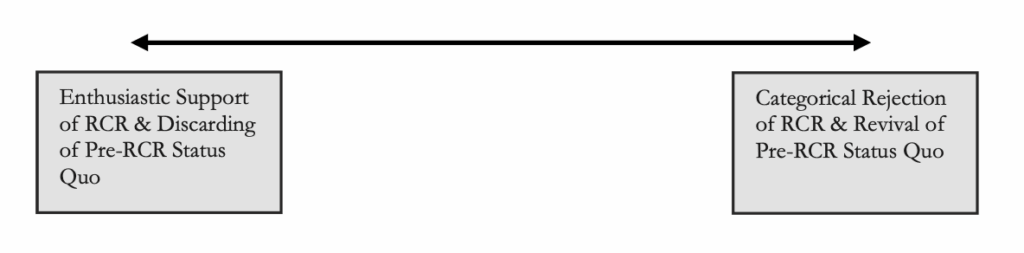
Closest to the pole that is enthusiastic about the RCR and critical of the previous status quo is the Wurman supplement. As discussed in Part I, it paints the pre-RCR regime as fundamentally flawed and unworkable, and the RCR appears as a wholesale, almost ideal, response to these problems. Of course, Wurman is critical of some aspects of the RCR, including the strong MQD reflected in Justice Gorsuch’s West Virginia opinion. But its favorable treatment of Chevron’s demise,184See supra notes 49–56, 104–105 and accompanying text.
its definition of the current forest of administrative law (as merely a revival of formalism),185See supra notes 45–46 and accompanying text.
and its emphasis on versions of the MQD that are ostensibly consistent with formalistic jurisprudence,186See supra notes 157–162 and accompanying text.
speak much louder.187This is broadly consistent with the author’s public statements. See Harvard Law School, HLS Rappaport Forum: It’s the End of the Administrative State as We Know It . . . and I Feel Fine, at 8:10, YouTube (Sept. 26, 2024), https://youtu.be/X0B7vPp20O8?si=jJLPVGrOEpcAde4o&t=490 (“In my view, some of the Supreme Court’s recent and controversial administrative law decisions were not only correct, but should have been 9-0.”).
Next to Wurman, Lawson is perhaps closest to that same pole. As previously discussed, the Lawson supplement evinces enthusiasm for some elements of the RCR, including its connection of the MQD to age-old ideas about lenity188See supra note 129 and accompanying text.
and optimism that the MQD will have “reverse-Chevron” effects.189 Lawson at 63; see supra note 129 and accompanying text.
But in other respects, Lawson is more reserved about the RCR. In particular, while sympathetic to Chevron’s overruling, the supplement is less certain that Loper Bright’s rejection of interpretive deference and assertion of interpretive judicial hegemony will make a difference. As it says “[w]ith a nod to Jurassic Park: Deference will find a way.”190See Lawson at 56.
Meanwhile, the Hickman-Pierce-Walker and Cass-Diver supplements strike us as largely accommodating of the RCR, without appearing entirely enthusiastic about its method or effect. For example, and as discussed in Part I, these supplements provide spare doctrinal stories of Chevron’s evolution, while highlighting what they cast as Chevron’s problems before getting to Loper Bright.191See supra notes 57, 62 and accompanying text.
As a result, their overall effect is to accommodate Loper Bright’s decision to overturn Chevron as, on the one hand, an internal legal response to doctrinal problems, and, on the other, a less serious intervention given the lack of context for the centrality of the Chevron regime. This accommodating effect is bolstered by the conspicuous absence of discussion of the changing political dynamics on the Court—and in broader society—that at least partly explain the RCR.192See supra note 66 and accompanying text.
Hickman-Pierce-Walker appears accommodating in other respects as well. For example, it does not include Justice Kagan’s dissent in Loper Bright—omitting any meaningful critique of the decision from the supplement’s text.193See supra note 60 and accompanying text.
It also treats the MQD—despite its fuzziness and ambiguity—as more workable than some common critiques suggest,194See supra note 163 and accompanying text.
and omits discussion of whether Congress can realistically respond to the MQD’s clear statement requirement for so-called “major questions.”195See supra note 173 and accompanying text.
While all these supplements fall on the side of the spectrum that is more hospitable to the RCR, many of the supplements appear on the other side.
Breyer-Stewart stands closest to the pole that rejects the RCR and seeks to revive the status quo ante. At almost every turn, it appears fundamentally critical of the RCR and protective of what existed before. This is evident, for example, in its emphasis on the “anti-administrativis[t]” forest that comes out of the RCR196See supra note 33 and accompanying text.
and in its highlighting of the severe costs that a robust MQD would have for the operation of the administrative state.197See supra note 168.
This stance is even more evident in its treatment of the demise of Chevron and coming of the Loper Bright regime. Indeed, as we have stressed, one of the key views the supplement presents is of Chevron as the inevitable result of legal realism and, as a result, Loper Bright is unlikely to meaningfully change how judicial review of agency statutory interpretation is conducted.198See supra notes 68–72, 101–103 and accompanying text.
The impression left is of the status quo ante as the result of law working itself pure and thus worthy of resurrection.199This is consistent with one of the author’s work on the subject. See Adrian Vermeule, Law’s Abnegation 2 (2016) (“[T]he law working itself pure concluded that abnegation was the best course of action, from an internal standpoint.”).
The Glicksman-Levy-Adelman, Asimow-Levin, Eskridge-Gluck-Nourse and Eskridge-Brudney-Chafetz supplements also seem to us fundamentally critical of the RCR, even though they are more ambiguous than Breyer-Stewart about the kind of future that awaits us post-Loper Bright.200See supra notes 93, 97, 120 and accompanying text.
The Manning-Stephenson and Gellhorn-Byse supplements are also critical of the RCR, but, we believe, reflect a more reserved approach. For its part, Gellhorn-Byse is certainly skeptical of the RCR. Indeed, it contains one of the most explicit statements that the RCR’s fundamental essence is “anti-administrativis[t]” in nature.201See supra notes 39–40 and accompanying text.
It is also not shy about highlighting the political factors that seemingly account for the revolution.202See supra notes 74–75 and accompanying text.
At the same time, the Gellhorn-Byse supplement does not suggest, like Breyer-Stewart and some of the other RCR-critical supplements, that the preexisting status quo of administrative law was inevitable. The impression one gets from sifting through the supplement’s many pages is one of deep skepticism toward the RCR, but without a clear commitment to reviving what preceded it in the same form.203For example, Gellhorn-Byse questions some of the claims made by Justice Kagan’s dissent in Loper Bright, noting, for example, that any stare decisis defense of Chevron has to contend with the fact that Chevron, itself, overruled prior precedent. See Gellhorn-Byse at 128.
If Gellhorn-Byse reads as more nuanced and reserved, Manning-Stephenson is perhaps even more so. While it certainly expresses persistent doubt about the RCR’s doctrinal changes, it too does not paint the pre-RCR status quo as optimal or anything close to inevitable. To the contrary, it relentlessly probes the various doctrinal complexities and questions of the pre-RCR regime.204See supra notes 81–88 and accompanying text.
It paints a picture of a complex regime that existed prior to the RCR, and a post-RCR regime that is likely to be just as complicated.205See supra notes 81–88 and accompanying text.
The Missing Picture
Thus far, our goal in this review has been to use the 2024 administrative law supplements to capture the dynamics of a legal field going through a revolution. In Part I we focused on the various snapshots of the RCR as they are reflected in some of the field’s leading supplements and casebooks. In Part II we argued that these snapshots reflect a bigger picture about the field itself, which is becoming more singular and polarized.
In this part, we turn from the interpretive and diagnostic to the normative. More specifically, we ask: Given the state of the field and the existence of the RCR, what kind of story should administrative law supplements tell about it? What is the “best” way for supplements and casebooks to present the material?
Of course, what makes a casebook “best” (let alone “ideal”) is a complicated question. People will respond to this question in different ways based on entirely legitimate differences in pedagogical and scholarly approaches.206For a useful discussion of these dimensions, see generally Eric L. Muller, A New Law Teacher’s Guide to Choosing a Casebook, 45 J. Legal Educ. 557 (1995).
We are also emphatically not of the view that one’s substantive view of the field must match the pedagogical approach taken in the casebook they are using. Duncan Kennedy is well-known for suggesting that “teaching against a casebook” is the most effective pedagogical strategy for law teaching.207See, e.g., Systemic Justice Videos, Contextualization in Legal Education: A Teach In, at 34:30, YouTube (Aug. 12, 2015), https://www.youtube.com/watch?v=RE8wG89_Jkw.
And we think there is some logic to that.208Indeed, both of us teach using casebooks that do not align with our approach to the RCR.
In this review, we use the term “best” in a very thin and modest sense. By speaking of “best,” we simply mean to denote the approach that would most clearly and easily comport with our own views about the most fruitful and important questions administrative law students and scholars should ask about the Roberts Court Revolution. We of course hope that our view will be congenial to others. But we recognize that others might not share our view or may need to be persuaded.
And as it happens, our own view puts us in a somewhat awkward position: We find that our perspective is not well represented within the present landscape of supplements. In our own thin and modest sense, therefore, none of the casebooks are yet in an ideal place. Some are perhaps closer to our own view than others. But none represents our view entirely.
What, then, is our view? On one hand, like many of the supplements, we too view the RCR’s overall changes as unattractive and ill-advised in welcoming an era of a more limited administrative government through, among other things, an ostensible commitment to formalistic jurisprudence and overconfidence in judicial capacity.209For one of our own arguments about the limits of separation of powers formalism, in particular, to resolve the disputes that arise today, see Shalev Gad Roisman, The Limits of Formalism in the Separation of Powers, 16 J. Legal Analysis 178 (2024); Shalev Gad Roisman, Balancing Interests in the Separation of Powers, 91 U. Chi. L. Rev. 1331, 1352–60 (2024).
What we’ve called the RCR, which stretches from Loper Bright to Seila Law to West Virginia, significantly embraces these notions, and we are united in our view that these should be emphatically rejected or, at least, should be put under serious scrutiny.
At the same time, we are skeptical of the view that what the field of administrative law requires is a revival of the pre-RCR status quo—a view which as we have suggested is reflected strongly in some of the supplements and is perhaps best exemplified by Justice Kagan’s dissent in Loper Bright.210See Loper Bright Enters. v. Raimondo, 144 S. Ct. 2244, 2294–311 (Kagan, J., dissenting).
To our minds, the previous administrative law equilibrium had plenty of its own serious problems—we ought not simply revive it.
For one thing, while we believe that a strong administrative state is desirable—and perhaps necessary—to govern a modern society such as ours, we also think it is similarly important not to treat the administrative state like an “unqualified… good.”211Of course, we draw this term from Morton J. Horwitz, The Rule of Law: An Unqualified Human Good?, 86 Yale L.J. 561 (1977) (book review).
The administrative state can and does have significant pockets of injustice. In fact, both the left and the right agree about this; they simply disagree on the particulars. For the right, those pockets of injustice are found, for example, in the excessive ambitions of administrative agencies to interfere with private ordering through unaccountable bureaucracy.212See, e.g., Christopher DeMuth, Can the Administrative State Be Tamed?, 8 J. Legal Analysis 121, 166 (2016).
For the left, these pockets of administrative injustice appear, for example, in the context of immigration and the national security state.213See, e.g., Adam B. Cox & Emma Kaufman, The Adjudicative State, 132 Yale L.J. 1769 (2023); Emily R. Chertoff, Violence in the Administrative State, 112 Calif. L. Rev. 1941 (2024); Bijal Shah, Administrative Subordination, 91 U. Chi. L. Rev. 1603 (2024); Emily R. Chertoff & Jessica Bulman-Pozen, The Administrative State’s Second Face, 100 N.Y.U. L. Rev. (forthcoming 2025).
The previous administrative law equilibrium, we think, tended to sweep these difficulties under the rug rather than face them head-on and channel them responsibly into the body of administrative law doctrines and administrative state organization.214For a claim in this spirit, see Oren Tamir, Getting Right What’s Wrong with the Major Questions Doctrine, 62 Colum. J. Transnat’l L. 543, 593–95 (2024) (discussing the place for “selective libertarianism” in administrative law). There are, of course, other standard critiques of the pre-RCR regime as well. See, e.g., Shalev Roisman, Presidential Law, 105 Minn. L. Rev. 1269, 1340 n.309 (2021) (“Routine among concerns are those relating to potential ‘ossification’ of rule-making, pushing regulatory policy underground to avoid such burdens, disincentivizing legislative fixes, and incentivizing enhanced presidential power.”).
We hasten to add that we are also unmoved by some key defenses of the pre-RCR status quo. For example, we are not attracted to Burkean defenses of the pre-RCR status quo that justify it based on its having been the norm.215See, e.g., Loper Bright, 144 S. Ct. at 2294 (Kagan, J., dissenting) (“For 40 years, Chevron . . . has served as a cornerstone of administrative law . . . .”); id. (describing Chevron as part of “the warp and woof of modern government”); Cass R. Sunstein, Administrative Law’s Grand Narrative 13–14 (Oct. 15, 2024) (unpublished manuscript) (on file with the Michigan Law Review) (describing Burkean “counternarrative” to Roberts Court). Part of the reason for this is the essentially Burkean concept of stare decisis. But we do not find stare decisis to be the most compelling ground to critique the RCR as many of the decisions being overruled—like Chevron—themselves overturned prior judicial regimes. Compare Skidmore v. Swift & Co., 323 U.S. 134, 140 (1944) (the Skidmore factors), with Chevron U.S.A. Inc. v. Nat. Res. Def. Council, Inc., 467 U.S. 837, 842–43 (1984) (the Chevron test).
Burkeanism—a respect for past practice or tradition216For an account suggesting Burkeanism values tradition for its own sake, see, for example, Anthony T. Kronman, Precedent and Tradition, 99 Yale L.J. 1029 (1990). For an account suggesting Burkeanism is based on consequentialist or pragmatic grounds, see, for example, Cass R. Sunstein, Burkean Minimalism, 105 Mich. L. Rev. 353 (2006).
—may have its attractions—stability, workability, and the like217See, e.g., Sunstein, supra note 216, at 358–59.
—but we do not think it is the best ground to defend the role of a strong administrative state, especially in light of the previous status quo’s blind spots, and particularly in the current context, where the traditional public grounding has been subject to attack.218See, e.g., Gabriel Scheffler & Daniel E. Walters, Revealing the Submerged Administrative State, Regul. Rev. (Sept. 3, 2024), https://www.theregreview.org/2024/09/03/scheffler-walters-revealing-the-submerged-administrative-state [perma.cc/2EFD-T5JJ] (discussing unpopularity of administrative state). Indeed, we find Burkeanism a particularly odd fit for progressive critics of the RCR. Progressives, after all, tend to prefer progress over tradition, and thus grounding critique in past practice will inevitably raise problems for progressive defenders of the administrative state.
We are perhaps even more skeptical of accounts that paint the pre-RCR status quo as somehow inevitable.219See supra notes 68–70 (discussing the Breyer-Stewart supplement’s suggestion that Chevron is the inevitable result of law running out); see also Loper Bright, 144 S. Ct. at 2294 (Kagan, J., dissenting) (describing Chevron as “the almost obvious choice”); Vermeule, supra note 199, at 24 (“The arc of administrative law bends toward abnegation. The critical point . . . is that the arc results from the law working itself pure.”).
That regime was contingent on developments of agencies—and judicial review—over the course of decades following the New Deal.220See, e.g., Roisman, supra note 214, at 1340–41 (discussing historical contingency of administrative law’s form today); see also Nicholas Bagley, The Procedure Fetish, 118 Mich. L. Rev. 345 (2019).
While that vision may be preferable to that underlying the RCR, there are other possibilities out there to accommodate a strong administrative state.221Oren Tamir, Our Parochial Administrative Law, 97 S. Cal. L. Rev. 801, 877–929 (2024) (discussing how other key jurisdictions around the world successfully work with a different regime for the “domestication” of administrative guidance and judicial control of administrative interpretations of law compared to the conventional approaches that are considered “on the wall” in the United States).
Finally, while we agree that the RCR has strong political explanations, rooted in the conservative movement’s changing views about the administrative state and conservative partisan entrenchment in the courts, we do not find that this explanation is itself a decisive indictment of the RCR. After all, the pre-RCR status quo was, itself, intertwined with a political vision of administrative agencies as necessary overseers of our society, which ground their decisions in expertise combined with a desirable form of political accountability.222See, e.g., Jeremy Kessler & Charles Sabel, The Uncertain Future of Administrative Law, Daedalus, Summer 2021, at 188; Noah Rosenblum, Toward a Realist Defense of the Civil Service, 13 Regul. Rev. Depth 7, 9 (2024).
The political nature of the RCR, in other words, is not an indictment against it. It is merely a reminder that in order to support a robust administrative state, such political buy-in must exist—both ideationally and throughout the institutions of government.
For all these reasons, we are emphatically not of the view that the right approach to the RCR is a kind of “reject-and-defend.” The first part (about the rejection) seems correct. But the second part (about defending and reviving the status quo ante) does not. To our minds, doing so is akin to rehashing the old “dogmas of the quiet past” that we strongly believe are “inadequate to the stormy present.”223This quote is of course from Abraham Lincoln. Annual Message to Congress (Dec. 1, 1862), in 5 Collected Works of Abraham Lincoln 518, 537 (Roy P. Basler ed., 1953).
Consequently, we think that something else entirely is needed. What we need is a new administrative law equilibrium that, on the one hand, provides legitimate public grounding for a robust administrative state but, on the other, is attentive to the real injustices of the administrative state, to the new possibilities of restructuring the court-agency relationship, and that goes beyond reliance on Burkean, deterministic, or apolitical grounds for administrative governance.
What are the specifics of this new equilibrium? That is harder to say, and we are ourselves uncertain (and potentially disagree) about what direction it should take. But we are united in our view that casebooks have a role to play in encouraging reflection on what such a future could be.
This view of the RCR and how to react to it is not encapsulated in any of the supplements we have reviewed. This is easiest to see in the supplements positioned close to the pole that is accommodating of the RCR. Given that we do not see the RCR as intrinsically attractive, we would clearly opt for a different approach than these supplements on almost all the dimensions we have covered. For one, we would emphatically opt for a forest approach, rather than focusing solely on the trees. We are of the view that the only way to understand the various changes in administrative law is by looking at the aggregate project, rather than each isolated instantiation. The cumulative picture we see (the “forest”) is a general project that seeks to limit the power of administrative agencies in our society, express putative commitment to formalism, and assert increasing judicial power.
With respect to Loper Bright, we would similarly not present Chevron’s demise—as many of the supplements more accommodating of the RCR do—as an ordinary case of legal course correction, rather than a combination of doctrinal complexities and external political developments. We would also be inclined to provide a more robust evolutionary doctrinal story of Chevron to Loper Bright, rather than the brisk treatment found in many of the supplements more favorable to the RCR. The goal would be to highlight that the Chevron regime was complicated and had its own problems, but also that it was a central feature of administrative law—rather than something brittle that could be easily disposed of. In discussing Loper Bright itself, we would include many of the doctrinal critiques of the decision—including whether Section 706 can bear the weight the case puts on it, and whether the Loper Bright regime will prove just as unworkable as Chevron ever was. An excerpt of Justice Kagan’s dissent in Loper Bright, which makes a number of these points, would certainly merit inclusion.
With respect to the MQD, we would present fairly some of the serious critiques of that doctrine, which, in our view, are underemphasized or unmentioned in some of the supplements more favorable to the RCR. These critiques include whether the MQD is workable in the current judicial regime and whether Congress can respond as the doctrine envisions. We would also take the opportunity of Justice Barrett’s idiosyncratic views about the MQD to enable a broader discussion exposing the potential fragilities of textualism as practiced (and how much it actually diverges, if at all, from other theories of statutory interpretation, including purposivism).
Given what we have said before about our own views about the state of administrative law, all this should be relatively clear. But, as we suggested, our view about the RCR also puts us in tension with many of the supplements that are closer to the pole that is critical of this revolution. Given that what we think is needed is not critique-and-defend-the-status-quo, but rather critique-and-imagine-something-new-instead, we would make different choices about the organization and presentation of the relevant materials. These choices put us perhaps closest to (though not fully harmonious with) the Gellhorn-Byse and Manning-Stephenson supplements, which, as we have suggested in Part I, provide, in our estimation, the most nuanced version of the RCR.
So, to begin with, while we agree with many of the supplements in this camp that a forest-like approach to administrative law is required, and that it should emphasize the RCR’s increasing anti-administrativism, formalism, and excessive judicial empowerment (if not hegemony), we would also emphasize side-by-side that the prior status quo was, itself, political—grounded in a prior consensus on the role of agencies in American society following the New Deal. We would also highlight other weaknesses of the previous administrative law equilibrium, including discussion of the serious pockets of bureaucratic injustice that existed within it (explaining that both the left and right agree on their existence, even if not their instantiations).
On the demise of Chevron, while we are critical of various aspects of Loper Bright, this does not entail a revival of the Chevron regime in response. Indeed, we would shy away from suggestions like the ones we find in Justice Kagan’s dissent and in the Breyer-Stewart supplement, that the Chevron regime was the inevitable manifestation of legal realism. Judicial review of agency statutory interpretation need not take the form of Chevron deference,224Tamir, supra note 221, at 911–29 (using comparative experience with regimes of deference to imagine a framework for judicial review different from, and arguably better than, Chevron).
and, as many of the supplements emphasize, the Chevron regime had its own share of problems and complexities.
Like most of the supplements, we would also avoid making strong predictions about the post-Loper Bright world. We believe there remain many avenues for a court to uphold an agency’s statutory interpretation if it wishes to do so. It can do so under Skidmore, by finding that a statute has implicitly delegated interpretive authority to the agency, by finding that the interpretation is a mixed question of fact/law, or by concluding that the agency’s interpretation turns out to be the “best view” of the relevant law.225See supra Section I.B.3.i (discussing various doctrinal paths).
At the same time, we think that courts will now have a much easier path to disagree with an agency’s interpretation of a statute than they did under the Chevron regime. Whether this is best characterized as a “mood” or a new authority, we do not know. But we suspect there will be more overruling of agency interpretations in the short term than would have happened under the Chevron regime.226We understand this will be hard to measure empirically. See, e.g., Gellhorn-Byse at 134.
While we do not have great confidence in which path courts will pursue—although we are more open to the mixed fact/law distinction playing a role than most of the supplements—we do have confidence that the political valence of support for judicial deference to agency interpretations will flip in the short term now that the Trump Administration’s regulations will be the ones subject to judicial review.
Finally, on the MQD, like many of the supplements critical of the RCR, we think it is important to expose and discuss its costs and to use the doctrine’s evolution and articulation in recent decisions varying from West Virginia v. EPA to Biden v. Nebraska as a vehicle to examine inherent tensions in the theory and application of textualism. At the same time, unlike some of the supplements more critical of the RCR, we would not treat the doctrine as inherently unworkable. Many doctrines are flexible and call for judicial judgment. There is nothing unique about that. While we are troubled by the current, overly broad nature of the MQD threshold, we think it is at least possible to conceive of a narrowed and more systematized threshold taking its place.227For example, the “extraordinary cases” exception to Chevron operated somewhat similarly and was not unbounded. See Thomas W. Merrill & Kristin E. Hickman, Chevron’s Domain, 89 Geo. L.J. 833, 912–13 (2001).
Relatedly, we think it would be fruitful for casebooks to emphasize the potential for a more moderate version of the MQD in the future.228See generally Tamir, supra note 214; Oren Tamir, The Major Questions Doctrines: A Case Study on the Domestic Possibilities of Comparative Administrative Law, in Research Handbook on Comparative Administrative Law (Mariana Mota Prado, Megan Pfiffer, Farrah Ahmed, Blake Emerson & Peter Lindseth eds., forthcoming 2025), available at: https://papers.ssrn.com/sol3/papers.cfm?abstract_id=5138430.
In keeping with this, we think it important to take seriously the differences between Chief Justice Roberts and Justice Gorsuch about what the MQD is. This debate shows that the doctrine is still flexible and that a real battle for what it might look like going forward remains. There are opportunities for moderation therein. We would also spend time on Justice Barrett’s linguistic defense of the MQD. This is not because we find her defense compelling on her own terms229Which we do not, at least as a matter of the strict textualism to which she is ostensibly committed.
but because we see it as signaling flexibility in the future of the MQD, as well as in how expansive textualism might yet become.
***
All these changes are of course important. We already highlighted the importance of casebooks to the construction of legal knowledge. But what’s more important is these changes’ overarching goal: to write casebooks that allow students and new entrants into the administrative law field to reflect critically on the Roberts Court Revolution, without foreclosing opportunities for something to emerge from it that may be better than what existed before. The RCR is something new, the response ought to be new too.
Going forward, we think the only avenue to defending a strong administrative state is to come up with new conceptions and defenses of it that are palatable to scholars, yes, but to the public too. This vision of a robust administrative state cannot be grounded simply in a recollection of its past acceptance after the New Deal. For better or worse, that moment is over. To defend a strong administrative state today, we need a new vision for the role of administrative agencies in our changing society.
Constructing such a vision is a central project for scholarship to come. But casebooks have a role to play as well. They can take a more proactive role in encouraging creative thinking about the future of administrative law. In particular, they can include more open questioning about how to conceive of a robust administrative state in our modern society going forward. Why, for example, do we need strong agencies? What roles should they serve? What would make them legitimate in the twenty-first century?
The answers to these questions are very much up for grabs. Students can play a fruitful role in helping answer them. They might be better attuned to what might convince the next generation of lawyers and citizens of the legitimacy of strong agencies. Classroom conversation can yield crucial insights. What will emerge from this process is, as yet, unclear. But this is the debate of the future. The previous administrative law equilibrium wasn’t the “end of history” for administrative law. We can do better than what we did. Indeed, we must—at least if we are to have a robust administrative state at all.
* Associate Professor of Law and Distinguished Early Career Scholar, University of Arizona James E. Rogers College of Law.
** Associate Professor of Law, University of Arizona James E. Rogers College of Law. We thank Danielle Chapman for expert research assistance. We would also like to extend sincere thanks to audiences at the Arizona State University College of Law, the University of New South Wales in Sydney Australia, and the Academia Sinica in Taipei Taiwan for helpful comments and suggestions, and especially Rehan Abeyratne, Farrah Ahmed, Francesca Bignami, Ros Dixon, Jonathan Green, Liz Fisher, Tarcila Reis Jordao, Erin Scharff, Jennifer Selin, Marcus Teo, Lulu Weis, and Mark Tushnet.
