
Courts of Indian Offenses, Courts of Indian Resistance
In the late nineteenth century, the Department of the Interior created the Courts of Indian Offenses with the express goal of eliminating elements of Native culture through the coercive power of criminal law. The courts stood on dubious constitutional grounds, were almost universally replaced by tribal courts in the twentieth century, and have been widely derided as crude assimilationist tools.
This Article examines the Courts of Indian Offenses to study how law and legal institutions operate as sites of colonial struggle. The Courts of Indian Offenses were formally created to criminalize Native culture. In practice, they were more complicated. Native judges entrusted with Washington’s assimilationist designs frequently declined to enforce the “Indian offenses,” instead using the courts to resolve crimes and disputes recognized by their tribal communities.
This Article uses three decades of annual reports from the Commissioner of Indian Affairs and archival records from three Courts of Indian Offenses to illustrate the courts’ structure and function at the turn of the twentieth century. It engages with concepts from subaltern studies, tribal legal studies, and law and colonialism literatures to explore how tribal law adapted and survived despite the formal imposition of Anglo-American legal forms. The Article ultimately suggests that the Courts of Indian Offenses may be understood as contested institutions through which tribal leaders preserved tribal self-government against the imperatives of empire.
Introduction
In 2022, the Supreme Court heard a double jeopardy case with a striking imperialist history. In Denezpi v. United States, the Court considered whether the Courts of Indian Offenses—now universally known as “CFR Courts”1Court of Indian Offenses, Dep’t of Interior: Indian Affs., https://www.bia.gov/CFRCourts [perma.cc/42T4-4YTM]; Angelique EagleWoman (Wambdi A. Was’teWinyan), Jurisprudence and Recommendations for Tribal Court Authority Due to Imposition of U.S. Limitations, 47 Mitchell Hamline L. Rev. 342, 353 (2020). “CFR” refers to the Code of Federal Regulations, which codifies the modern Courts of Indian Offenses.
—benefited from the dual sovereignty doctrine such that a defendant could be subsequently prosecuted in federal court.2Denezpi v. United States, 142 S. Ct. 1838, 1843 (2022). Under the dual sovereignty doctrine, the double jeopardy clause does not bar duplicative prosecutions stemming from different sovereigns. The Court has recognized both states and tribes as separate sovereigns for the purposes of the dual sovereignty doctrine. See United States v. Lanza, 260 U.S. 377, 382 (1922); United States v. Wheeler, 435 U.S. 313, 332 (1978); see also Angela R. Riley & Sarah Glenn Thompson, Mapping Dual Sovereignty and Double Jeopardy in Indian Country Crimes, 122 Colum. L. Rev. 1899, 1901 (2022).
The inquiry dredged up a “curious” episode in American legal history.3Denezpi, 142 S. Ct. at 1851 (Gorsuch, J., dissenting).
The Courts of Indian Offenses were introduced in 1883, pursuant to a letter from Secretary of the Interior H.M. Teller to Commissioner of Indian Affairs Hiram Price.4Id. at 1850 (Gorsuch, J., dissenting).
The Office of Indian Affairs implemented these reservation courts without any Congressional authorization.5Id. at 1851 (Gorsuch, J., dissenting) (questioning the constitutionality of the Courts of Indian Offenses); see 1887 Off. Indian Affs. Ann. Rep. III, 32 [hereinafter 1887 CR] (“I renew my recommendation of last year that [the Courts of Indian Offenses] be placed upon a legal basis by an act of Congress authorizing their establishment.”); William T. Hagan, Indian Police and Judges: Experiments in Acculturation and Control 110 (1966) (documenting the Commissioner’s concern that the courts had been operating “without money, legislative authority, or precedent” (quoting 1890 Off. Indian Affs. Ann. Rep. III, LXXXIII [hereinafter 1890 CR])). But see United States v. Clapox, 35 F. 575, 577 (D. Or. 1888) (finding that the President is undoubtedly authorized to establish such “educational and disciplinary instrumentalities” to fulfill his guardianship responsibility to his Indian wards). The constitutionality of the Courts was tried only twice. A century after Clapox, the Tenth Circuit affirmed the courts’ legality. Tillett v. Lujan, 931 F.2d 636, 639 (10th Cir. 1991). In the late nineteenth century, agencies received minimal congressional direction and even less judicial review, and it was not uncommon for departments to create or reorganize offices and later gain approval from Congress. See Jerry L. Mashaw, Creating the Administrative Constitution: The Lost One Hundred Years of American Administrative Law 241, 245 (2012).
The courts were established for the express purpose of “civiliz[ing]” Indians: to make Native people abandon their “savage and barbarous practices” by imposing a criminal legal regime.6Denezpi, 142 S. Ct. at 1850 (Gorsuch, J., dissenting) (quoting 1 Rep. of the Sec’y of the Interior X (1883)).
The so-called “Indian offenses” included traditional dances, plural marriage, funerary rites involving the destruction of property, and the traditional practices of medicine men.7Letter from Henry Teller, Secretary of the Interior, to Hiram Price, Commissioner of Indian Affairs (Mar. 30, 1883), https://commons.und.edu/indigenous-gov-docs/131 [perma.cc/9HZC-76B9].
Throughout the late nineteenth century, calls for “law for Indians”81875 Off. Indian Affs. Ann. Rep. 3, 15 [hereinafter 1875 CR]; see also Sidney L. Harring, Crow Dog’s Case: American Indian Sovereignty, Tribal Law, and United States Law in the Nineteenth Century 13 (1994).
stressed the federal government’s obligation to “save this race from itself.”91875 CR, supra note 8, at 197 (restating the agent’s report from the Commission Appointed to Treat with the Sioux Indians for the Relinquishment of the Black Hills).
This blatantly racist, colonial project can be understood as a relic of its time. It may be a shock to the average American that the Courts of Indian Offenses still exist today. In fact, the Denezpi majority endorsed their continued operation and sovereign political status as tribal institutions.10Denezpi, 142 S. Ct at 1846 (finding that the dual sovereignty doctrine applied such that Merle Denezpi could be tried in the Southwest Region CFR Court and again in federal court).
The Courts of Indian Offenses no longer prosecute the Indian offenses set out by Commissioner Price. In the twentieth century, the federal government retreated from its policy of coerced assimilation and allowed tribes to create their own judicial systems.11See Riley & Thompson, supra note 2, at 1912 (discussing how the Indian Reorganization Act enabled tribes to replace Courts of Indian Offenses with tribal courts). According to Riley and Thompson, “Tribal courts are now the norm in Indian country, and the evidence suggests that the few tribes still operating CFR courts do so primarily because of a lack of resources to create an entirely tribally based system.” Id.
As a result, sui generis tribal institutions replaced most Courts of Indian Offenses. The few remaining courts underwent a dramatic transformation. Today’s CFR courts essentially operate as tribal courts, run by tribal judges, applying tribal law.12Brief Amici Curiae of the Ute Mountain Ute Tribe, et al. in Support of the United States at 5–6, Denezpi, 142 S. Ct. 1838 (No. 20-7622) [hereinafter Tribes’ Amicus Brief]. Today, tribal governments run CFR Courts via 638 contracts with the federal government. Id. at 18–19; see also 25 C.F.R. § 161.3 (1938); Brief of Amici Curiae Federal Indian Law Scholars and Historians in Support of Respondent at 12, Denezpi, 142 S. Ct. 1838 (2022) (No. 20-7622) [hereinafter Professors’ Amicus Brief].
Although those tribal laws are technically assimilated into the Code of Federal Regulations13Denezpi, 142 S. Ct. at 1852–53 (Gorsuch, J., dissenting).
and the Department of the Interior formally retains ultimate authority over the courts,14Id. at 1850 (Gorsuch, J., dissenting).
one can persuasively argue that modern CFR Courts derive their ultimate source of power from the tribes’ inherent sovereignty.15Tribes’ Amicus Brief, supra note 12, at 16. The dissent makes a good point that this determination seems to conflict with the Court’s holding in Puerto Rico v. Sanchez Valle, 579 U.S. 59, 78 (2016). Denezpi, 142 S. Ct. at 1855 (Gorsuch, J., dissenting) (“If the courts of Puerto Rico are properly classified as federal under our case law, it defies the imagination to think administrative tribunals hatched by the Department of the Interior could be treated differently.”). Perhaps Sanchez Valle was wrongly decided.
In Denezpi, the Court was convinced of as much.
In addition to the primary legal questions of dual sovereignty and double jeopardy, Denezpi raised questions concerning the actual historic function of the Courts of Indian Offenses. The dissent recited a conventional narrative lambasting the assimilationist imposition of criminal law that subjected tribal communities to the legalized tyranny of federal agents.16Denezpi, 142 S. Ct. at 1850. See Harring, supra note 8, at 13–14 (“[B]eginning in the 1880s, [traditional tribal law] lost much of its authority to a BIA legal order composed of an all-powerful Indian agent backed by a ‘code of Indian offenses,’ Indian police, and agency-appointed chiefs and judges.”).
But the law professor amici suggested a different story.17The Professors’ Amicus Brief was composed by Professors Gregory Ablavsky, Maggie Blackhawk, Bethany Berger, and Angela Riley. It was filed by Amanda L. White Eagle of the NYU-Yale American Indian Sovereignty Project. See generally Professors’ Amicus Brief, supra note 12.
The professors agreed on the imperialist federal impetus behind the establishment of the courts, observing that “[f]ederal officials hoped to leverage these courts to transform Native culture and extinguish traditional practices.”18Id. at 1.
But they suggested a radically different reality: “In practice, these courts largely served as extensions of tribal communities, with Native judges—often elected by tribal members—enforcing tribal law with little regard to the federal regulations.”19Id. at 1–2.
According to the amici, “the courts’ reality rarely corresponded to the agents’ assimilationist aspirations.”20Id. at 9.
In this way, Denezpi evoked a limited but longstanding literature on the contested function of the Courts of Indian Offenses. Throughout the 1880s and 1890s, Indian Affairs agents repeatedly lauded the courts as successful civilizing interventions.21See infra Part III. Agents’ evaluations after 1900 are harder to know because their reports stopped being included in the Commissioner’s annual report to the Secretary of the Interior.
Yet the Meriam Report of 1928 suggested that hardly one in ten judges was familiar with the rules the courts purported to enforce.22 Lewis Meriam, Ray A. Brown, Henry Roe Cloud, Edward Everett Dale, Emma Duke, Herbert R. Edwards, Fayette Avery McKenzie, Mary Louise Mark, W. Carson Ryan, Jr., & William J. Spillman, Inst. for Gov’t Rsch., The Problem of Indian Administration 769 (1928), https://files.eric.ed.gov/fulltext/ED087573.pdf [perma.cc/B233-WK8B].
Ray Brown, one of the Meriam Report’s authors, wrote independently that the courts were very different from Anglo-American courts, especially in how “the deliberations of the judges are governed not so much by legal rules and principles as they are by the common sense and native intuition of the Indians who preside over them.”23Ray A. Brown, The Indian Problem and the Law, 39 Yale L.J. 307, 313 (1930). In 1996, Sidney Harring suggested that “the Indian judges of these courts preserved much tribal common law; therefore, these ‘courts of Indian offenses’ should not be dismissed as simply copies of white courts.” Harring, supra note 8, at 14. To be sure, on the very same page Harring also described the same courts as a sharp departure from tribal law as it existed prior to federal intervention. Id.
In 1966, William Hagan, whom the professor amici regard as the courts’ “principal historian,”24Professors’ Amicus Brief, supra note 12 at 19.
described the courts as a fusion of legal traditions: “Anglo-Saxon legal concepts . . . buil[t] on native institutions.”25 Hagan, supra note 5, at 10. Matthew Fletcher recently referred to these institutions as “curious arrangements, neither fully federal nor fully tribal.” Matthew L.M. Fletcher, The Three Lives of Mamengwaa: Toward an Indigenous Canon of Construction, 134 Yale L.J. 696, 707 (2025).
More recent scholarship has emphasized the ways in which the courts undermined customary tribal law. In 1983, Vine Deloria Jr. and Clifford M. Lytle described the courts as components of a “transitional period” in tribal governance, in which early reservation governments continued traditional forms of community oversight, “albeit in the whites’ institutional clothes.”26 Vine Deloria, Jr. & Clifford M. Lytle, American Indians, American Justice 98 (1983).
According to Deloria and Lytle, some of the courts had at times earned the respect of their reservation constituents.27Id. at 114. Deloria and Lytle point out that Manuelito, one of the most celebrated Diné leaders, served on the Navajo Court of Indian Offenses. Id.
However, Indian judges ultimately “served at the pleasure of the agent, not the community,” such that a majority of tribes were eager to “rid themselves of this hated institution” upon the arrival of the Indian Reorganization Act.28Id. at 115–16.
In 2021, Angelique EagleWoman described the courts as “instrumentalities of the assimilation policy” at odds with the guarantees of the federal Constitution.29EagleWoman, supra note 1, at 351. Deloria and Lytle also suggest that these institutions may be understood as little more than “instruments of cultural oppression.” Deloria & Lytle, supra note 26, at 115.
In 2023, Kekek Stark described the Courts of Indian Offenses as colonial tools that served the broader process of destroying and replacing tribal law.30See Kekek Jason Stark, Indian Policing: Agents of Assimilation, 73 Case W. Rsrv. L. Rev. 683, 691 (2023) (suggesting that CFR Courts, to this day, remain Anglo-oriented to the exclusion of tribal culture).
Stark and the other critics are undoubtedly right—the Courts of Indian Offenses were designed to refashion tribal social, spiritual, and legal traditions into an Anglo-American model with zero regard for tribal self-determination. The tribal law scholars mentioned above correctly recognize that the courts succeeded in uprooting and replacing traditional tribal legal procedure. At the same time, the early non-Native observers could also have been correct in concluding that the courts were far from carbon copies of their state, federal, or territorial analogs. The courts were undeniably transformative impositions, but the extent to which they articulated Anglo-American or tribal law remains disputed in the literature. The Denezpi professor amici presented one of the boldest assertions, claiming that the courts were essentially practicing tribal law.31Professors’ Amicus Brief, supra note 12 at 1, 9. To be fair, scholars often present history in starker terms as amicus briefers addressing the court than they do in formal scholarship. See M. Henry Ishitani, Note, Today’s Brandeis Brief? The Fate of the Historians’ Brief Amidst the Rise of an Originalist Court, 2 J. Am. Const. Hist. 1, 9–13 (2024).
In this Article, I explore this departure of function from purpose. I take a deeper look at the claim of the professor amici to examine the actual procedure and substance of the Courts of Indian Offenses. My intervention combines the novel application of critical theory and methodology with a fine-grained focus on unexamined archives to understand how these courts operated on the ground. The Courts of Indian Offenses exemplify how American criminal law can operate as a colonial tool of coerced assimilation. Yet they are simultaneously instructive as to how colonized peoples can retain power through strategic accommodation. As Keith Richotte Jr. observed, “[W]hile tribal communities were certainly acted upon by colonial forces in the Allotment Era, they did not merely accede to happenings of the day.”32 Keith Richotte Jr., Claiming Turtle Mountain’s Constitution: The History, Legacy, and Future of a Tribal Nation’s Founding Documents 8 (2017).
Rather, they made difficult choices and strategic adaptations to preserve tribal sovereignty at a time when the federal government was utterly hostile to the notion of tribal survival.33According to Richotte: “While this was a shaky, troublesome, uncertain time in which the federal government was actively trying to eliminate tribal nationhood, the peoples themselves responded in a multitude of ways that sought to maximize any and all of the legal and political authority that they could wrangle.” Id.
I explore the Courts of Indian Offenses from this frame. I argue that the Courts of Indian Offenses are best understood as forums of Native resistance, in which tribal leaders preserved tribal autonomy within a colonial legal framework by formally working with federal agents.
This historical study finds that while the Courts of Indian Offenses frequently functioned as effective venues for resolving small claims and misdemeanors, they hardly achieved the Secretary’s overarching goals. A local Indian agent predicted this result just a year after the courts’ establishment. As John W. Scott, the federal agent assigned to the Ponca, Pawnee, and Otoe Agency in the Indian Territory, observed in 1884:
In settling the ordinary disputes and misunderstandings that occasionally arise among the Indians, I think they will be a great help and relief to the agent. As to their efficiency in preventing or punishing what are technically termed Indian offenses, such as bigamy, the sun-dance, giving away property at funerals, &c., I am by no means sanguine. I think it will be difficult to persuade Indian judges to regard and punish as crimes acts which they and their people have from time immemorial looked upon as perfectly proper and right. What is needed is a radical change of sentiment among the Indians, and this must be effected by moral means. Coercion will never accomplish it.341884 Off. Indian Affs. Ann. Rep. III, 85 [hereinafter 1884 C.R.].
Agent Scott suggested that the Courts of Indian Offenses were fit for local dispute resolution but inadequate for the elimination of entrenched cultural practices. Instead, he recommended that missionaries and schools would be more effective at transforming Native culture.35Id. at 85–86.
Indeed, by the 1910s, the Commissioner’s reports hardly mentioned the Courts of Indian Offenses, instead focusing on educational initiatives as the best means to induce cultural change.36See infra Section III.C. To be sure, I do not mean to suggest that the formal criminalization of Native culture had no impact. Rather, my study questions the actual practice and overall effectiveness of assimilation through legal coercion in a decentralized court system.
Scott’s observations are backed up by the court dockets included in agent reports, compiled in the Commissioner’s annual report to the Secretary of the Interior, as well as the local records of Courts of Indian Offenses. In the twenty-one years after the official advent of the courts, 1,565 discrete cases were catalogued in the Commissioner’s annual reports.37This count only includes cases that specify the charges. Larger caseloads were tried and reported, but only with general trends (i.e., predominantly assaults and adultery) rather than offering specific counts. See infra Section III.C.
Of those, 28 were for plural marriage, 14 were for medicine practices or conjuring, 2 were for dances, and 41 were for the destruction of property or theft.38For this basic count, I am excluding the sex work/dowry category, given its vagueness. Many cases evoke infidelity, but in this period, very few (e.g., “harlotry”) clearly fit in this category. Likewise, there is some fuzziness between adultery and plural marriage. Adultery was a common charge in most of the Courts of Indian Offenses surveyed, and some courts clearly distinguished bigamy or polygamy as a separate crime. I have decided to separate the adultery cases from the polygamy count, though some may well have been based on Indigenous marital or sexual norms.
These Indian Offenses accounted for 1.79%, 0.89%, 0.13%, and 2.62% of the total reported cases, respectively, or 5.43% altogether. As these numbers show, the Courts of Indian Offenses were spending very little time prosecuting Indian Offenses. Instead, they managed property and family disputes, ordinary criminal offenses, and public intoxication.39See infra Part III. The Yakama court spent much of 1903 and 1904 adjudicating the ownership of horses. See infra Section IV.A.
The courts’ personnel further complicate the picture. Although agents often sought to fill the courts with judges and clerks they deemed “progressive” (i.e., willing to adopt white American norms and customs),40See Deloria & Lytle, supra note 26, at 115.
some prominent judges openly defied the professed goals of the Code of Indian Offenses. Judge Shorty White-grass served on the Court of Indian Offenses for the Blackfeet Nation. In 1899, his performance from the bench so impressed the Board of Indian Commissioners that they likened him to a member of the House of Representatives.41See 1899 Off. Indian Affs. Ann. Rep. pt. II, at 326 [hereinafter 1899 C.R.].
In the very same paragraph, the Commissioners also noted that Judge White-grass was a respected medicine man who spent every Sunday practicing traditional religion with the “other conservatives of the tribe.”42Id.
Judge Quanah Parker, a famed Comanche leader, served as a judge for the Kiowa Comanche Court of Indian Offenses. Despite an express ban on polygamist judges, Judge Parker assumed the bench with no fewer than five wives.43 Hagan, supra note 5, at 135.
He married another woman during his tenure and maintained his position, despite outrage from Washington.44Id. at 137. But see 1891 Off. Indian Affs. Ann. Rep. pt. 2, at 1, 287 (Tongue River agent) (reporting that since all the most competent men who could serve as judges were polygamists, he was not able to create a court).
As these men demonstrate, Indian judges were not always models of assimilation, nor were they wholly under the control of federal agents.
As previewed above, this Article relies heavily on archival sources. First, I use the annual reports by the Commissioner of the Office of Indian Affairs to the Secretary of the Interior. These reports include summaries and policy commentary by the Commissioner as well as hundreds of pages of reports from federal agents in the field.45See, e.g., id.; 1899 C.R. Pt. II supra note 41. As Richotte observed, the records of the Indian agents are “particularly elucidating . . . [in] their often-voluminous correspondence, the superintendents provided not only their own perspectives on the issues and conundrums of the day, but they recorded the voices, thoughts, and activities of community members.” Richotte, supra note 32, at 90.
For this study, I use reports spanning from 1875 to 1915. Second, I use the local archival records of Courts of Indian Offenses for the Yakama, Pima, and Standing Rock Agencies. These records range from the 1880s to the 1920s, with more complete documentation from the early twentieth century. Each was chosen for the relative completeness of its records and for regional diversity. These courts are featured as case studies in Part IV.
In my use of these archival sources and engagement with the older secondary literature, I borrow methods and insights from subaltern studies, tribal legal studies, and the broader law and colonialism literature. Scholars in these fields work to recapture the lives, stories, and political relations of peoples who rarely controlled their representations in the archive. These fields attempt to reckon with the distortions of imperial historiography, find meaning in archival absences, and read the recorded past against the grain.
Part I starts with a discussion of methods and assumptions. Part II reviews the pertinent legal and political context of the late nineteenth century, focusing on the state of jurisdiction in Indian country and the structure of the Office of Indian Affairs in the postbellum administrative state. This section uses studies of bureaucracy to examine the roles, interests, and powers of reservation superintendents and lower-level Indian Affairs employees, including Native appointees. Part III considers the Courts of Indian Offenses from the 1880s to the 1920s in terms of purpose, structure, and function. Part IV examines three Courts of Indian Offenses to better understand their origins, their relationship with tribal politics and tribal legal history, their typical caseloads and procedures, and their limitations. The Yakama Agency case study demonstrates how the Court of Indian Offenses was imposed onto an existing tribal court. The Pima Agency case study illustrates how the Court of Indian Offenses served as a space for tribal politics and how court actors appealed to the formal power of a largely absent agent to service internal tribal power struggles. Finally, the Standing Rock case study interrogates the meaning of resistance by exploring the Court of Indian Offenses’ role in the assassination of Sitting Bull and the violent suppression of the Ghost Dance movement. These three case studies add depth to the overarching story depicted in the Commissioners’ Reports. While all three cases feature tribal autonomy, they also underscore the significant variation across the Courts of Indian Offenses.
I. Tribal Law and Critical Historiography
This Part serves as methodological framing. First, I identify the problems with studying Indigenous law through colonial records, and I reach for methodological solutions. I recognize the necessary limitations of such a project and briefly discuss the significance of researcher positionality. Second, I address assumptions and expectations concerning the history of tribal law. In broad strokes, I discuss the historic invisibility of tribal law to Western observers, the disruption of tribal law in the process of colonization, and the survival and transformation of tribal law. Third, I engage with the law and colonization literature to draw out a nuanced conception of colonial law that frames this inquiry.
A. Reading Against the Grain
The colonial archive presents a historiographic problem. While colonial records are an essential resource for historical scholarship,46See Florencia E. Mallon, The Promise and Dilemma of Subaltern Studies: Perspectives from Latin American History, 99 Am. Hist. Rev. 1491, 1507 (1994).
they are attended by significant limitations.47Colonial legal systems, in particular, generate an abundance of records regarding people otherwise absent from the recorded past. Yet legal records are distorted by the colonial preconceptions of institutional actors. See Renisa Mawani, Law and Colonialism: Legacies and Lineages, in The Handbook of Law and Society 417, 422 (Austin Sarat & Patricia Ewick eds., 2015).
As Ranajit Guha remarked, “Historians know all too well how the contents of a series in an official archive or a company’s record room derive much of their meaning from the intentions and interests of the government or the firm concerned.”48Ranajit Guha, Chandra’s Death, in 5 Subaltern Studies: Writings on South Asian History and Society 135, 139 (Ranajit Guha ed., 1987).
Those records are mediated not only by conscious interests, but also deeply held “Eurocentric assumptions that periodize colonial populations and Europeans as pre-modern/modern and pre-political/political.”49Mawani, supra note 47, at 423. Linda Tuhiwai Smith suggests that such assumptions exist not only in the archival records, but in the project of history generally. See Linda Tuhiwai Smith, Decolonizing Methodologies: Research and Indigenous Peoples 30 (1999).
Thus, nineteenth century federal Indian agents reported on both the remarkable, inherent peacefulness of Native peoples allegedly living with neither violence nor law,501875 C.R., supra note 8, at 245.
as well as the great need to civilize Native peoples by imposing Anglo-American legal norms.51Id. at 15–16.
Historians in the subaltern studies movement52For a description of subaltern history, see Edward W. Said, Foreword to Selected Subaltern Studies, at v, v–ii (Ranajit Guha & Gayatri Chakravorty Spivak eds., 1988).
and adjacent colonial and Indigenous history fields53See, e.g., Richotte, supra note 32, at 13; Rebecca Kugel, To Be the Main Leaders of Our People: A History of Minnesota Ojibwe Politics, 1825–1898, at 2 (1998).
have developed critical historiographies to address the problems of the colonial archive and draw out truth from distortion. In its efforts to capture the lives and conditions of people at the lowest levels of imperial society, subaltern studies pursues textual analysis that “bend[s] closer to the ground in order to pick up the traces of a subaltern life in its passage through time.”54Guha, supra note 48, at 138.
In a method commonly known as reading “against the grain,”55See Mallon, supra note 46, at 1506.
critical historians and literary theorists work to deconstruct texts “along lines of power and hierarchy.”56Id. at 1497.
Reading against the grain requires interrogating the power relations that underwrite the historical sources before us.57Id. at 1499.
This approach involves searching for meaning in the absences of those left out of the records and the processes that created them.58See Guha, supra note 48, at 154.
It looks not only for the experiences of individuals, but also for the power structures that constrained them.59See, e.g., id. (extracting a patriarchal system of social control from scant legal records).
Secondary literature can also be read against the grain. Throughout this project, I engage with William Hagan, “the principal historian” of the Courts of Indian Offenses. While I rely on his considerable research, I approach it critically, wary of how he implicitly endorses a developmentalist narrative of Native nations.60Hagan described tribes as occupying various stages of civilization, on a scale ranging from the supposedly least developed Plains societies to the Five Civilized Tribes. Hagan, supra note 5, at 172. He also described Indian police and Courts of Indian Offenses as “vanguards of a more highly developed civilization.” Id. at 168. These attitudes echo those held by federal actors of the late nineteenth century. In the words of Commissioner T.J. Morgan, “[Indians] represent a great number of distinct phases of human development. Some are yet very degraded, living a mere animal life with few of the characteristics of humanity, while others have already become absorbed into our national life and are not distinguishable from their fellow citizens.” 1891 Off. Indian Affs. Ann. Rep. 3, 3 [hereinafter 1891 C.R.].
This historiographic approach attempts to make the most of the colonial archive; it does not pretend to rescue the past completely. Subaltern history is, in essence, the missing narratives that can never fully be recovered;61See Said, supra note 52, at vii; Mallon, supra note 46, at 1498.
in Gayatri Spivak’s famous formulation, “The subaltern cannot speak.”62Gayatri Chakravorty Spivak, Can the Subaltern Speak?, in Marxism and the Interpretation of Culture 271, 308 (Cary Nelson & Lawrence Grossberg eds., 1988).
This fundamental limitation in colonial history informs my inquiry. As I attempt to recover the practices of and the political context for the Courts of Indian Offenses, I do not presume to depict a complete picture.
Just as the roles and identities of the record-making agents and court personnel influence the archive, the roles and identities of modern scholars inevitably influence their scholarship.63Non-Native writers, like myself, should strive to be especially thoughtful about our outsider orientation. See generally Vine Deloria, Jr., Custer Died for Your Sins: An Indian Manifesto 78–100 (1988).
Past studies of tribal courts by non-Native researchers have at times featured unduly critical characterizations based on limited research and inadequate knowledge.64See, e.g., Fred W. Gabourie, Book Review, Am. Indian Culture & Rsch. J., 1979, at 104 (reviewing Samuel J. Brakel, American Indian Tribal Courts: The Costs of Separate Justice (1978)). Judge Gabourie was the first Native judge for the State of California appointed to the Los Angeles Municipal Court in 1976 and has also served as Chief Judge for the Kootenai Tribe of Idaho. See Indian Appointed Judge, Rec. Searchlight, Jan. 19, 1976, at 2, https://newspapers.com/article/record-searchlight/129482045 [perma.cc/8RQN-Q6NN]; see also Justin B. Richland & Sarah Deer, Introduction to Tribal Legal Studies, at xviii, 12 (3d ed. 2016) (describing the use and limitations of scholarship by non-Indian researchers).
All researchers carry assumptions that impact their writing, especially when faced with an incomplete record. This Article is based on several conscious assumptions: first, that tribal law existed well before contact, though often in forms unrecognizable to Western law; second, that colonization is a violent and coercive process, and criminal law is often complicit; third, that tribal law survives colonization; and fourth, that Native people exercise agency despite colonial coercion, resulting in many forms of resistance and survival. The bases for these assumptions are explored in the remainder of this Part.
B. Studying Tribal Law
American attitudes toward tribal governments have long been informed by the mistaken notion that Native nations lacked law prior to colonization.65See Richland & Deer, supra note 64, at 67.
Even where Western scholars identified forms of social control analogous to Anglo-American law, they too often derided tribal systems as inferior.66Id. at 8.
This profound translation error can be explained by substantial differences in the operation of tribal and Anglo-American law, erosion of tribal law by the violent upheaval and dispossession of colonization, and potent European notions of racial superiority exacerbated by material incentives.
In many places, tribal law has looked very different from Anglo-American law.67See Fletcher, supra note 25, at 706. To be sure, it is not easy to generalize about traditional tribal legal systems given the incredible diversity of Native social arrangements. See Deloria & Lytle, supra note 26, at 82.
As Val Napoleon asserted, “law is culturally bound,” such that “it is difficult to see and understand law in other cultures.”68Val Napoleon, Thinking About Indigenous Legal Orders 3–4 (2007).
Cultural context shapes the structure and operation of legal systems. Indigenous legal processes are more often implicit, informal, and decentralized compared to Western law and, hence, less cognizable to Western legal observers.69See id. at 9; Harring, supra note 8, at 11 (remarking that tribal law often “operated informally within very small social units. Most tribal legal actions were invisible; others appeared to whites as individual actions.”); Carrie E. Garrow & Sarah Deer, Tribal Criminal Law and Procedure 13 (2d ed. 2015) (“Early settlers from Europe sometimes concluded that Indigenous people did not have law because they did not see Native people doing anything that resembled legal systems in Europe.”).
As Kekek Stark has described, tribal law is often better understood in terms of “social, kinship, and clan obligations and responsibilities,” as opposed to targeted prohibitions to restrain antisocial behavior in individuals.70Stark, supra note 30, at 698; see also Garrow & Deer, supra note 69, at 14 (“Traditional law in many Native societies is often based on values, duties, and responsibilities that are closely linked to spiritual beliefs.”).
Such systems of social obligation were often transmitted through storytelling and enforced through social pressure and social ridicule.71Stark, supra note 30, at 705; Garrow & Deer, supra note 69, at 26 (describing stigma as social control); Napoleon, supra note 68, at 13–16 (describing how Indigenous law was recorded in stories, dances, language, oral histories, relationships, and responsibilities).
Anglo-American law looks remarkably centralized and formal in comparison. Because of the relative invisibility of tribal law, American observers have at times noted the effectiveness of tribal law (i.e., in restraining antisocial behavior and preventing violence) without actually recognizing tribal law itself.72See, e.g., 1875 C.R., supra note 8, at 245, 255.
Tribal law underwent significant transformation due to the violent disruption of colonization. Following contact, tribal law had to adapt to significant social, economic, and political developments.73 Harring, supra note 8, at 11.
American history is an incredibly violent place.74 Ned Blackhawk, Violence Over the Land 1 (2006); Karl Jacoby, Shadows at Dawn: A Borderlands Massacre and the Violence of History 2 (2008). American law was often complicit in the proliferation of violence on tribal land. See Lisa Ford, Settler Sovereignty 96–97, 107 (2010) (remarking that “[s]ettlers did not spurn the law, they used it”); Benjamin Madley, An American Genocide 26, 139, 146, 197 (2016) (identifying the many instances in which local and state law enabled white Californians to kill Natives with impunity).
Colonial technologies of violence remade Native social and political worlds, which were already rocked by the Old-World diseases that decimated Native populations.75See Blackhawk, supra note 74 at 7.
When communities were thrown into crisis, when systems of social obligation were disrupted and laws were broken without recourse, tribal legal systems lost legitimacy and broke down.76See Napoleon, supra note 68, at 10.
Meanwhile, the forced relocation of Native nations to reservations further facilitated the destruction and transformation of tribal law.77See id. at 16–17.
Reservations cut across political boundaries, often dividing and grouping Native people in novel ways.78Id.; 1875 C.R., supra note 8, at 14 (observing that the development of tribal government was hindered by having multiple tribes on the same reservations, and that language barriers and historic enmities made democratic tribal government unworkable).
As the United States undermined tribal legal systems through policies of removal, Americans also constructed a racial expectation of Indian lawlessness. As Philip Deloria has described, Americans developed expectations of violent Indians,79 Philip J. Deloria, Indians in Unexpected Places 20–21 (2004).
expectations that enabled the American conceit of defensive conquest.80Id. at 50; see also Jill Lepore, The Name of War 112 (1998); Madley, supra note 74, at 119–20; Richard White, The Middle Ground: Indians, Empires, and Republics in the Great Lakes Region, 1650–1815, at 391 (1991). As Deloria explored in his prior work, Playing Indian, the racialization of Indian lawlessness is complicated—it also includes the far more positive notion of Indian liberty. This was all at play when rebellious Bostonians dressed up as Natives to dump tea in the harbor. See Philip J. Deloria, Playing Indian 9, 10–37 (1998).
These notions of Indian violence and Indian lawlessness—distinct elements of the broader racist trope of Indian savagery—facilitated the expansion of the American empire by justifying dispossession81See Matthew L.M. Fletcher, Uncomfortable Truths About Sovereignty and Wealth, 27 Roger Williams Univ. L. Rev. 288, 291 (2022).
and undercutting the legal force of tribal sovereignty.82See Harring, supra note 8, at 17 (referencing an Alabama court describing tribal law as a “high pretension of savage sovereignty” (quoting Caldwell v. State, 1 Stew. & P. 327, 331 (Ala. 1832)); 1875 C.R., supra note 8, at 23 (“They have been treated as if capable of acting for themselves in the capacity of a nation, whereas all history shows no record of a tribe, within our republic, able to assume and continue the character and relations of a sovereign people. There may have been a reason in the weakness of the early colonies, and far superior numbers of their Indian foes, for recognizing this condition of Indian sovereignty.”).
In the nineteenth and twentieth centuries, the specter of Indian lawlessness justified federal imposition of Anglo-American criminal law and legal norms onto Native nations, greatly undermining tribal law and tribal jurisdiction in the process.83See Garrow & Deer, supra note 69, at 37; Alexandra Fay, Tribes and Trilateral Federalism: A Study of Criminal Jurisdiction, 56 Ariz. St. L.J. 53, 84 (2024).
Never mind that, in many instances, the bulk of violence around reservations came from white settlers.84See 1859 Off. Indian Affs. Ann. Rep. 1, 3 (describing how “the most atrocious cases of murder and rapine, charged to the account of the Indians, have in reality been committed by white men wearing the disguise of Indians”); 1875 C.R., supra note 8, at 13 (reporting the “the alarming intrusion of outlawed white men” and “the very worst class of [white] men that infest an Indian border”); Hagan, supra note 5, at 7 (describing “the human debris which the moving frontier had deposited on Indian land”).
Despite these compounding factors working to delegitimize and eliminate tribal law, tribal law survived. Transformed by American colonialism, tribal law often adapted to reflect Anglo-American legal norms and structures.85See Garrow & Deer, supra note 69, at 55. Native cultural traditions targeted by the federal government in the era of the Courts of Indian Offenses also survived, albeit transformed by their time underground. See generally Richard Moves Camp, My Grandfather’s Altar: Five Generations of Lakota Holy Men (Simon J. Joseph ed., 2024) (providing an oral-literary narrative of Lakota religious traditions); Cutcha Risling Baldy, We Are Dancing for You: Native Feminisms and the Revitalization of Women’s Coming-of-Age Ceremonies (2018) (providing an account of the Hoopa Valley Tribe’s revitalization of the coming-of-age Flower Dance ceremony); Gregory H. Bigler, Rabbit Decolonizes the Forest: Stories from the Euchee Reservation (2024) (capturing stories and traditions of the Euchee people).
Tribal leaders, jurists, and scholars today work to articulate and enshrine traditional Indigenous legal principles in contemporary tribal legal systems.86For a survey of traditional justice principles in modern tribal law, see Garrow & Deer, supra note 69, at 55–86.
C. Colonial Law as a Site of Struggle
Settler colonialism produces categories of colonizer and colonized—dominant and subaltern—characterized crudely by a dramatic power imbalance. While the general power relation is an essential feature of colonization, neither class is static nor uniform.87See Mallon, supra note 46, at 1500.
We should understand subaltern and dominant groups as mutually interdependent categories whose law and politics remain in dialogue.88Id. at 1494; see also Deloria, supra note 79, at 6 (“The world we inhabit is the shared creation of all peoples, though the costs and benefits have been parceled out with astonishing inequality, as have the notions about who has been active in that creation and who has been acted on.”); Mawani, supra note 47, at 424 (“[T]he colonies were not merely the recipients of Western law. They were sites where disputes over law, coercion, and violence transformed European and indigenous legalities while producing new forms of political and cultural authority in the process.”).
And within subaltern or Indigenous classes, we should expect a multitude of strategies for survival and resistance.89Mallon, supra note 46, at 1500. The Latin American Subaltern Studies Group documented many distinctive instances of complicity, adaptation, collaboration, and resistance throughout Latin American colonial history. According to Florencia Mallon, to work in this field requires engaging with “the multi-layered and contradictory nature of subaltern politics, cultures, and struggles.” Id. at 1502–04. Settler groups also consist of many factions, whose interests are not always aligned. Mawani, supra note 47, at 425.
Engaging with colonial law and colonial legal institutions is one well-documented strategy for contesting colonial domination.90See Mallon, supra note 46, at 1500; Mawani, supra note 47, at 419; Sally Engle Merry, Law and Colonialism, 25 Law & Soc’y. Rev. 889, 891 (1991).
Colonial law can be understood as both a coercive tool of empire and a critical site for struggle and subversion.91Mawani, supra note 47, at 419. According to Sally Engle Merry, law’s function as vehicle for cultural transformation makes it an essential site of resistance. Merry, supra note 90, at 892.
Renisa Mawani observed that because colonial law is typically plural and inconsistent, it offers unique opportunities for contestation.92Mawani, supra note 47, at 421.
In Part III, I argue that this expectation of regional and local variation coupled with local dependence by federal agents on Native leadership made the Courts of Indian Offenses likely sites of resistance through formal participation. Participation does not necessarily mean complicity.93Id. at 424.
According to Mawani, colonized peoples often “collaborated strategically with Europeans at the very same time that they resisted colonial legal rule.”94Id.
Even as engagement with colonial institutions can be subversive, it may also undermine movements for revolutionary change and collective liberation.95See Mallon, supra note 46, at 1500.
Even as it facilitates imperial goals, colonial law places limits on empire. As Sally Engle Merry asserted: “Law often serves as the handmaiden for processes of domination, helping to create new systems of control and regulation. At the same time, it constrains these systems and provides arenas for resistance.”96Merry, supra note 90, at 917.
Merry identified a few ways in which colonial law can be used to constrain empire. Law can enforce limits on the brutality and exploitation tolerated by settler society.97Id. at 891. But see Jacoby, supra note 74, at 187–88.
Through colonial law, Native nations can “mobilize the ideology of the colonizers” to protect Native lands and Native rights.98Merry, supra note 90, at 891.
Native nations can co-opt colonial law and make colonial legal forms compatible with Native social and political norms.99Id. at 909.
In these ways, local courts can serve as sites of colonial contest.100Id. at 893.
Of course, contesting colonization in the colonial legal arena is far from a fair fight. Merry noted, “[C]olonial officials and settler populations exerted vastly greater power than colonized groups.”101Id. at 891.
Colonial law—and criminal law especially—serves settler sovereignty and generally undermines Indigenous rights.102See Ford, supra note 74, at 2 (2010).
In nineteenth-century America, settler communities abused legal procedure to escape punishment for crimes against Native people, thus using the courts to legitimate colonial violence.103See id. at 96. In 1887, an agent for the Shoshone Agency reported,
I am sorry to say that in this vicinity the act of Congress giving jurisdiction in certain cases to the county court is calculated to do the Indians a great deal of harm. A class of white men forming the juries in this county are . . . completely prejudiced against the race, and any Indian brought before them, whether guilty or innocent, is going to be convicted, as no Indian testimony will be considered . . . .”
1887 C.R., supra note 5, at 314.
As Lisa Ford has argued, the theoretical perfection of settler sovereignty in the Anglophone world has demanded the supremacy of settler jurisdiction and the obliteration of Indigenous customary law.104 Ford, supra note 74, at 2, 183, 188.
Destruction and domination may well be the primary role of colonial law. This Article explores the historical limitations of that mission, paying particular attention to how Native adaptation and accommodation of colonial law managed to carve out spaces of resistance.
Accommodating colonial legal terms can be especially useful when it enables Native autonomy and, in effect, sovereignty. According to Lauren Benton, we should understand local autonomy by Indigenous political entities as a normal pattern of empire.105 Lauren Benton, A Search for Sovereignty 294 (2010). Benton rejects the notion that such “divided sovereignty” was an exceptional, temporary concession and instead argues that this pattern of local autonomy should be understood as something fundamental to the model of European empire. Id. at 297–98.
As Benton wrote, Indigenous authorities can “exercise something very close to the full range of sovereign prerogatives without posing a challenge to imperial rule precisely because their relation to sovereign power was defined as subordinate.”106Id. at 294.
In other words, formal legal subordination may actually allow for self-government. This model of “layered sovereignty”107Id. at 295.
was common across European colonies.108Id. at 298.
In all these ways, collaboration with colonial law can work to subvert the goals of empire and retain tribal sovereignty. This Article approaches the Courts of Indian Offenses with the expectation that Native participation in colonial institutions is often a means of survival and resistance. And it is politically very complicated.
II. Indian Policy and Bureaucracy in the Late Nineteenth Century
In the late nineteenth century, the Courts of Indian Offenses operated simultaneously as instruments of federal policy and structures within a decentralized federal bureaucracy. This Part situates the courts and the judges who ran them in this context. First, I consider the courts in terms of law and policy. The Courts of Indian Offenses filled a perceived jurisdictional gap in the late nineteenth century.109See Professors’ Amicus Brief, supra note 12, at 2–3. For a sketch of jurisdiction in Indian country in the late nineteenth century, including this perceived absence of law and order on reservations, see Fay, supra note 83, at 82–90.
They were also designed to be transitionary tools expected to complement allotment and, ultimately, Indian citizenship. Second, I consider the courts as extensions of a growing federal bureaucracy. I situate the Office of Indian Affairs in the nineteenth -century administrative state and describe its organization and personnel. I examine the roles, interests, and powers of the federal employees involved—the non-Native reservation agents, as well as the Native judges and police officers—to better understand their actions.
A. Indian Courts in the Assimilation Era
The history of federal Indian policy has long been divided into “eras” characterized by distinct federal aims.110 Cohen’s Handbook of Federal Indian Law § 2.01 (LexisNexis 2024) [hereinafter Cohen’s Handbook].
The exact number of eras and their periodization is not universally fixed; the 2024 edition of Cohen’s Handbook of Federal Indian Law, the classic treatise of federal Indian law, now identifies eleven policy eras—from early contact in colonial British North America (1607–1776) to the current era of “tribal resurgence and governance” (1980–present).111See id. In this periodization, the courts straddle two eras: the “Triumph of Federal Power in Indian Affairs” (1861–1886) and “The Rise and Fall of Assimilation” (1887–1928). Id. §§ 2.07–.08.
The period spanning the 1880s through the early 1900s is characterized by an incredible expansion of federal power and a federal commitment to assimilation.112See id. § 2.08. In this period, the federal government increased its efforts to force Native children into infamous federal boarding schools designed to acculturate them to Anglo-American norms. Bryan Newland, Bureau of Indian Affs., Federal Indian Boarding School Initiative Investigative Report 35–36, 51 (2022), https://www.bia.gov/sites/default/files/dup/inline-files/bsi_investigative_report_may_2022_508.pdf [perma.cc/6M8R-JDA9]; Cohen’s Handbook, supra note 110, § 2.07. In 1885, Congress passed the Major Crimes Act, expanding federal criminal jurisdiction on tribal land. 18 U.S.C. § 1153. In 1886, the Supreme Court introduced the doctrine of federal plenary power over Indian affairs. See United States v. Kagama, 118 U.S. 375, 384 (1886). And perhaps most significantly, Congress passed the General Allotment Act in 1887, unilaterally breaking up reservations and enabling a devastating loss of tribal land. Indian General Allotment Act, ch. 119, 24 Stat. 388 (1887) (repealed 1934); see also Cohen’s Handbook, supra note 110, § 2.08(d). This era of assimilation only ended with the Indian New Deal, marked by the Indian Reorganization Act of 1934. See id. § 2.09(2).
The Courts of Indian Offenses served as instruments of federal intervention, designed to facilitate assimilationist goals and prepare Native people for American citizenship.
At this time, federal officials and legislators were no longer interested in a vision of America that allowed for tribal self-government and tribal separatism. Commissioner of Indian Affairs Thomas Jefferson Morgan (1889–1893) articulated this sentiment plainly in his 1891 Report to the Secretary of the Interior:
One great political truth has been made absolutely clear by the march of events, and that is that the people of the United States constitute one nation. There is no place within our borders for independent, alien governments, and the Indians must of necessity surrender their autonomy and become merged in our nationality. In requiring this we do not ask that they concede anything of real value to themselves, but only that for their highest welfare they abandon their tribal organizations, their provincialisms, their isolation, and accept in lieu thereof American citizenship and a full participation in all the riches of our civilization.1131891 C.R., supra note 60, at 6.
While demanding Indians abandon their tribal identities and integrate into American civilization, Commissioner Morgan took the time to disparage tribal society. Morgan invoked the ward-guardian relationship established by the Supreme Court in 1831,114See Cherokee Nation v. Georgia, 30 U.S. (5 Pet.) 1, 2 (1831).
asserting that many Native people were “in a stage of childhood . . . weak, ignorant, superstitious, and as little prepared to take care of themselves as so many infants.”1151891 C.R., supra note 60, at 6.
Like children, Native people could not be allowed to govern themselves.116Id. (“It is therefore unwise, out of excessive regard for their manhood, to defer wholly to their wishes with reference to what is clearly for their good.”).
Instead, paternalist federal interventions were deemed essential to the civilizing project: The allotment of reservations, compulsory Western education, and other efforts to eliminate tribal relations and “heathenish” practices were seen as necessary intermediate steps for the ultimate integration of Native people into American society.117Id.; see Rani-Henrik Andersson, The Lakota Ghost Dance of 1890, at 4 (2008) (“The fact that white society offered Indians the road to civilization justified their treatment. Becoming civilized and ultimately achieving U.S. citizenship was believed to be sufficient compensation for the Indians’ loss of their land and culture.”).
Thus, federal policymakers expected the Courts of Indian Offenses, like the entire Office of Indian Affairs, to be temporary institutions.118 Cathleen D. Cahill, Federal Fathers & Mothers: A Social History of the United States Indian Service, 1869–1933, at 12 (2011).
The courts were introduced as transitionary tools, precursors to the total integration of Indians into mainstream American society.
B. Indian Courts in the Federal Bureaucracy
To contextualize this study of the Courts of Indian Offenses, one must also consider the federal bureaucracy in which they were embedded. In 1824, Secretary of War John C. Callhoun created the Office of Indian Affairs.119Prior to 1824, Indian Affairs’ responsibilities were spread across a range of agencies. Theodore W. Taylor, The Bureau of Indian Affairs 34 (1984). The agency was renamed as the Bureau of Indian Affairs in 1947. Valerie Lambert, The Big Black Box of Indian Country: The Bureau of Indian Affairs and the Federal-Indian Relationship, 40 Am. Indian Q. 333, 336 (2016).
In 1849, Indian Affairs was relocated from the War Department to the newly created Department of the Interior, where it has remained ever since.120What is the BIA’s History?, Dep’t of Interior: Indian Affs. (Jan. 12, 2021), https://www.bia.gov/faqs/what-bias-history [perma.cc/6CCK-TWVP].
In the 1880s, the chain of authority flowed down from the President of the United States to his Secretary of the Interior to the Commissioner of Indian Affairs to superintendents to local field agents.121 S. Lyman Tyler, A History of Indian Policy 66–67 (1973). The Commissioner of Indian Affairs position was created in 1832 in the Removal Era. Duane Champagne, Organizational Change and Conflict: A Case Study of the Bureau of Indian Affairs, Am. Indian Culture & Rsch. J., 1983, at 3, 4. In 1849, there were only five superintendents, and two of them doubled as territorial governors. Every reservation agency had a federal Indian agent, but not necessarily a local superintendent. Tyler, supra, at 67; see also Taylor, supra note 119, at 34 (1984). In the nineteenth century, superintendents were regional officers who oversaw local Indian agents assigned to specific tribes. Champagne, supra, at 4. Under President Carter, the Commissioner’s role was replaced by that of Assistant Secretary for Indian Affairs, to match other agencies within the Department of the Interior. See Donald L. Fixico, Bureau of Indian Affairs, at xi (2012).
The Office of Indian Affairs had its central office in Washington, D.C., where it handled matters of general administration, national policy, and supervision of field offices.122Champagne, supra note 121, at 4.
Local field agents enjoyed significant discretion and autonomy.123Id. at 4–5.
Indian Affairs only adopted its present system of regional offices in 1949.124Id. at 7. Today, the Bureau of Indian Affairs operates twelve field offices. See Regional Offices, Dep’t of Interior: Indian Affs., https://www.bia.gov/regional-offices [perma.cc/DKY3-KKVR]; see also Fixico, supra note 121, at iix.
Indian Affairs profoundly shaped the development of the administrative state.125 Stephen J. Rockwell, Indian Affairs and the Administrative State in the Nineteenth Century 4 (2010) (“Indian policy was a common denominator of the national government’s creative activities in the eighteenth and nineteenth centuries. It stood at the center of regulatory activity, at the intersection of church and state, at the core of policy development, the focus of debates on federalism and government involvement in the economy, the creative force behind developments in public administration, and the lynchpin of national survival and expansion.”)
The need for maintained diplomatic relations with tribes drove the expansion of federal administrative capacity in the Early Republic.126 Mashaw, supra note 5, at 81–82, 89.
Tribal relations took up a major portion of the federal budget. According to Robert Lee, “Between 1791 and 1890, as much as 12 cents of every dollar spent by the federal government of the young United States of America went into the conquest of Indian country.”127Robert Edward Lee, Louisiana Purchases: The US-Indian Treaty System in the Missouri River Valley 1 (2017) (Ph.D. dissertation, University of California, Berkeley) (on file with U.C. Berkeley Electronic Theses and Dissertations) [perma.cc/24F4-FM3D]; see also Rockwell, supra note 125, at 55–56,
Likewise, the sale of tribal lands made up a significant part of federal revenue.128See Rockwell, supra note 125, at 226–27 (suggesting that as much as 80% of federal revenue came from land sales in the early nineteenth century).
Removal was an extraordinary administrative undertaking.129Id. at 6 (describing the administrative capacity necessary to relocate over 100,000 Native people from the American Southeast to west of the Mississippi). As Rockwell observes, “Removal is not infamous because it was bungled; it is infamous because it was administered with imposing effectiveness.” Id. at 187.
Maintaining the reservation system130See id. at 263–69 (describing the many components of reservation management).
and later the administering allotment were similarly enormous feats of federal management.131Id. at 302.
Despite its historic centrality to federal administration, scholars of the administrative state often ignore Indian Affairs in their historical studies, which results in misleading accounts.132One of the most influential of these fatally incomplete histories is Stephen Skowronek’s Building the New American State. See generally Stephen Skowronek, Building a New American State: The Expansion of National Administrative Capacities, 1877–1920 (1982); see Rockwell, supra note 125, at 5 (criticizing administrative state histories for their elision of Indian Affairs).
Scholars such as Stephen Skowronek erroneously characterize the antebellum administrative state as a “state of courts and parties”—a highly local, highly partisan, minimalist system very foreign to our modern bureaucracy.133 Skowronek, supra note 132, at 29–30.
As Stephen Rockwell argues, attention to Indian Affairs debunks this story.134 Rockwell, supra note 125, at 3–4.
The myth of a small national government has long been propped up by the myth of America as wilderness.135Rockwell keenly observed:
An open wilderness is easy to conquer—individual pioneers can do it. The myth never requires, and therefore never sees, the extensive activities of the national government. A people continent—and a dangerous continent, and a complicated continent—immediately reveals the need for, and presence of, indispensable coordinating activity and administrative structures.
Id. at 9.
In truth, the West was not an uninhabited wilderness—hundreds of Native nations, composed of millions of people, lived there.136Id.
Far-reaching, coordinated federal intervention, manned by a professional workforce, enabled westward expansion.137See id. Rockwell takes particular issue with the common characterization of federal appointments as mere patronage. He argues that the Indian Service was always professional, in the sense that expertise routinely trumped patronage when the two were in conflict. Id. at 167–68. Indeed, key agents often held their positions across multiple presidential administrations. Id. at 252–53.
Indian Affairs enjoyed significant autonomy. Beyond matters of funding, Congress offered minimal oversight, instead deferring to the President and agents of the Executive Branch.138Id. at 74.
This pattern conforms with Jerry Mashaw’s account of late-nineteenth-century bureaucracy. According to Mashaw, the Gilded Age was an era of significant bureaucratic agency unrestrained by the legislative branch.139 Mashaw, supra note 5, at 233.
In the absence of detailed statutes, departments determined their own internal operation, including the creation of new bureaus and other forms of reorganization.140Id. at 241.
At this time, it was not uncommon for administrators to draft relevant legislation for Congress.141Id. at 233.
Meanwhile, the federal judiciary was reluctant to intervene in agency decisions.142Id. at 245.
When courts did review administrative action, they were concerned primarily with whether the officers in question were acting within their jurisdiction and whether those actions were consistent with the agency’s internal rules.143Id. at 252–53. In this context, perhaps it is not surprising that the Courts of Indian Offenses faced very little judicial scrutiny despite their apparent lack of congressional authorization and dubious constitutionality.
While this period featured efforts to reform civil service, most notably through the Pendleton Act of 1883, these efforts had little impact on Indian Affairs administration in the field.144 Rockwell, supra note 125, at 313; Pendleton Act (1883), Nat’l Archives (Feb. 8, 2022), https://www.archives.gov/milestone-documents/pendleton-act [perma.cc/U5EB-ZVG2].
The Courts of Indian Offenses arose in a period of tremendous bureaucratic expansion. In 1852, the Office of Indian Affairs employed a total of 108 employees—14 in the central office and 94 in the field.145 Taylor, supra note 119, at 35.
In 1869, Indian Affairs had just over 500 employees in the field.146 Cahill, supra note 118, at 2.
Over the next two decades, employment more than tripled to a total of 1,725 employees.147 Taylor, supra note 119, at 35.
By 1897, the number reached nearly 4,000, and by 1912, Indian Affairs had 6,000 employees.148 Cahill, supra note 118, at 2. By 1934, the Office of Indian Affairs employed 12,000 people. Taylor, supra note 119, at 35.
These figures are likely undercounts, as most records failed to include temporary positions, local contractors, and missionaries working for the agency.149 Rockwell, supra note 125, at 254–55.
Congressional appropriations for Indian Affairs likewise exploded—the budget for Indian education alone expanded from $75,000 in 1881 to over $2 million in 1895.150 Cahill, supra note 118, at 2.
President Grant’s Peace Policy demanded significant federal investment in reservations and Indian schools.151Id. at 18.
Subsequent administrations maintained and enhanced Grant’s assimilationist policies, justifying the tremendous growth of the Indian Office.152See generally id. at 34–59.
Federal agents staffed Indian schools both on and off reservation. They served as reservation farmers, charged with instructing Native men in the proper ways of industry.153Id. at 45.
The Office of Indian Affairs employed women to monitor Native households and ensure Native women’s assimilation into white American familial and housekeeping norms.154Id.
In these ways, Indian Affairs pursued a far more invasive, labor-intensive approach to tribal relations in the Assimilation Era. This model of “intimate colonialism” interfered with family and household relationships to redefine ideas of gender, marriage, and labor.155Id. at 6.
The Code of Indian Offenses was designed to aid this mission of cultural imperialism.
In the early twentieth century, the Office of Indian Affairs experienced the national move toward standardization and professionalization. This was most evident in the proliferation of forms, reports, and circulars across the agency.156Id. at 220–21.
Reservation agents received regular copies of rules and regulations and were in turn required to keep more standardized records—all in the name of rationalizing Indian Affairs.157Id. It is unclear whether these bureaucratic developments improved the agency.
At this time, the Courts of Indian Offenses received recordkeeping forms to track cases, though not all courts appear to have adopted them.
At the turn of the twentieth century, over a third of Indian Affairs employees were tribal members.158Id. at 2.
Many of these people worked in Indian schools and in the Indian police forces.159Id. at 104 (schools), 109 (police).
The Office of Indian Affairs was keen on hiring Native employees—especially Indian school graduates—for a few reasons. First, the Native employees could teach specific skills and lead by example.160Id. at 106.
Second, federal employment was thought to keep Native people in civilized habits, to prevent them from “returning to the blanket.”161Id.
Finally, Native participation in federal reservation policy was expected to undermine tribal authority.162Id.
In 1880, the Office of Indian Affairs adopted a hiring preference rule: “No work must be given white men which can be done by Indians.”163Lambert, supra note 119, at 347. Non-Indian skepticism toward Indian competency would remain pervasive in the Service well into the twentieth century. Id. at 348.
However, white men still made up the majority of the service.164See id. at 347. This changed in the twentieth century, and today the vast majority of BIA employees are enrolled members of federally recognized tribes. Maggie Blackhawk, Legislative Constitutionalism and Federal Indian Law, 132 Yale L.J. 2205, 2213 (2023).
As Cathleen Cahill explains, Native employees had their own reasons for seeking federal jobs, including greater freedom to travel, privileges for themselves and their families, opportunities to serve their communities, and personal economic survival.165 Cahill, supra note 118, at 105, 113; see also Lambert, supra note 119, at 339 (“Alongside this antagonism a plethora of even more complicated and complex American Indian relationships with the BIA exists. Such relations, which often still involve but cannot be defined in terms of antagonism, defy easy characterization. . . . Significantly, in many cases Indians have forged these other types of relations with the BIA, as well as with other non-Indian governmental entities, on their own terms.”).
In some circumstances, tribal members actually sought federal employment to maintain traditional structures of tribal authority. As Cahill notes, the Pine Ridge Reservation Indian police force was composed of men who already served in the Lakota akicita role, a traditional form of law enforcement.166 Cahill, supra note 118, at 109.
Meanwhile, other Native people expressly rejected federal employment. Carlos Montezuma, a Yavapai Apache activist and founding member of the Society of American Indians, was twice offered, and twice rejected, the job of Commissioner of Indian Affairs.167Lambert, supra note 119, at 341.
The Courts of Indian Offenses required cooperation between Native and non-Native federal employees. The courts were locally established by non-Native reservation agents and maintained under their formal authority. These local agents were beholden to distant federal managers in the Department of the Interior. Of course, the courts were actually run by Native judges and clerks. Thus, to understand court operations, one must consider the professional relationship between these actors.
Here we can borrow from the broader world of bureaucracy studies. Reservation agents and superintendents resembled the local actors Michael Lipsky described as street-level bureaucrats.168 Michael Lipsky, Street-Level Bureaucracy: Dilemmas of the Individual in Public Services 3 (updated ed. 2010).
In his 1980 study of public service structures, Lipsky defined street-level bureaucrats as those civil servants who interact directly with the American people and exercise substantial discretion in the course of their jobs.169Id.
While legislation, regulations, and superior managers’ directions guide their duties, the human nature of civil-servant responsibilities combined with immense workloads inevitably results in discretionary decisionmaking and locally determined routines.170Id. at xi–xii, 14–16 (necessity of discretion); id. at 18 (development of routines to cope with massive caseloads).
Street-level bureaucrats play such indispensable roles in their bureaucratic structures that they enjoy exceptional autonomy vis-à-vis their centralized managers.171Id. at 13, 24.
Like the teachers, school administrators, police officers, district attorneys, and welfare office workers Lipsky studied, reservation agents necessarily enjoyed significant discretion to address highly local, human problems.172 Rockwell, supra note 125, at 111.
They were charged with managing schools, maintaining employee payrolls, obtaining provisions and furniture, securing and distributing treaty annuities, resolving interpersonal disputes, administering censuses, creating tribal rolls, maintaining law and order, holding prisoners of war, monitoring off-reservation travel, and upholding other responsibilities.173See id. at 263–69. In 1903, Commissioner Francis Leupp described the average agent’s responsibilities as an “unremitting grind”:
[E]very day from eight in the morning ’til five in the evening, hearing complaints, issuing orders, writing letters, opening bids, signing leases, supervising accounts, drawing checks, settling domestic disputes, exercising the functions of a guardian for orphan children, unravelling the intricacies of heirship . . . adjusting debts and credits between individual Indians, preparing cases for the prosecution of dram sellers or the ejection of intruders, devising forms for legal instruments which will save some remnant for the Indian after the white man gets through stripping him – performing these and a hundred other kindred duties day in and day out . . . .
Id. at 295.
They were geographically far removed from their managers in Washington, and they often lacked the resources to adequately address every task assigned to them.174See, e.g., Letter from E.B. Merritt, Assistant Comm’r of Indian Affs., to Henry J. McQuigg, Superintendent of Turtle Mountain Agency (June 23, 1923) (on file with Nat’l Archives in Seattle, Folder 140 “Law and Order” in Turtle Mountain Series 6 Numerical Correspondence Files 1906–1927, Box 79).
They worked with distinct tribal cultures, governed by distinct treaties and pressured by distinct local interests.175See Rockwell, supra note 125, at 117–18.
Discretionary authority and localized decisionmaking were essential to effective administration.176Id. at 304–05.
In the history of Indian Affairs, big government and local discretion were wholly compatible.
These local federal agents were guided by interests distinct from those of their superiors.177Agents had to navigate conflicting obligations to tribes, individual Native people, local white people, and their federal managers. See id. at 83.
Lower-level workers usually have professional priorities that differ from those of their managers.178 Lipsky, supra note 168, at 18–19.
While managers focus on results and adherence to overarching policy goals, lower-level workers are primarily occupied with processing workloads.179Id. Lipsky also notes that street-level bureaucrats are also interested in maximizing their own autonomy. Id. at 25.
This is particularly true of street-level bureaucrats who are assigned massive caseloads and provided with inadequate resources (e.g., public school teachers, criminal justice personnel, social workers, and late-nineteenth-century reservation superintendents). To handle such workloads expeditiously, street-level bureaucrats develop shortcuts and routines—not sanctioned by superior managers180Id. at 18.
—to streamline work processing.181Id.
They are primarily attuned to expediting the process, not the policy goals set out by statute and regulations.182See id. at 18–19.
This emphasis on work processing is evident in many agents’ reports: They are grateful for the Indian courts first and foremost because they remove mundane dispute resolution from the superintendents’ list of responsibilities, freeing up more time for other pressing matters.
Street-level bureaucrats are also responsive to client resistance. While involuntary clients lack the power to exit the bureaucratic structure altogether, they retain means of resistance.183Id. at 57.
Most notably, clients can withhold compliance and burden one of street-level bureaucrats’ most treasured resources: their time.184Id. at 58.
The Native people subjected to federal agents’ discretion—like the low-income Americans involuntarily entangled in criminal proceedings, public school administrations, and welfare offices today—could also exercise this power of noncompliance. In this context, it is not surprising that local agents were willing to elide directions and goals set out by the Office of Indian Affairs to ensure client compliance and court function.
Thanks to their indispensable frontline roles, street-level bureaucrats are allowed to develop these shortcuts and local routines with greater freedom than other lower-level workers.185Id. at 23–24.
Thus, they can more often get away with routines and shortcuts in conflict with their managers’ interests. According to Lipsky, the relationships between street-level bureaucrats and their managers feature (1) reciprocal relations of mutual dependence with their managers, and (2) intrinsically conflictual interests.186Id. at 24–25.
Consequently, authority does not simply flow from superior officer to subordinate officer, nor can the subordinates be assumed to carry out the superiors’ objectives in a straightforward manner.
A couple of final insights from Lipsky are relevant to this study of reservation employees. First, the routines, shortcuts, and discretionary decisions made by frontline federal actors constitute federal policy—at least as much as the enabling statutes and regulations that formally govern the bureaucracy.187See id. at xii, 3; Herbert Kaufman, The Forest Ranger: A Study in Administrative Behavior 3 (1960) (“Policy is enunciated in rhetoric; it is realized in action.”); Hendrik Hartog, Pigs and Positivism, 1985 Wis. L. Rev. 899.
In other words, the local agent decisions and procedures, which established the Courts of Indian Offenses and governed their practice, should be recognized as federal Indian policy. The Code of Indian Offenses handed down by the Commissioner of Indian Affairs does not eclipse the import of actual practice. Second, street-level bureaucrats tend to modify their own objectives to fit their capabilities.188 Lipsky, supra note 168, at 141.
Over time, agents begin to accept and embrace these routines and shortcuts as elements of their policy goals. Thus, it is not surprising that the Commissioner’s annual reports feature local agents praising their Courts of Indian Offenses for apparently deviating from the Code of Indian Offenses’ assimilationist goals. As one agent happily reported in 1900, “[The court] has been of infinite assistance to the superintendent, relieving him of numerous vexations incident to the many quarrels and disputes trivial in their nature but very important to the individual Indian.”1891901 Off. Indian Affs. Ann. Rep. pt. I, at 1, 519 [hereinafter 1901 C.R.] (report from Indian School at Keams Canyon, AZ).
What about the Indian judges? So far, I have applied Lipsky’s study of bureaucratic actors to the incentives and behaviors of non-Native reservation superintendents. The Indian judges, as federal employees appointed by reservation superintendents, also resemble Lipsky’s street-level bureaucrats. Their interests very often differed from those of their bureaucratic superiors, and they often benefited from discretion and autonomy. Given their unique access to tribal communities and client compliance, plus the aforementioned heavy workloads occupying reservation superintendents, these judges likely benefited from the dependence of their immediate managers. In this way, the street-level-bureaucrat analysis can operate on two levels.
In summary, applying Lipsky’s insights to the Courts of Indian Offenses warns us that the Indian judges, the reservation superintendents, and the Washington-based managers were each likely driven by distinct interests and pressures, and each acted within a web of mutual dependence. Based on this structural understanding, we can then consider the policies these interrelated actors produced.
III. The Courts of Indian Offenses
This Part explores the Courts of Indian Offenses from their formal establishment in 1883 to the 1910s, when agency courts were common and court records were most complete. I begin by exploring the federal government’s assimilationist goals for the courts. Next, I set out the courts’ structure—judicial appointments, jurisdiction, court sessions, official relationships with agents, infrastructure for punishment, and so on. I then look more closely at the practical function of the courts. This includes the nature of hearings, the types of cases that were heard, the reasoning articulated in judicial decisions, the punishments imposed, and the judges’ interactions with agents. I underline the striking absence of any reported enforcement of certain “Indian offenses” originally set out by Commissioner Price.
A. Purpose
In the late nineteenth century, federal observers expressed significant concern with the state of law in Indian country. In 1875, Commissioner of Indian Affairs Edward P. Smith asserted that tribal attempts at reservation governments were failing.1901875 C.R., supra note 8, at 13.
His annual report to the Secretary of the Interior complained that “this large population becomes more and more helpless under the increasing lawlessness among themselves and the alarming intrusion of outlawed white men.”191Id.
The Commissioner was concerned with anarchy among both Native people and white frontiersmen, urging that “[Indians] ought not to be left the prey to the worst influence which can be brought to them in the life and example of the meanest white men.”192Id. at 14.
Rather, “[t]hey deserve such guardianship and care on the part of the United States as will secure for them the powerful aid to elevation which comes from the presence of law.”193Id.
They deserved the civilizing gift of criminal law.
Commissioner Smith’s concern for the prevention of violent crime came with equal concern for the improvement (i.e., assimilation) of Native people. He was alarmed that state courts lacked jurisdiction to try Indians, remarking:
This state of immunity for crime by Indians is unfortunate for them and embarrassing to the service, and becomes increasingly so as a tribe approaches civilization, from the fact that every step in that direction loosens and disintegrates the old tribal government of authority by chiefs, and furnishes only anarchy in return.194Id. at 16.
In these terms, civilization necessarily entailed the abandonment of tribal law, tribal government, and traditional social relations. In other words, civilization meant alienation from tribal life and assimilation into white American society. The imposition of Anglo-American law was thus essential to replace traditional modes of social control.
Criminal jurisdiction was not only seen as a necessary consequence of civilization, but also as a facilitator of the civilizing process. According to Commissioner Smith, jurisdiction over Indian country would work to “make an Indian as amenable to law as any other subject of the United States,” and to “encourage and, if necessary, compel him to abandon tribal relations and act for himself as an individual.”195Id.
Along these lines, the courts were regarded as training grounds for American citizenship.196As a Standing Rock agent asserted in 1890, the Court of Indian Offenses “prepares the Indians for the inevitable trial by judge and jury when they shall become citizens of the United States.” 1890 C.R., supra note 5, at LXXXVI.
As Sidney Harring observed, the BIA’s slogan of “Law for the Indian” was a shorthand for a coercive program of assimilation in which courts and prisons were considered analogous to schools.197 Harring, supra note 8, at 13; see also The Lawless Indian, 55 Independent 576, 576 (1903) (describing Courts of Indian Offenses as “excellent primary schools of law and justice”).
By 1880, the Indian police forces recruited to serve federal agents were already lauded as indispensable civilizing forces that weakened the power of traditional leaders.198 See Hagan, supra note 5, at 40 (describing the police as “an auxiliary step toward civilization” (quoting 1877 Off. Indian Affs. Ann. Rep. 387, 466)); id. at 79 (noting Commissioner Price in 1881 as saying that “[Indian police] weakens, and will finally destroy, the power of tribes and bands” (quoting 1881 Off. Indian Affs. Ann. Rep. III, XVII–XVIII)); 1883 Off. Indian Affs. Ann. Rep. III, IV [hereinafter 1883 C.R.] (asserting that “[o]ur Indian police are an absolute necessity”).
The Courts of Indian Offenses were brought about to continue this work of alienating Native people from their cultures and preparing them for integration with white society.
In December of 1882, Secretary of the Interior Henry M. Teller wrote to Commissioner of Indian Affairs Hiram Price, urging the promulgation of rules prohibiting the practice of many Native traditions.199Price, supra note 7, at 1–2.
In particular, he hoped to abolish “the old heathenish dances,”200Id. at 1.
plural marriages,201Id.
medicine men,202Id. at 2.
and funerary rites that involved the destruction of property.203Id.
The following March, Commissioner Price introduced rules for establishing the Courts of Indian Offenses “with the view of having the evil practices mentioned by the honorable Secretary ultimately abolished.”204Id.
In his annual report for the year of 1883, Commissioner Price asserted that there was “no good reason why an Indian should be permitted to indulge in practices which are alike repugnant to common decency and morality.”2051883 C.R., supra note 198, at XV.
He instructed Indian agencies to organize Courts of Indian Offenses to “put a stop to the demoralizing influence of heathenish rites” and preserve “good order on the reservations.”206Id.
The resulting Code of Indian Offenses would also be known as the Religious Crimes Code and the Civilization Regulations.207 Michael D. McNally, Defend the Sacred: Native American Religious Freedom Beyond the First Amendment 33 (2020).
All of Secretary Teller’s requests made it into the original list of five “Indian offenses.”208Price, supra note 7, at 3 (giving the courts “original jurisdiction over all ‘Indian offenses’ ”).
Traditional dances and feasts were first among these offenses: “The ‘sun-dance,’ the ‘scalp-dance,’ the ‘war-dance,’ and all other so-called feasts assimilating thereto.”209Id.
In Secretary Teller’s imagination, dances were “a great hindrance to the civilization of the Indians,”210Id. at 1.
promoting “falsehood, deceit, theft, murder, and rape” for the “demoralization of the young.”211Id.
With this depiction of warriors boasting of “inhumanity,” Secretary Teller illustrated a common, racist expectation of Native violence and brutality.212Id.
His focus on the transmission of customs and values from one generation to the next exemplified the Office of Indian Affairs’ obsession with educating and alienating Native youth.213See Newland, supra note 112, at 53; Christie Renick, The Nation’s First Family Separation Policy, Imprint (Oct. 9, 2018), https://imprintnews.org/child-welfare-2/nations-first-family-separation-policy-indian-child-welfare-act/32431 [perma.cc/U5JE-VMLK].
Indian offenses also regulated marriage and sex. Secretary Teller was concerned with plural marriages as well as the casual dissolution of marital relations.214Price, supra note 7, at 1.
He remarked, “The marriage relation, if it may be said to exist at all among the Indians, is exceedingly lax in its character, and it will be found impossible, for some time yet, to impress them with our idea of this important relation.”215Id.
Commissioner Price’s rules asserted that “[a]ny plural marriage hereafter contracted . . . shall be considered an ‘Indian offense’ ”216Id. at 3.
and that any Indian who “fails, without proper cause, to support his wife and children” will likewise be considered an offender.217Id. at 4.
The rules for the Courts of Indian Offenses went beyond Secretary Teller’s suggestions to include an additional offense criminalizing the payment of money or goods for the “purpose of living or cohabiting with [a] girl or woman.”218Id.
In this way, the Courts of Indian Offenses were designed to police prostitution, extramarital sex, and the social roles of women through criminal law.
The rules criminalized the practices of medicine men, “[a]nother great hindrance to the civilization of the Indians.”219Id. at 2.
Secretary Teller recognized medicine men as powerful and respected figures who often led resistance to assimilation policies. In particular, the Secretary worried that these spiritual leaders would convince parents to keep their children out of school. Federal agents and missionaries widely dismissed the actual healing powers of Native medicine men, denouncing those men as conjurers and impostors.220See id.; Deloria, supra note 63 at 105.
The rules for the Courts of Indian Offenses announced that “[t]he usual practices of so-called ‘medicine-men’ shall be considered ‘Indian offenses.’ ”221Price, supra note 7, at 4.
These offensive practices expressly included “any means to prevent the attendance of children at the agency schools,” the use of “the arts of a conjurer to prevent the Indians from abandoning their heathenish rites,” and any other practice deemed by the court to be “of an equally anti-progressive nature.”222Id.
In this way, the courts were ordered to take down traditional religion and traditional leaders whenever they stood against federal policy. Some local agents shared the Secretary’s animosity toward medicine men—for example, a Pine Ridge agent denounced these spiritual leaders as “barbarism personified” and “one of the principal obstacles in the way of civilization.”2231884 C.R., supra note 34, at 40.
The Courts of Indian Offenses were also designed to punish property crimes. Secretary Teller was particularly concerned with traditions that involved the destruction or distribution of a deceased person’s property.224Price, supra note 7, at 2.
The Secretary recognized this kind of funerary custom as part of a more communitarian conception of property, and he worried that it discouraged Indians from pursuing private property.225Id.
Seeing that the embrace of private property was a marker of civilization, such traditions undermined the BIA’s mission to improve Indians.226Id. (“The value of property as an agent of civilization ought not to be overlooked.”). Private property, especially in land, was regarded as a key means of alienating Native people from their tribal relations, promoting industry, and thus civilization. See 1875 C.R., supra note 8, at 15, 24.
The resulting Indian offense was worded broadly to include all attempts to steal or destroy any property of another Indian. The rule specified that being a mourner offered no protection.227Price, supra note 7, at 4.
The 1883 rules included additional clues about the courts’ intended purpose. In addition to the five enumerated Indian offenses, the courts were empowered to punish the sale and consumption of alcohol, other “misdemeanors committed by Indians belonging to the reservation,” and “civil suits where Indians are parties thereto.”228Id.
In this way, the courts could introduce a formal, Anglo-American model of law to address crimes involving actual violence as well as private civil disputes like inheritance and land use. The Courts of Indian Offenses were not imposed on the Five Civilized Tribes229Id. at 3.
because the Department of the Interior implicitly recognized and respected that the Five Tribes’ governments largely resembled the American model. As the moniker indicated, the federal government recognized the Cherokee, Chickasaw, Choctaw, Muscogee (Creek), and Seminole Nations as more civilized and, thus, less in need of federal intervention.
In 1892, the Commissioner added a criminal offense of vagrancy. According to that directive, “[I]f an Indian refuses or neglects to adopt habits of industry, or to engage in civilized pursuits or employments, but habitually spends his time in idleness and loafing, he shall be deemed a vagrant.”2301892 Off. Indian Affs. Ann. Rep. 5, 27, 30 [hereinafter 1892 C.R.] (“[V]agrancy is declared to be an offense punishable by the court.”). However, the vagrancy offense was not published in the 1894 or 1904 editions of the Regulations of the Indian Office, which printed the same instructions for the courts found in the 1884 edition. Off. of Indian Affs., Dep’t of the Interior, Regulations of the Indian Office 105–09 (1894) [hereinafter 1894 Regulations]; Off. of Indian Affs., Dep’t of the Interior, Regulations of the Indian Office 101–05 (1904) [hereinafter 1904 Regulations]. These codes do forbid travel outside the reservation without approval from the agent. See id. at 104.
This addition has been compared to contemporaneous Southern vagrancy laws aimed at maintaining white supremacy and the racist plantation economy.231 Hagan, supra note 5, at 120.
Labor and industry were key elements of the BIA’s program for civilization—from boarding school curricula,232 Newland, supra note 112, at 59–63.
to the purported promises of allotment,233General Allotment Act, ch. 119, 24 Stat. 388 (1887) (repealed 1934); Dawes Act (1887), Nat’l Archives, https://archives.gov/milestone-documents/dawes-act [perma.cc/PK7Y-F6ZR].
to the arguments against fulfilling treaty rights and delivering services.2341875 C.R., supra note 8, at 24 (asserting that to progress toward civilization, “[Indians] must be driven to toil by cold and the pangs of hunger”).
The Indian vagrancy offense essentially recruited the penal power of criminal law to enforce this vision of progress.
The architects of the Courts of Indian Offenses intended to “abolish rites and customs so injurious to the Indians and so contrary to the civilization that they earnestly desire.”235Price, supra note 7, at 2.
They created a Code of Indian Offenses designed to interfere with fundamental aspects of Native culture and tribal self-governance. They sought to eliminate tribes’ social rules, practices, and worldviews, replacing those customs with Anglo-American, Christian norms and values. By setting up systems of judges and police who answered to federal agents, they hoped to weaken and ultimately destroy traditional tribal government.236See Hagan, supra note 5, at 79 (citing Commissioner Price’s hopes for the Indian police).
In other words, they attempted to eliminate tribal law and impose Anglo-American law in its place, all in the name of civilization.
B. Structure
Under the founding rules, reservation agents held tremendous power over Courts of Indian Offenses. The agent was responsible for appointing judges.237Price, supra note 7, at 3.
Judges were subject to removal at any time at the discretion of the Commissioner, who almost certainly relied on the agents’ reports. Agent approval was required for setting the time and place of court sessions and for convening any special sessions. Under the rules, the agent had the power to review all cases and determine which to refer to the court.238Id. (“The court as above organized shall hear and pass judgment upon all such questions as may be presented to it for consideration by the agent . . . .”).
Alternatively, the agent could choose to grant the court original jurisdiction over all Indian offenses. The subpoena power lay not with the court, but with the agent.239“[T]hat the several orders of the court may be carried into full effect, the United States Indian agent is hereby authorized and empowered to compel the attendance of witnesses . . . .” Id.
The agent also possessed the ultimate power to enforce court decisions.240The police, after all, reported to the agent. Id.
Most importantly, “all orders, decrees, or judgments of the court shall be subject to approval or disapproval of the agent.”241Id.
Punishments involving the withholding of government rations were subject to agent approval.242Id. at 4.
Litigants could appeal decisions to the Bureau of Indian Affairs, but only with agent approval.243Specifically, the court and the agent must find that the litigant has posted some kind of bond sufficient to guarantee “good and peaceful behavior pending the final decision of this office.” Id. at 3.
Considering this expansive power over court operation vested in individual agents, it is no surprise that the most common contemporary critique of the Courts of Indian Offenses was the “agent’s capacity for tyranny.”244See Hagan, supra note 5, at 173; Professors’ Amicus Brief, supra note 12, at 6–7 (describing agents with apparently unbridled authority, considered “incompetent tyrants”).
For the selection of judges, the 1883 rules dictated that “[t]he first three officers in rank of the police force at each agency shall serve as judges . . . when practicable.”245Price, supra note 7, at 3.
If the agent determined that the officers were not fit and competent, he could select instead “from among the members of the tribe persons of intelligence and good moral character and integrity,” though “no person shall be eligible to appointment as a member of said court who is a polygamist.”246Id.
Each agency was to have one court consisting of three Indian judges.247Id.
While some agents immediately created courts that began reviewing cases in 1883,248See, e.g., 1883 C.R., supra note 198, at 4 (Colorado River); id. at 96 (White Earth); id. at 110 (Santee); 1884 C.R., supra note 34, at IX–XI.
many others reported difficulty finding judges. Some agents—like those assigned to the Rosebud Agency, the Quinault Agency, and the Indian Territory—reported that no reputable men were willing to serve as judges because they objected to the Indian offenses. According to the Rosebud agent, “From [the] Indian standpoint the offenses as set forth, and for which punishment is provided, are no offenses at all, and [it is] doubt[ful] if one could be found willing to punish another for the offenses as set forth in the rules governing such.”2491883 C.R., supra note 198, at 42.
He concluded that “the checking of the so-called Indian offenses must be gradual, and done, if at all, by the agent.”250Id.
The Quinault agent reported that the community adamantly objected to the criminalization of medicine men and that no one would serve as a judge.251Id. at 147.
An agent for the Indian Territory reported that most of the tribes were similarly reluctant to establish a Court of Indian Offenses, “fearing that it might interfere with some of their ancient customs or traditions.”252Id. at 86.
There was an even more serious problem for the retention of judges: No one wanted to do the job without pay. The founding rules specified that “the judges herein provided for shall receive no money consideration on account of their services in connection with said court.”253Price, supra note 7, at 3.
Police officers were expected to take on additional duties without any change in their salaries, and other judges were asked to work as unpaid volunteers. Pine Ridge Indian police lieutenant Standing Soldier argued that police officers already “incurred the enmity of many of our people” for “adopting the white man’s ways.”2541884 C.R., supra note 34, at 41.
To also act as judges would “still further endanger our lives and increase their enmity”—consequences that no officer wanted to take on without compensation.255Id. Standing Soldier also voiced his concern about the concentration of powers in the same people. He pointed out that this was not how state and federal courts operated. He also pointed out how much more white officers received in pay. Id.
In the years following the courts’ advent, Commissioner Price repeatedly asked for funds to pay judges twenty dollars a month.2561883 C.R., supra note 198, at XV; 1884 C.R., supra note 34, at XI; 1885 Off. Indian Affs. Ann. Rep. III, XXIII [hereinafter 1885 C.R.]; 1886 Off. Indian Affs. Ann. Rep. III, XXVII [hereinafter 1886 C.R.]. He reported:
[M]any of the agents have been unable to organize the court, because their best Indians are unwilling to leave their farms and business occupations when they know that their only reward may perhaps be a loss of influence and popularity among the tribe. . . . [I]f it is desired that this court should be continued, and carried into successful operation, it is absolutely necessary that some provision be made to pay the officers of the court a reasonable compensation.
1884 C.R., supra note 34, at XI.
He noted that some agencies paid judges out of court fines, observing that “it is not a wise or safe policy to have the salary of an officer contingent on his own decisions.”2571885 C.R., supra note 256, at XXII.
Moreover, appropriations for judge salaries would allow the courts to be wholly independent from the police forces—a desirable change.258Id. at XXIII.
In 1888, Congress finally appropriated funds to support the Courts of Indian Offenses,259See 1890 C.R., supra note 5, at LXXXIII–LXXXIV.
and by 1890, judges were receiving wages ranging from $3 to $8 a month.260Id. at LXXXIV tbl. 11.
The Department of the Interior continued to call for reasonable salaries.261“The importance, dignity, and in many cases unpopularity of the position of an Indian judge is such that it should command a salary of at least per month[.]” Id. at LXXXV.
The rules gave minimal guidance on actual court operations. They required the courts to hold at least two regular sessions every month, where they could decide cases by a two-judge majority.262Price, supra note 7, at 3.
The rules specified that when reviewing civil cases, “the practice . . . shall conform as nearly as practicable to the rules governing the practice of justices of the peace in such State or Territory.”263Id. at 4.
But no such guidance existed for reviewing Indian offenses. The Code of Indian Offenses was silent as to attorneys, evidentiary rules, or any other court rules. It appears many courts operated without any attorneys.264See id.; 1904 Regulations, supra note 230, at 101–05. Many courts appeared to have operated without attorneys. An observation from the Shoshone Court of Indian Offenses claimed that “[t]he mode of procedure before the court is crude, but has a similarity to the white man’s court, with no attorneys.” 1890 C.R., supra note 5, at LXXXIX. The agent for the Yakama Agency reported that the court refused to let Indian attorneys practice in their court on minor cases. 1889 Off. Indian Affs. Ann. Rep. 3, 291 [hereinafter 1889 C.R.].
In the wake of the 1888 appropriations bill, the Commissioner announced a few additional guidelines. Given the new funding for judge salaries, police officers would no longer be eligible to serve.2651889 C.R., supra note 264, at 27.
Every court was to have a marshal, and the jury system was to be implemented wherever possible. It is unclear how common juries were in Courts of Indian Offenses; some courts apparently never implemented this directive.266For example, the Pima Agency Court of Indian Offenses has no mention of jury trials. Instead, the court routinely announced the decisions of the judges in the 1910s. See 1890 C.R., supra note 5, at 9; Records of the Court of Indian Offenses (on file with the Nat’l Archives at Riverside, Records of the Court of Indian Offenses, 1913–1922, Record Group 75, Folders 1–9).
In terms of punishment, the founding rules specified incarceration, manual labor, fines, and the withholding of rations.267Price, supra note 7, at 3–4.
Sentences were capped at thirty, sixty, or ninety days of imprisonment, depending on the type of offense.268Id. For example: thirty days of imprisonment for dances; twenty days of hard labor for plural marriage; thirty days of imprisonment for destruction or theft of property; sixty days of imprisonment for prostitution; and thirty to ninety days of imprisonment for alcohol related offenses.
Exile was available for non-Indians: “[I]f any white man shall be found guilty of any of the offenses herein mentioned[,] he shall be immediately removed from the reservation and not allowed to return thereto.”269Id. at 4.
The Courts of Indian Offenses were never uniform nor universal. By 1890, twenty-eight agencies had courts, employing a total of ninety-three judges.2701890 C.R., supra 5, at LXXXIV.
At least one agency boasted multiple courts for the several tribes on the shared reservation—the Puyallup Agency had sixteen judges for seven courts.271Id. at LXXXIX, LXXXIX.
In 1894, the Grand Ronde Agency only had one judge.2721894 Off. Indian Affs. Ann. Rep. 1, 260 [hereinafter 1894 C.R.]. The Flathead Agency reported four judges in 1898. 1898 Off. Indian Affs. Ann. Rep. 1, 191 [hereinafter 1898 C.R.]. The Pine Ridge Agency also reported four judges. Id. at 277. The Standing Rock Agency reported five judges in 1899. 1899 Off. of Indian Affs. Ann. Rep. pt. I, at 1, 278 [hereinafter 1899 C.R.].
Most agencies had a single court run by three judges.2731890 C.R., supra note 5, at LXXXIV, tbl. 11.
In 1900, the Courts of Indian Offenses reportedly reached their height: About two-thirds of the fifty-one agencies had courts.274 Hagan, supra note 5, at 109; 1900 Off. Indian Affs. Ann. Rep. pt. 2, 5, 738 (for the list of Indian agencies).
The number of courts declined after the passage of the 1934 Indian Reorganization Act, as tribes chose to replace the Courts of Indian Offenses with tribal courts.275See Riley & Thompson, supra note 2, at 1912.
C. Function
Courts drew authority from both the coercive power of the agents and the constructive power of community respect. These sources of legitimacy appeared in varying measures across different agencies. Agents wielded the punitive threat of criminal law—the power to detain people in agency headquarters and withhold government rations. The agent commanded the police force to aid in enforcing court orders and other rules.276Indian police forces predated the Courts of Indian Offenses, such that two-thirds of agencies had police forces by 1880, and virtually all agencies had police forces by 1890. Hagan, supra note 5, at 42–43.
However, this power was not absolute. There were documented occurrences of Indian police refusing to carry out orders, especially when agents ordered police officers to force children into boarding schools.277Many policemen flatly refused to enforce school attendance, choosing to quit rather than round up children. Id. at 74. But see 1890 C.R., supra note 5, at LXXXIX (Puyallup agent reporting that the courts aided his effort to send children to school).
In at least one case on the Southern Ute Reservation, an Indian police captain led the opposition against a new boarding school.278 Hagan, supra note 5, at 78.
In 1892, the Pima agent reported that the Indian police were particularly resistant to making children attend school, opining that the police “think more of the good will of their people than they do of the positions they hold.”2791892 C.R., supra note 230, at 215.
It appears that customary norms, or perhaps even customary law, still influenced the Pima police officers’ actions.
An episode from the Cahuilla Reservation further underscores agents’ limited power. Superintendent William Stanley opposed the popular Cahuilla leader Leonicio Lugo and his calls for Cahuilla self-government.280See Tanis Thorne, The Death of Superintendent Stanley and the Cahuilla Uprising of 1907–1912, 24 J. Cal. & Great Basin Anthropology 233, 244 (2004); Lowell John Bean & Sylvia Brakke Vane, The Native American Ethnography and Ethnohistory of Joshua Tree National Park: An Overview 35 (2022), https://npshistory.com/publications/jotr/ethnography-ethnohistory.pdf [https://perma.cc/4XYR-4FUC] (asserting that Stanley sought to shut down traditional feasts, which precipitated the assassination).
According to California ethnohistorian Tanis Thorne, Stanley was not uniquely hostile or authoritarian in managing the Reservation. But he embodied the Office of Indian Affairs’ stubborn insistence on federal control.281Thorne, supra note 280, at 244–45.
On May 2, 1912, a confrontation between Lugo and the Indian police turned into a gun fight, and Lugo’s supporters shot and killed Stanley.282Id. at 246.
The Superintendent may have held ultimate power over the Reservation on paper, but, in reality, he was always vulnerable to Native opposition.
Community respect was hardly a sure thing for the courts. The Commissioner expressed concern that judicial appointments would reduce respected members’ influence and popularity.2831884 C.R., supra note 34, at XI.
Some agents would bend or wholly ignore rules from Washington to recruit tribal leaders to the bench.284See Hagan, supra note 5, at 133–37 (describing how Quanah Parker kept his appointment on the Kiowa Comanche Court of Indian Offenses despite violating many of the Indian offenses himself, including polygamy).
From the Courts’ first year of operation, agents reported modifying the Commissioner’s rules.2851883 C.R., supra note 198, at 154–55 (Yakama agent describing modifications to the requirements regarding when to hold sessions, appointment of judges, issue of judge pay, and punishments).
In this way, agents were forced to compromise with tribal leaders, drawing together the formal police power of the agency with the social and political legitimation offered by tribal leadership.
In practice, agents could not wield the unchecked power suggested by the 1883 rules. To be sure, agents formally held tremendous authority, causing observers, including Commissioner T.J. Morgan, to worry that the police forces and Courts of Indian Offenses made agent power “almost absolute.”286 Hagan, supra note 5, at 173.
But on the ground, agents were in many ways dependent on Native cooperation and community acceptance to effectively implement federal policy.287See D’Arcy McNickle, Hard Riding, in The Hawk Is Hungry & Other Stories 3, 3–12 (Birgit Hans ed., 1992) (describing an Indian agent attempting to establish a court, his dependence on tribal leaders, and how technical compliance can be used to subvert the whole purpose of policy).
After all, courts could only be established with willing judges.288See 1892 C.R., supra note 230, at 239 (Lemhi agent reporting that he did not establish a court because the Indians did not want one). Even when Lemhi Agency established a court in 1899, the agent and the judges appeared to have had an antagonistic relationship regarding the sources and application of law. 1900 Off. Indian Affs. Ann. Rep., at 1, 221 [hereinafter 1900 C.R.] (“Less than one year ago a court of Indian offenses was organized; but on account of the peculiar ideas held by the Indians, and their diminutive sense of right and wrong, minor offenses only are intrusted to this court. The decisions of this court, in the more important cases, are adjusted by the agent.”).
While agents formally had the power to review and approve all court decisions, it appears they rarely overruled a court order, typically deferring to the judges’ decisions.289See, e.g., 1892 C.R., supra note 230, at 234 (“The court of Indian offenses still maintains its dignity, inquiring carefully into and investigating fully every case brought before it and rendering its decisions impartially. I seldom have occasion to censure the court or overrule its decrees.”).
The 1928 Meriam Report asserted that while some courts may have been dominated by the agents, “[a]t many other places, however, the decision of the Indian judges is untrammeled, and the only interference by the superintendent is an occasional diminution of punishment.”290Meriam et al., supra note 22, at 772.
Indeed, the Meriam Report was far more concerned with agent inaction and tribal court autonomy.291Id. (“Although the superintendent should not attempt to control the action of the court, and certainly should not himself act as judge, it is extremely desirable that he advise the court when requested, veto its actions when arbitrary and unjust, and assist in enforcing its judgments. Among the Senecas of New York, the Peace Makers Courts are entirely uncontrolled by outside governmental authority, and the unfortunate result has been a reign of unshamed corruption.”).
In terms of incoming caseload, there is limited evidence that agents exercised much discretion in restricting which cases went before the courts.292But see 1900 C.R., supra note 288, at 297 (reporting that the court reviewed four cases, whereas the agency punished fifty-one other offenders “for being drunk and disorderly and for leaving [the] reservation without permission.”).
And as for the appointment of judges, agents on several reservations delegated selection to democratic elections, giving the tribes the power to choose their judges.293See, e.g., 1887 C.R., supra note 5, at 101 (Cheyenne); 1888 Off. Indian Affs. Ann. Rep., at v, 228 (Puyallup) [hereinafter 1888 C.R.]; 1893 Off. Indian Affs. Ann. Rep. 5, 271 [hereinafter 1893 C.R.] (Siletz); 1892 C.R., supra note 230, at 299 (Fort Peck) (praising the electoral process as resembling American democracy); 1900 C.R., supra note 288, at 358 (Klamath) (considering elections).
Some of the most successful courts developed “[w]here agents chose to share their power and authority.”294 Hagan, supra note 5, at 125 (explaining the recruitment of particularly influential and talented judges and the success of the Kiowa Comanche Court).
While Washington wanted judges who modeled assimilation in all areas of life, conformity with white norms was not a uniform requirement. Many agents highlighted the “progressive” attributes of their judges in their reports. Those for the Umatilla and Colville Agencies lauded their judges who dressed in Western clothes, lived in Western-style homes, and supported allotment and schooling.2951890 C.R., supra note 5,at LXXXVII–VIII.
Meanwhile, an agent for the Ponca Agency described his newly established Court of Indian Offenses by celebrating one judge in particular who did not speak any English and only wore Western clothes occasionally.296Id. at 193. Just a year later, the Ponca agent remarked that the judges were not as progressive as he would have liked, but that they performed their duties adequately. 1891 C.R., supra note 60, at 355.
The 1883 rules asserted that polygamists were ineligible to serve, but this explicit disqualification was ignored. As Hagan documented, Judge Quanah Parker not only had five wives at the time of his appointment,297See Hagan, supra note 5, at 135–36.
but he also blatantly committed an Indian offense by marrying another wife during his tenure on the Kiowa Comanche Court of Indian Offenses.298Id. at 136–37.
Despite pressure from the BIA, Judge Parker never gave up his plural family structure.299See id. at 137. Compare this with the situation at the Tongue River Agency, where the agent lamented that he could not establish a court because all the most competent men were polygamists and thus disqualified for service as judges. 1891 C.R., supra note 60, at 287.
He also used peyote, wore his hair long, and refused to enforce bans on traditional dances.300 Hagan, supra note 5, at 133.
He was never removed for any of these transgressions because he was invaluable to the court as a revered tribal leader.301Id. at 134. We might compare Quanah Parker to other tribal leaders who strategically adopted some but not all of the Indian Office’s designs. Pablo Abeita was a long-serving governor of the Isleta Pueblo and also a judge on its Court of Indian Offenses. Malcolm Ebright & Rick Hendricks, Pablo Abeita: The Life and Times of a Native Statesman of Isleta Pueblo, 1871–1940, at 16 (2023). According to Abeita’s biographers, the Pueblo leader “found ways to use the court to protect Pueblo traditional practices and ceremonies.” Id. at 86. As someone raised in Pueblo culture but then educated in Anglo-American society, Abeita was able “to thrive in two worlds.” Id. at 17. Quanah Parker has also been described as having “a foot in each camp” as the son of a Comanche chief and a white woman. Hagan, supra note 5, at 163. According to Hagan, Parker was “willing to go down the white man’s road at least part of the way, and he could command the respect of his fellow tribesmen.” Id. at 133–34. Diné Chief Manuelito led the original Navajo police force, which was formed in the 1870s. Stark, supra note 30, at 723. In this way, prominent tribal leaders who were willing to adopt some changes were able to gain sufficient trust from both agents and their tribal communities, run effective courts, and even protect elements of tribal autonomy. But see Deloria & Lytle, supra note 26, at 115. According to Deloria and Lytle,
Although the CFR courts were staffed by Indian judges, they served at the pleasure of the agent, not the community. The Indian agent appointed his judges as a patronage exercise, which rewarded the Indians who seemed to be assimilating while depriving the traditional people of the opportunity to participate in this vital function of the community.
Id.
In their reports to Washington, agents focused less on judges’ attitudes toward assimilation and more on their judicial abilities. According to a Siletz agent, “The judges are men of intelligence and discernment and their verdicts are, in the main, just and impartial, and it is by far the most important factor in preserving order . . . .”3021900 C.R., supra note 288, at 361. The Cheyenne River Agent wrote a similar report: “I have found its decisions generally fair and sometimes showing considerable judicial ability upon the part of its members.” Id. at 371. Others praised the courts in terms of both assimilation (progressiveness) and ability. The Standing Rock agent reported that the judges were “progressive and intelligent and their findings uniformly just.” 1893 C.R., supra note 293, at 240. The Otoe agent also reported that their judges were “progressive, and administer the law with justice and equity.” 1892 C.R., supra note 230, at 260; see also 1898 C.R., supra note 272, at 123 (Navajo Agency); id. at 142 (Fort Hall Agency); id. at 181 (White Earth); id. at 185–86 (Blackfeet); id. at 191 (Flathead).
An agent for the Fort Berthold Reservation reported, “In all cases justice is impartially administered, and although the judges may not possess the wisdom of Solomon nor the legal knowledge of Blackstone they are as fair a body as any court in the land.”3031900 C.R., supra note 288, at 313.
According to a Tulalip agent, the “judges have been, as a rule, careful, conscientious, worthy, and consistent in all cases.”3041906 Off. Indian Affs. Ann. Rep. 380 [hereinafter 1906 C.R.].
A Yankton agent reported that the judges “exercise justice with perfect impartiality.”3051898 C.R., supra note 272, at 289.
An agent for the Crow Reservation noted that the judges were “sober, industrious men” who always acted “wisely and impartially.”3061906 C.R., supra note 304, at 254; see also 1898 C.R., supra note 272, at 267 (Cheyenne Agent) (reporting judges’ decisions to be “fair and impartial”).
Since these annual reports were sent by agents to the Commissioner for presentation to the Secretary of the Interior, perhaps it is not surprising that agents emphasized the success of the courts far more than any disappointments or deviations from the Commissioner’s rules.
Not every agent celebrated the courts and their judges. In 1893, the Mescalero Agency reported that “these Indian judges and courts are the greatest farces that were ever conceived.”3071893 C.R., supra note 293, at 216; see also 1894 C.R., supra note 272, at 207 (Mescalero Agency again reported an ineffective court); 1898 C.R., supra note 272, at 246 (Ponca, Pawnee & Otoe Agency sharing a similar sentiment).
According to the agent, the court was totally ineffective because all the offenders “hold all Indian judges and courts in the greatest contempt, and the judges, being afraid of the class of prisoners brought before them, generally discharge them, no matter what the crime.”3081893 C.R., supra note 293, at 216.
The agent reported that he rarely referred cases to the court. Instead, he “acted as judge and jury [himself] . . . dealing with all petty cases and punishing them as [he] thought best.”309Id.
The regularity of court sessions varied from agency to agency. Some courts operated twice a month as specified by the 1883 rules.310See, e.g., 1887 C.R., supra note 5, at 86–87 (Pima Agency) (reporting that the court met every two weeks).
Some met as little as once a month,311See, e.g., 1892 C.R., supra note 230, at 208–09 (Navajo Agency) (reporting that the court met just once a month and more frequently only when necessary).
while others met every week, and still others held variable sessions.312See, e.g., id. at 235 (Nez Percé Agency) (reporting that the court met every week); 1906 C.R., supra note 304, at 274 (Western Shoshone Agency) (reporting that the court met every week); supra Section IV.A (describing the Yakama court, which followed an irregular calendar).
Some courts had minimal formal roles.313See 1900 C.R., supra note 288, at 296–97 (Jicarilla Agency) ( “The court here is composed of three judges, who have punished four Indians during the year for Indian offenses. Fifty-one Indians have also been punished by confinement to agency jail for being drunk and disorderly and for leaving [the] reservation without permission.”); see also 1906 C.R., supra note 304, at 217–18 (Lemhi Agency) (reporting that “the work of the Indian court has been very light”) & 351 (Lower Brule Agency) (reporting “very few cases”).
An agent for the Quapaw Agency reportedly advised would-be litigants to bring their disputes to the tribal council for resolution and to come to the court only as a last resort.3141887 C.R., supra note 5, at 92.
A Fort Berthold agent reported that the court “has been called upon to try very few cases” and that instead, “the judges of the Indian court have lent their influence to the adjustment of dispute out of court.”3151906 C.R., supra note 304, at 295.
A Mescalero agent similarly reported, “The court of Indian Offenses has had but little to do in its official capacity, but members of the court as individuals have wielded a good influence among the tribe.”316Id. at 277–78.
One cannot help but wonder whether these observations reflect the perpetuation of the more decentralized form of law described by tribal law scholars Kekek Stark and Val Napoleon.317See Stark, supra note 30, at 697–98; Napoleon, supra note 68, at 9.
In contrast, other courts had substantial dockets, formally trying over seventy cases a year.3181892 C.R., supra note 230, at 361, 365 (explaining that Standing Rock Agency reported 72 cases).
At least one court acted as a legislature. As an agent from the Ponca, Pawnee, and Otoe Agency reported, “When there are no cases to be tried the court frames and makes laws to govern the reservation.”3191890 C.R., supra note 5, at LXXXVII.
Another guided general council meetings.3201906 C.R., supra note 304, at 215 (Fort Hall Agency) (reporting that the judges presented “lectures . . . to the members of their tribe in open council”).
In this way, court practice varied tremendously.
Federal observers typically described court proceedings as fair but decidedly different from state and federal courts. Most courts were not strictly bound by any written laws, rules, or precedents.321See Hagan, supra note 5, at 120, 143; 1887 C.R., supra note 5, at 277, 279 (Warm Springs Agency) (calling the Court of Indian Offenses “a farce” for its want of consistent jurisprudence, laws, or rules). But see 1890 C.R., supra note 5, at LXXXIX (Puyallup Agency) (reporting that the “justice of the peace practice act is taken for a guide, as far as practicable”).
They called witnesses322See, e.g., 1887 C.R., supra note 5, at 86–87 (Pima agent) (describing how the court had both sides of a property dispute present evidence and then inquired as to the applicable American law).
but followed no documented rules of evidence.323 Hagan, supra note 5, at 143.
According to the 1928 Meriam Report, court procedure was generally informal,324Meriam et al., supra note 22, at 770.
and decisions depended “not upon code or precedent, but upon that subtle quality of the mind called common sense and upon an understanding of the current native ideas of property and justice.”325Id. at 769.
Some federal observers regarded this departure from state and federal courts as valuable.326See Hagan, supra note 5, at 143.
As one agent remarked, “No guilty party ever escapes punishment on account of a technicality of the law.”327Id. at 120 (quoting 1890 C.R., supra note 5, at 77).
Another noted that the court’s “decisions are very often based upon the broadest principles of equity, but are uniformly just and sustained by the facts.”3281906 C.R., supra note 304, at 273–74 (Western Shoshone Agency).
Court sessions could be very casual.329Hagan, supra note 5, at 118.
While court records might be kept in English, proceedings were typically conducted in Native languages.330Id. at 119.
Collectively, the Courts of Indian Offenses heard hundreds of cases every year, yet remarkably few Indian offenses were reported. The Meriam Report found that “the usual matters” involved “drunkenness, sexual offenses, minor assaults, domestic troubles, and personal property disputes.”331Meriam et al., supra note 22, at 769.
To be sure, sexual offenses and domestic troubles can sometimes fit within the Indian offenses targeting polygamy, extramarital sex, desertion, and prostitution. Similarly, theft is technically an Indian offense that was not uncommon. However, there is a striking absence of the other Indian offenses. The Meriam Report remarked that “it is doubtful whether one in ten of the judges has ever read any [of the rules that are supposed to govern their jurisdiction].”332Id.
Hagan also observed that, while extramarital relations were regularly before the court, medicine men and traditional dances almost never appeared.333 Hagan, supra note 5, at 122. Hagan observed that many judges blatantly refused to hear cases against medicine men and local agents acquiesced. However, the rule against dances offered more ambiguity that could be used to suppress enforcement. After all, the federal government recognized that there was such a thing as benign, nonthreatening dances. See id.; 1915 Off. Indian Affs. Ann. Rep. 7, 55 [hereinafter 1915 C.R.] (“A distinction is recognized between the barbarous dances of the Indian’s wild days and those indulged in at the present time. The influence of the surrounding whites, of returned students, and a more enlightened spirit among the younger Indians has strongly tended to break up the ancient rites with their brutality and degrading features.”); see also 1906 C.R., supra note 304, at 297 (Fort Berhold Agency) (reporting a tribal dance, not as a crime in itself, but as the site of scuffle that required intervention).
Some judges also wholly avoided interfering with polygamy and funerary customs.334 Hagan, supra note 5, at 115. But see 1890 C.R., supra note 5, at LXXXVII, 151 (reporting three cases of burning property from the Ponca, Pawnee, and Otoe Agency); id. at LXXXVIII (Umatilla Agency) (reporting that plural marriage was one of the main offenses prosecuted). In 1888, the Umatilla agent also noted that the judges were willing to suppress plural marriage and medicine men. 1888 C.R., supra note 293, at 213.
The annual reports overwhelmingly follow this pattern. The table below seeks to capture these trends using the limited available data. The table represents original analysis of archived cases reported in the Commissioner Reports from 1884 to 1904.335I did not include the year 1883. Of the few agencies reporting operational courts, a majority of them did not report caseloads with any specificity. See 1883 C.R., supra note 198.
These numbers come from the following agencies: Colville, Crow, Devil’s Lake, Flathead, Fort Belknap, Hoopa Valley, Lemhi, Muckleshoot, Nevada, Nez Perce, Mescalero, Moqui Pueblo, Pima, Pine Ridge, Ponca, Santee, Standing Rock, Tulalip, Turtle Mountain, and White Earth. Not every agency reported caseload breakdowns every year. Most agents described the courts in qualitative terms, referring to trends in caseloads without offering concrete figures. The numbers represented below come from those exceptional reports in which agents gave precise breakdowns of offenses tried.336Unfortunately, this does not include reports like that of the Jicarilla Agency, in 1901, saying that the court punished two Indians for unspecified Indian offenses and fifteen Indians for being drunk, disorderly, or trying to leave the reservation without permission. 1901 C.R., supra note 189, at 281. Remarkably, for the whole year of 1897, no agents reported caseloads with sufficient specificity to be included in the chart. Meanwhile, in 1903, very few specified cases were reported, namely from the Green Bay Agency, which reported 158 cases involving drunk and disorderly conduct. 1903 Off. Indian Affs. Ann. Rep. pt. I, 346 [hereinafter 1903 C.R.].
Over the years, such specificity became increasingly rare, with very few distinct crimes reported in the 1900s. The results are further skewed by the fact that some agents reported only the criminal cases while referring vaguely to many other unquantified civil cases. This approach is admittedly unsatisfying, but it nonetheless demonstrates an obvious absence of Indian offenses in the record.
Table 1
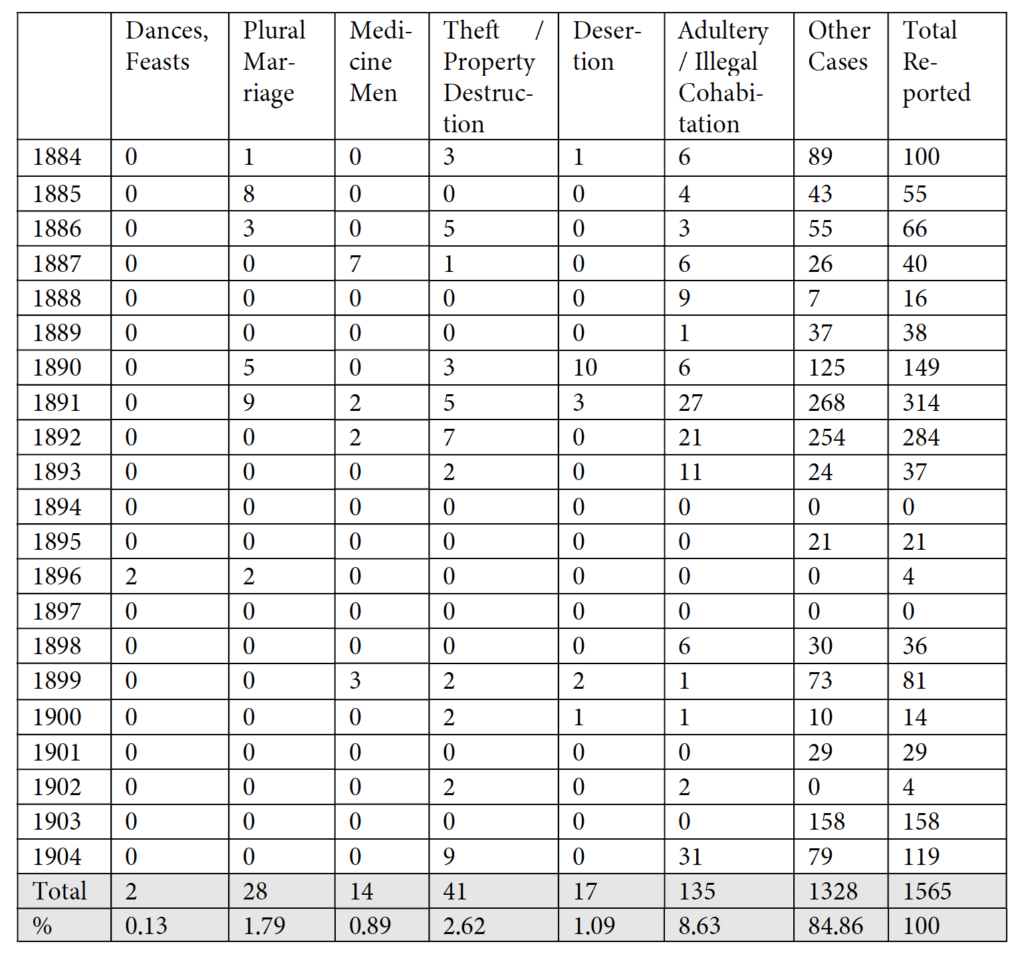
These figures, rough as they are, underline a striking absence of Indian offenses. Despite agents’ fretting about Indian dances, especially during the Ghost Dance movement,337See 1891 C.R., supra note 60, at 123–24, 352.
only two cases based on dances were reported in any of the itemized caseloads. Both cases were reported by the Flathead Agency in 1896.3381896 Off. Indian Affs. Ann. Rep. 186 [hereinafter 1896 C.R.]. I should note, however, that in the year 1891, the agent for the Cheyenne River Agency referred to at least one conviction for encouraging the Ghost Dance. 1891 C.R., supra note 60, at 389–90. Nevertheless, this was not included in the chart because the Cheyenne River agent did not provide a numerical breakdown of the court’s cases.
Crimes based on the practices of medicine men or conjuring were also quite low, amounting to a total of 14 out of 1,565 reported cases in this period. Marital and sexual crimes were far more common. The broadest count of Indian offenses—including all reports of theft, desertion, adultery, bastardy, and illegal cohabitation—results in 237 plausible Indian offenses over this twenty-one-year period, or 15.1% of the total reported cases. Excluding the fuzzy, overinclusive category of adultery/bastardy/illegal cohabitation, the count is down to 102 cases, or 6.52% of the reported cases.
The Nez Perce Court of Indian Offenses published the most complete docket records in annual reports for the thirteen years the court operated, from 1884 to 1897. These reports documented a total of 268 criminal cases, including 14 cases involving plural marriage and 7 cases involving medicine men.339See 1884 C.R., supra note 34; 1885 C.R., supra note 256; 1886 C.R., supra note 256; 1887 C.R., supra note 5; 1888 C.R., supra note 293; 1889 C.R., supra note 264; 1890 C.R., supra note 5; 1891 C.R., supra note 60; 1892 C.R., supra note 230; 1893 C.R., supra note 293; 1894 C.R., supra note 272; 1895 Off. Indian Affs. Ann. Rep. [hereinafter 1895 C.R.]; 1896 C.R., supra note 338; 1897 Off. Indian Affs. Ann. Rep. [hereinafter 1897 C.R.].
That translates to 5.22% and 2.61% respectively, or together, 7.84% of the total criminal docket for the entire run of the court. No cases of property destruction, dances, feasts, or prostitution were ever listed.
A more comprehensive year-by-year approach reveals similarly low rates of Indian offenses. Consider the agent reports for the year 1892. The Fort Hall Agency asserted that about half the cases tried by the court were for “promiscuous cohabitation, an evil which it seems impossible to break up.”3401892 C.R., supra note 230, at 234.
The Standing Rock Agency reported 72 cases in total, only 30 of which were criminal cases.341Id. at 365.
Of those 30, only 9 might be considered Indian offenses—8 for extramarital sex (adultery, seduction, bastardy) and 1 for larceny.342Id. The other criminal offenses included assault (12), drunkenness (3), wife beating (2), blackmailing (2), attempted rape (1), and “Unnatural offense” (1). Id.
The Colville Agency reported 58 criminal cases, featuring only 12 possible Indian offenses: 6 cases of adultery, 3 cases of larceny, and 3 cases of robbery.343The vast majority of crimes were drunkenness (41). The remaining five cases were for wife beating. Id. at 491.
The Tulalip Agency reported 79 criminal cases, featuring only 5 possible Indian offenses—all adultery.344Id. at 504. The Agency also reported two cases of “Ta-man-no-us” referring to spirit power in the Chinook jargon of the Pacific Northwest. Of course, these cases could fit under the prohibition against medicine men. They could alternatively refer to tribal law offenses. The report offers little context.
Occasionally, the reports make clear that Indian offenses were occurring, even if they never made it onto the dockets of the Courts of Indian Offenses. In the early 1900s, the Fort Apache Agency repeatedly reported problems with medicine men, yet the Fort Apache Court of Indian Offenses apparently never convicted a single medicine man. In 1903, the agent described the residents of Fort Apache as extremely superstitious and lamented that their faith in medicine men “interfere[d] with progress in civilization.”3451903 C.R., supra note 336, at 118.
He noted that “[t]he medicine man is usually the shrewdest man of the band, and he combats the schools, for intelligence is against his business.”346Id.
In the same report, the agent stated that the Court of Indian Offenses only reviewed cases involving theft, drunkenness, and fighting that year.347Id.
In 1904, the Fort Apache agent described medicine men as “a menace to civilization or training in any useful industry.”3481904 Off. Indian Affs. Ann. Rep. 133.
He went on: “The other Indians are afraid to testify against these medicine men, fearing that sickness and death would be the penalty for such testimony. . . . When they are brought before the court for disturbance they meet the charge by saying that they are praying to God.”349Id.
The agent also observed that the Indian police were protective of these men.350Id.
Thus, it is not surprising that the sixty-one cases punished by the Court of Indian Offenses that year were for “mainly drinking, fighting, stealing, adultery, and divorce.”351Id. at 134.
Some courts saw far more civil cases than criminal. In 1900, the Turtle Mountain Agency reported that “[t]hirty-two cases were tried during the year, none of a criminal character, being mainly disputes over debts, over land and meadows, and family troubles.”3521900 C.R., supra note 288, at 312. The Turtle Mountain Agency previously reported in 1898 that the court had twenty-nine cases, “all disputes about debts and similar misunderstandings.” 1898 C.R., supra note 272, at 224.
In 1906, the Warm Springs Agency reported that “[t]he court of Indian offenses has very little work here. No serious crimes have been committed during the year. Family and property disputes and cases of drunkenness have constituted the bulk of the business of the court.”3531906 C.R., supra note 304, at 337.
The same year, the Lower Brule Agency reported “very few cases, just settling a few family differences,”354Id. at 351.
and the Lemhi Agency reported that its court’s docket “has been very light, consisting chiefly of settling the ownership of horses.”355Id. at 218.
To be sure, the line between civil and criminal is not always clear nor consistent with modern Anglo-American legal categories.
In terms of punishment, sentences for hard labor were particularly common.356Meriam et al., supra note 22, at 771 (“The sentence of the court is usually imprisonment . . . . Imprisonment does not, however, mean actual incarceration, but rather a term of labor about the agency grounds, on the roads, or on the irrigation ditches.”); Hagan, supra note 5, at 121.
Many agencies lacked prisons, so agency headquarters were often used as makeshift jails.357 Hagan, supra note 5, at 121.
Many prisoners were required to spend only their days in confinement and were allowed to go home at night.358See id.; Meriam et al., supra note 22, at 771 (“There are jails, but they are ordinarily only places of temporary confinement and are frequently kept unlocked. At some reservations the prisoners are detained in the jail at night, while at others they are permitted to remain in their own homes.”).
Some agencies used nearby army guard posts as temporary prisons.359See Hagan, supra note 5, at 121.
The Devils Lake Agency reported that “after having received a sentence from said court to the guardhouse at labor, the guardhouse needs no lock or key, and the labor is faithfully and cheerfully performed.”3601898 C.R., supra note 272, at 222.
While reports demonstrate imprisonment, labor, and fines, there is little record of agencies withholding rations.361See, e.g., 1906 C.R., supra note 304, at 265 (Omaha), 299 (Fort Yates), 337 (Warm Springs), 345 (Cheyenne River).
The Meriam Report asserted that the “chief criticism” of the courts was their “inadequacy in dealing with serious cases or hardened offenders,” considering their “quasi-paternal admonitions and slight punishments.”362Meriam et al., supra note 22, at 773.
As the generalizations and many exceptions recounted above demonstrate, it is challenging to characterize the many Courts of Indian Offenses. There was significant variation among the courts—variation that may have impeded the courts’ founding assimilationist goals. As Renisa Mawani remarked, the plurality and inconsistency of colonial legal systems make such systems ripe for contestation and resistance.363Mawani, supra note 47, at 421.
The absence of an expectation of uniformity allowed for federal agents and tribal leaders to compromise and accommodate each other’s priorities. In this way, variation can be seen as evidence of divided control and retained tribal autonomy.
Until the Meriam Report of 1928, federal attention to the Courts of Indian Offenses significantly decreased in the early nineteenth century. In the 1910s, the Commissioner of Indian Affairs’ annual reports to the Secretary of the Interior stopped showcasing the Courts of Indian Offenses altogether. The Commissioner continued to discuss assimilationist ends but focused on alternative means. In the 1916 Annual Report, the Commissioner triumphantly wrote that “[t]he antipathy of the Indian woman to the white man’s hospital is fast being overcome and the medicine man will soon be only a memory.”3641916 Off. Indian Affs. Ann. Rep. 3 [hereinafter 1916 C.R.].
Notably, there was no mention of the Courts of Indian Offenses nor their criminalization of medicine men. Instead, the Commissioner credited schools, women’s associations, Indian Service hospitals, and “baby shows” at agricultural fairs.365Id. at 8. For more on nineteenth-century baby shows, see generally Susan J. Pearson, “Infantile Specimens”: Showing Babies in Nineteenth-Century America, 42 J. Soc. Hist. 341 (2008).
Of course, the Bureau of Indian Affairs had not wholly abandoned the project of using criminal law to forcibly assimilate Native people. In the very same report, the Commissioner called for an expansion of the Major Crimes Act to prosecute Indian crimes against society and morality in federal court.3661916 C.R., supra note 364, at 63.
But the Courts of Indian Offenses made no appearance, and educational and social approaches to assimilation took center stage.
IV. Case Studies
This final Part presents three case studies based on an original analysis of the archival sources. The first focuses on the Yakama Agency, where a formal, recorded reservation court system predated the 1883 Courts of Indian Offenses. The second concerns the Pima Agency, featuring uniquely detailed records that offer a snapshot into the political and interpersonal dimensions of the Courts of Indian Offenses in the early twentieth century. The third focuses on the Standing Rock Agency, where the assassination of Sitting Bull and the Wounded Knee Massacre demonstrate the limits of the Courts of Indian Offenses. These three case studies represent distinct tribal cultures from three different regions, further illustrating how Courts of Indian Offenses actually operated around the turn of the twentieth century.367These snapshots of court practice are admittedly incomplete without additional historical and sociological work to situate the Courts of Indian Offenses within the distinct legal traditions of these tribes. Though beyond the scope of this initial article, I intend to undertake such an endeavor in a future project.
A. Yakama
The Confederated Tribes and Bands of the Yakama Nation have lived in the Pacific Northwest since time immemorial.368Don Healy, Yakama Nation History, Yakama Nation, https://yakama.com/about [perma.cc/FD8X-TTH6]. For more on the fourteen tribes and bands confederated in the Yakama Nation, see Yakama History, Yakama Nation Museum & Cultural Ctr., https://yakamamuseum.com/home-history.php [perma.cc/C684-W8UJ].
The Nation ceded much of its aboriginal land to the United States in the Treaty of 1855, establishing the 1.13 million-acre Yakama Reservation in southern Washington.369Treaty with the Yakama Nation, U.S.-Yakama Nation, June 9, 1855, 12 Stat. 951. For a map showing the ceded aboriginal territory, see Ceded Area & Reservation Boundary of the Confederated Tribes and Bands of the Yakama Nation, Yakama, https://yakama.com/about [perma.cc/FD8X-TTH6] (click “view map” under the section titled “Map of Yakama Nation Ceded Area & Reservation”).
According to the 1880 census, 3,400 Indians resided on the Reservation.3701882 Off. Indian Affs. Ann. Rep. 3, 168.
Indian police records held by the National Archives describe a Yakama court dating back to at least 1879.371U.S. Indian Police Service Record Book 200 (1879–1889) (on file with Nat’l Archives at Seattle, Law Enforcement Records, Box 253).
The police records describe the tribal council convening as a court with the federal agent presiding.372Id. at 200.
The records document criminal cases from 1879 to 1882, featuring crimes of theft, adultery, and arson.373Id. at 200–52.
The court empaneled juries and examined witnesses.374Id. at 207–08.
One defendant was acquitted “for want of evidence.”375Id. at 252.
When the jury rendered guilty verdicts, the court announced sentences consisting of various combinations of confinement in irons and whipping.376Id. at 205–31.
When the Commissioner and the Secretary promulgated the founding rules for the Courts of Indian Offenses, the Yakama Reservation already had a formal justice system endorsed by the local federal agent.
In his 1883 annual report, agent R. H. Milroy described establishing an “Indian judiciary” loosely in line with the Indian Bureau’s new rules for Courts of Indian Offenses.3771883 C.R., supra note 198, at 153–54.
Milroy divided the reservation into districts such that the people of each district elected the chiefs who served as justices of the peace. The agent appointed a three-judge panel to serve as “a reservation court of original and appellate jurisdiction.”378Id. at 154.
Any party tried before a justice of the peace had the right to appeal to the court.379Id.
Milroy admitted to deviating from the Indian Bureau’s rules: “I found said rules mainly proper and applicable for the guidance of the court of this reservation . . . but in several particulars I found said rules inapplicable, and so instructed the court.”380Milroy wrote that having police officers serve as judges was “incompatible with our ideas of government.” Id. He noted that it was impracticable to expect judges to work without pay, so he paid each for each day served, using funds raised from taxes and fines. He found that holding sessions twice a month was more than necessary since he had established the justices of the peace to resolve most cases. He also established a whole Board of Commissioners composed of tribal members to handle other unspecified aspects of reservation governance. Id.
Milroy asserted that he retained the right to review court decisions and correct errors but that he expected the court to “get along without [his] presence.”381Id. at 155.
The following year, Milroy reported that judges and court clerks would be elected in the same manner as the justices of the peace.3821884 C.R., supra note 34, at 176.
From 1885 to 1902, the records of the Yakama court grew thin,383In 1887, the agent’s annual report observed that the court did good work enforcing Western marriage relations. 1887 C.R., supra note 5, at 303. In 1889, the annual report noted that the court refused to allow Indian attorneys to practice in their court in minor cases. 1889 C.R., supra note 264, at 291. A decade later, the agent’s annual report remarked that “[t]he Indian courts are too much inclined to follow old Indian customs to be very much assistance in settling land questions or civil cases of any kind.” 1899 C.R., supra note 272, at 363.
until the local records of the court picked up in 1903. The twentieth-century court departed from the court of the 1870s and 1880s in terms of both the substantive content of their cases and the kinds of punishments they administered.
While the court still spent much of its time reviewing claims of adultery and bigamy, the twentieth-century court’s docket was full of horses and alcohol. Out of the 71 cases recorded from 1903 to 1905, there were 18 cases of bigamy, 9 cases involving horse ownership, 8 cases of assault and “cruelty,” 4 cases of adultery, 4 cases involving disputed property (not horses), and 28 other or unspecified cases.384Volume 1 of Yakama Court Records (1903–1904) (on file with Nat’l Archives at Seattle, Records of the Court of Indian Offenses, Box 252) [hereinafter Volume 1].
The next batch of recorded cases from 1912 to 1915 includes 128 cases total, featuring: 44 cases of intoxication, 27 cases involving horse ownership, 10 cases of assault, 5 cases of property disputes (not horses), 4 cases of adultery, and 1 case of bigamy.385Volume 2 of Yakama Court Records (1903–1904) (on file with Nat’l Archives at Seattle, Records of the Court of Indian Offenses, Box 252) [hereinafter Volume 2].
The remaining 37 cases included instances of cohabitation without marriage, petty theft, debt collection, and various uncommon and unspecified crimes.386Id.
While the early court relied on corporal punishment and incarceration, the twentieth-century court relied far more on fines and restitution through goods. Fines, fees, and debt suffuse the court records. Disguised the brand on your neighbor’s horse? $10 fine plus $15 court fee.387See Volume 1, supra note 384, at 4 (listing cases from December 16, 1903).
Committed assault and battery? $10 fine plus $20 court fee.388See id. at 19 (listing cases from December 16, 1903).
Stole barbed wire? $15 to the plaintiffs plus $10 court fee.389Volume 2, supra note 385, at 1 (case from January 8, 1912).
One defendant paid off his court debt with a horse and a saddle.390Volume 1, supra note 384, at 8 (Martin Ma-ni-nukt v. Charley Ha-lease, December 15, 1903).
Fines and fees were the norm, but occasionally, criminals received other punishments. Interfering with the police resulted in eight days in jail.391Id. at 27 (case from March 23, 1904).
A drunken fight resulted in fifteen days’ labor for both participants.392Volume 2, supra note 385, at 2 (Yakima Nation v. Sam).
As recounted above, the Yakama Court of Indian Offenses deviated from Secretary Teller’s vision in various ways. The court was built upon a preexisting tribal court, and its officers were elected democratically. The reservation agent happily allowed the court to conduct its business without oversight, and the court spent its sessions considering the ownership of horses rather than medicine men, dances, or feasts.
B. Pima
Based in Sacaton, Arizona,3931892 C.R., supra 230, at 212.
the Pima Court of Indian Offenses governed the Akimel O’odham (Pima), Tohono O’odham (Papago), and Piipaash (Maricopa) peoples of the Gila River Valley.394History, Gila River Indian Cmty., http://www.gilariver.org/index.php/about/history [perma.cc/R2C5-GQP3]; History & Culture, Salt River Pima-Maricopa Indian Cmty., https://srpmic-nsn.gov/history_culture [perma.cc/5377-5JX3]; see 1888 C.R., supra note 293, at 4. See generally Anna Moore Shaw, A Pima Past (1974) (recounting shifts in Pima traditions, identity, and social organization from the late nineteenth century through the mid-twentieth century, from a Pima woman’s perspective).
The O’odham and Piipash first encountered Spanish missionaries and explorers in the seventeenth century, and many members converted to Catholicism.395See Shaw, supra note 394, at 4–5.
As in many tribes of the Southwest, traditional spirituality and ceremonies persisted alongside Catholic ritual.396See, e.g., id. at 16 (describing a christening ceremony blending Catholic and O’odham traditions).
The O’odham and Piipash had longstanding agricultural traditions and were regarded by Europeans as relatively friendly allies in the nineteenth century.397See id. at 33; History & Culture, Salt River Pima-Maricopa Indian Cmty., https://srpmic-nsn.gov/history_culture/#postcontact [perma.cc/PB5Y-LUX9] (Post Contact). But see Pima Uprising of 1751, Nat’l Park Serv. (May 6, 2025), https://nps.gov/tuma/learn/historyculture/pima-uprising-of-1751.htm [perma.cc/T79P-KUFU] (Akimel O’odham uprising against the Spanish).
The United States formally annexed the Gila River Valley in 1854 through the Gadsden Purchase.398Salt River Pima-Maricopa Indian Cmty., supra note 394 (Timeline of O’odham Piipaash History).
Under American rule, Akimel O’odham, Tohono O’odham, and Piipaash peoples were relegated to the Gila River Reservation, the Salt River Reservation, and the San Xavier Reservation—all under the supervision of the Pima Agency.399See 1888 C.R., supra note 293, at 6.
By the 1880s, the Pima Agency oversaw nearly 7,000 Indians, including about 4,000 Akimel O’odham, 2,000 Tohono O’odham, and 300 Piipash.400Id. Yet two years later, in 1890, Indian Affairs reports 11,518 Indians at the Pima Agency. 1890 C.R., supra note 5, at LXXXIII–LXXXIV.
The first reference to the Court appears in the superintendent’s annual report for 1887, in which he asserted that “the wisdom of [the Courts of Indian Offenses] has been fully exemplified. The court has met regularly every two weeks, and many vexed questions of land ownership, damages from stock, etc., has been satisfactorily adjusted.”4011887 C.R., supra note 5, at 87.
He noted that the judges require both sides of every dispute to present evidence, and that they relied on the superintendent for relevant rules in American law.402See id. The records of the Court of Indian Offenses show that in later years, the court made law from the bench. See Jose Manuel v. Hal Antonio Morales, Indian Court Proceedings (June 26, 1914) (on file with Nat’l Archives at Riverside, Records of the Court of Indian Offenses, 1913–1922, Record Group 75, Folder 3 [hereinafter Riverside Archives Folder 3]) (unprocessed series) (articulating the rule that unfenced land would be treated like public land for the purpose of procuring timber).
He proudly reported that “there is not now a single case of polygamy on this reservation” and that desertion of one’s spouse without divorce had been largely reduced.4031887 C.R., supra note 5, at 87.
As of 1890, the court had three judges, each paid $8 per month.4041890 C.R., supra note 5, at LXXXIV.
The local records of the Court of Indian Offenses offer a clearer picture of court procedure. The records now held by the National Archives begin in 1913. By that time, the court was meeting weekly, rather than every other week. The court still had three judges at every sitting, though occasionally a judge would be recused and a substitute would take his place.405Addie Johnson v. Cheerless, Indian Court Proceedings, No. 2 (Jan. 10–17, 1913) (on file with Nat’l Archives at Riverside, Records of the Court of Indian Offenses, 1913–1922, Record Group 75, Folder 1 [hereinafter Riverside Archives Folder 1]); Jackson v. Wellington, Indian Court. Proceedings. (Jan. 24, 1913) (on file with Riverside Archives Folder 1, supra ); Continuation of Complaint Against John G. Whittier, Indian Court Proceedings (Jan. 31, 1913) (on file with Riverside Archives Folder 1, supra); Sarah Santo v. Juan Santo, Indian Court Proceedings (Feb. 7, 1913) (on file with Riverside Archives Folder 1, supra); Case of Kittie Elsmere, Indian Court Proceedings, No. 2 (Feb. 14, 1913) (on file with Riverside Archives Folder 1, supra) (unprocessed series).
As the superintendent initially reported, the court spent a lot of time reviewing evidence. Trials often involved multiple witnesses and sometimes lasted many days.406See Johnson, Indian Court Proceedings (Riverside Archives Folder 1, supra note 405); Case of Kittie Elsmere, Indian Court Proceedings (Riverside Archives Folder 1, supra note 405).
When parties did not present sufficient evidence, the cases were dismissed.407See Jos. Paul v. Edgar Miles, Indian Court, Special Session (Sep. 10, 1914) (on file with Riverside Archives Folder 3, supra note 402); United States v. Cook, Indian Court Proceedings (Dec. 5, 1913) (on file with Riverside Archives Folder 1, supra note 405).
For cases involving disputed property boundaries, judges personally inspected the land or chattels in question.408See Sam Howard v. Sahui Mollie, Indian Court Proceedings (Feb. 21, 1913) (on file with Riverside Archives Folder 1, supra note 405) (dispute over land boundaries, judges postponed the hearing so that they could personally go examine the land in question); Maggie Schurz v. David Manuel, Indian Court Proceedings (May 15, 1914) (on file with Riverside Archives Folder 3, supra note 402) (just as in Howard v. Mollie, the judges went to view the land in question before ruling).
Private parties brought the vast majority of cases, both civil and criminal.409See generally Records of the Court of Indian Offenses, supra note 266.
Punishments typically involved jail time at the agency headquarters and hard labor, though fines were also assessed occasionally.
One of the longest cases took up six sessions before the court. The case of Kittie Elsmere, a pregnant twelve-year-old girl, began on February 14, 1914, and continued weekly through March 14, 1914.410Inquiry into the Case of Kittie Elsmere, Indian Court Proceedings (Riverside Archives Folder 1, supra note 405).
The court ultimately transferred the rape case to the superintendent on March 30, 1914. The court heard between three and fourteen witnesses each day, including repeat witnesses.411See id.
Yet the court declined to pass a judgment on the defendant’s guilt. Upon transfer, Superintendent Thackery found the defendant guilty and sentenced him to six months of jail time with hard labor.412Id. Two months later, when the baby was delivered far too early to line up with the alleged rape, the superintendent released the defendant and suspended the sentence indefinitely.
The court typically delivered its decision orally, after reviewing all the evidence. On occasion, it transferred to the superintendent particularly divisive cases and cases involving federal employees.413See Annie Enas v. Frank Howard, Indian Court Proceedings (Sep. 10, 1914) (on file with Riverside Archives Folder 3, supra note 402) (referring a difficult rape case, based on circumstantial evidence, to the Superintendent for resolution); Lucy Charles v. John Wiston, Indian Court Proceedings (Mar. 27, 1914) (on file with Riverside Archives Folder 3, supra note 402) (involving an assault case that was sent back to the court after it initially sent the case to the Superintendent Thackery for resolution due to insufficient evidence).
In this period, the superintendent appears not to have intervened in the court except when invited by the judges.
The records offer not only insight into court procedures, but also the substance of their caseload. Between 1913 and 1918, the court records include 117 discrete cases. 38.5% addressed property disputes. 23.1% were about violent crimes such as assault, murder, and rape. 17.9% concerned marital relations—adultery, desertion, divorce, and alimony cases. 9.4% involved intoxication or the introduction of liquor to the reservation. 7.7% were cases of theft. 1.7% involved libel.414These figures are based on my original research.
Additionally, there was a case in which the court was called upon to resolve a disputed election.415When asked to resolve an election dispute for Chief of Snaketown, the court called for a new election on May 2, 1913, and later confirmed those new results on May 16, 1913. In re Election of Chief, Snaketown, Indian Court Proceedings (May 2–16, 1913) (on file with Riverside Archives Folder 1, supra note 405) (unprocessed series).
In this period, there were no documented cases of plural marriage, though perhaps the agent was correct in claiming that the practice had ended in the 1880s. There were no cases involving dances or feasts. The only mention of a medicine man in the entire record appeared in an inheritance dispute: A medicine man had died, and his heirs were fighting over his possessions.416Leo Varvajas and Hugh Miguel v. Carlos Mendoza, Indian Court Proceedings (Aug. 6, 1915) (on file with Nat’l Archives at Riverside, Records of the Court of Indian Offenses, 1913–1922, Record Group 75, Folder 4) (“Division of property in horses”).
In other words, Indian offenses were uncommon in the Court of Indian Offenses. Those that did appear involved desertion and theft, fitting the broader pattern outlined in Part III.
At the Pima Agency and elsewhere, the Court of Indian Offenses was not only a space in which judges made and administered law, but also a forum for internal tribal politics. A series of hearings in 1913 showcased how various tribal leaders used the court forum for political or even personal conflicts. The saga began in January 1913, when Indian policeman John G. Whittier was accused of public drunkenness. Three witnesses testified against the officer: One claimed to have consumed liquor alongside Whittier on January 4, and the other two asserted they had heard Whittier was drunk that day.417Continuation of Complaint Against John G. Whittier, Indian Court Proceedings (Jan. 13, 1913) (on file with Riverside Archives Folder 1, supra note 405).
While the usual panel of judges consisted of Meacham Hendricks, John Makil, and Juan Chiago, for this case, Chiago was replaced by Charles Matthews. Instead of serving as a judge, Chiago testified as a witness in support of the defendant.418Id. at 1.
Despite the support of Judge Chiago, the court found Officer Whittier guilty of drunkenness. The court ordered that he be discharged from the office of Indian police and jailed until Superintendent Thackery returned to the Agency. Because Whittier was a federal employee, the Superintendent was to have final say on his sentence.419Id. at 2.
Though Thackery’s ruling does not appear in the record, it seems Whittier was ultimately removed from the police force.
Two months later, the court heard another, more scandalous case involving tribal leadership. On March 1, 1913, Emma Wiston brought a prosecution against Judge Juan Chiago for the alleged rape of her young niece, Lizzie Johnson.420Emma Wiston v. Juan Chiago, Indian Court Proceedings (Mar. 1, 1913) (on file with Riverside Archives Folder 1, supra note 405).
Once again, Judge Chiago was recused, this time replaced by an Antonio Juan. In the one-day trial, the court heard testimony from Lizzie Johnson and her doctor. The court found Chiago guilty and suspended his judgeship. Just as in Whittier’s case, the court deferred to Superintendent Thackery for final judgment.421Id.
Exchanges after the trial complicate the story. On March 4, 1913, M.J. Chiago wrote a letter to Superintendent Thackery.422Letter from M.J. Chiago to Superintendent Thackery (Mar. 4, 1913) (on file with Riverside Archives Folder 1, supra note 405).
M.J. Chiago was Juan Chiago’s wife as well as Lizzie Johnson’s older sister. M.J. Chiago urged the Superintendent to reverse the court’s ruling, claiming that the rape accusation was manufactured as part of a “campaign for revenge” against Chiago for failing to protect John Whittier in the drunkenness suit.423Id. (asserting that Wiston had previously broken down the Chiagos’ door out of anger on behalf of Whittier).
M.J. Chiago also asserted that Emma Wiston was not Lizzie Johnson’s legal guardian and should not have been allowed to bring the suit on her behalf. The real guardian was their uncle, Lewis Wood. Chiago lamented that Wiston did not have the girl’s best interests at heart and that she had “lead [sic] my sister Lizzie Johnson to spoilation [sic] in character,” by convincing her to “plead strong false statement in their favor of revenge.”424Id.
That same day, Judge Chiago also penned a letter to the Superintendent. He told the same story: “If wasn’t for John G. Whitter [sic] and her Aunt Emma Wisten gone for her she could have told the straight truth . . . . [They] mislead [sic] the young girl to aid strong purgery [sic] in this favor, on a fake charge of criminal libel.”425Letter from J.W. Chiago to Superintendent Thackery (Mar. 4, 1913) (on file with Riverside Archives Folder 1, supra note 405).
Juan Chiago asserted that “[t]he judges are not crafty enough to know that this suit against me [was for] revenge.”426Id.
He claimed that he and another witness could prove that Lizzie’s story was not factual, but the judges would not hear them at the trial.427Id.
Why would Emma Wiston be doing John Whittier’s dirty work? While neither Chiago offered an explanation, a later case from June 20, 1913, revealed that Emma Wiston and John Whittier had been in a longstanding intimate relationship.428Emma Wiston v. John Whittier, Indian Court Proceedings (June 20, 1913) (on file with Nat’l Archives at Riverside, Records of the Court of Indian Offenses, 1913–1922, Record Group 75, Folder 2 [hereinafter Riverside Archives Folder 2]).
He had apparently promised to divorce his wife to be with Wiston but never followed through. So, Wiston eventually sued him too in the Court of Indian Offenses.429Id.
On April 12, 1913, Superintendent Thackery reversed the court’s decision.430Notice of April 12, 1913 (on file with Riverside Archives Folder 1, supra note 405).
Citing the existence of contradictory testimony, Thackery vacated the ruling against Chiago. It is unclear whether the Superintendent was convinced by the Chiagos’s story of revenge, was supporting a favored colleague, or was simply acting in adherence to strongly held convictions about the burden of proof in criminal cases—or perhaps all of the above at once. Chiago was relieved from criminal punishment. However, his name did not return to the roster of judges.431See Riverside Archives Folder 2, supra note 428; Riverside Archives Folder 3, supra note 402.
As the Wiston/Whittier/Chiago drama illustrates, the Pima Court of Indian Offenses featured return players who used this legal forum to contest leadership positions and address longstanding grievances. The court was not only a site for ordinary conflict resolution, but also for tribal politics. The largely absent superintendent had a role to play—at least when invited to intervene by one of his judges.
C. Standing Rock
This last case study concerns the Lakota and Dakota people of the Standing Rock Sioux Tribe. The Standing Rock Sioux were a party to the 1868 Fort Laramie Treaty, which established the Great Sioux Reservation, spanning approximately half of South Dakota.432Treaty with the Sioux Indians, Sioux-U.S., Apr. 29, 1868, 15 Stat. 635; Section 3: The Treaties of Fort Laramie, 1851 & 1868, Map 2, N.D. Stud., https://www.ndstudies.gov/gr8/content/unit-iii-waves-development-1861-1920/lesson-4-alliances-and-conflicts/topic-2-defending-lakota-homelands/section-3-treaties-fort-laramie-1851-1868 [perma.cc/LE4N-M3HR].
In subsequent years, the United States failed to uphold the treaty, allowing miners to flood the sacred Black Hills, ultimately inciting the Great Sioux War of 1876 and the famous Battle of the Little Bighorn.433 Andersson, supra note 117, at 14–15.
In 1877, Congress unilaterally abrogated the treaty to take the Black Hills.434United States v. Sioux Nation of Indians, 448 U.S. 371, 371, 388 (1980) (“A more ripe and rank case of dishonorable dealings will never, in all probability, be found in our history . . . .” (quoting United States v. Sioux Nation, 207 Ct. Cl. 234, 241 (1975))).
In 1889, Congress divided the Great Sioux Reservation into six smaller reservations, including the Standing Rock Reservation straddling the border between South and North Dakota.435Act of Mar. 2, 1889, ch. 405, 25 Stat. 888; About, Standing Rock Sioux Tribe, https://standingrock.org/about [perma.cc/8UQC-Y8YS].
In this tumultuous time, the Standing Rock Agency established a Court of Indian Offenses.
In 1884, the Standing Rock Agency reported the successful creation of the Court of Indian Offenses, installing a panel of judges described as “good men who command respect and have the confidence of the Indians.”4361884 C.R., supra note 34, at 56–57.
These judges were selected from the police force as instructed, and the agent described them as “just and impartial.”437Id.
The court met every other week, and the agent interfered mainly to “guard against the severity of punishment imposed.”438Id. at 57.
In 1886, the agency characterized the court as indispensable,4391886 C.R., supra note 256, at 91–92.
and in 1888, the agency approvingly reported that the court continued to command respect from the reservation community, holding biweekly sessions without need for agent interference.4401888 C.R., supra note 293, at 63.
According to the report, the court was so helpful “in maintaining order and in aiding our work that I would regard it as a serious loss to the service were it discontinued.”441Id.
In 1890, the agency reported a court docket of 91 cases. This count included 5 cases of plural marriage (3 cases involving second wives, 2 cases involving second husbands), 8 cases of adultery, and 14 other cases involving marital problems (desertion, seduction, and elopement). In addition to these marital cases, there were 4 cases of larceny, 1 ambiguous case of “evil speaking,” and nothing else that resembled an Indian offense.4421890 C.R., supra note 5, at LXXXVI.
There was no mention of dancing or medicine men. In 1891, the agency reported that the court had altered its schedule, meeting triweekly for two days at a time.4431891 C.R., supra note 60, at 327.
The report listed 106 cases tried, though only 8 could be identified as Indian offenses—6 cases of bigamy and 2 cases of larceny.444Id.
Again, there was no mention of any cases involving dances or medicine men.445The limited local archives of the Standing Rock Court of Indian Offenses back this up. What remains of the physical docket, for the year 1890, are lists of cases of theft, desertion, adultery, assault, rape, resisting arrest, leaving the reservation with cattle, selling alcohol, a land dispute, “marrying 4th husband,” and one admittedly curious case of “woman fighting with Holy Ghost.” Court of Indian Offenses Case List (1890) (on file with Nat’l Archives at Kansas City, Standing Rock Agency Series 42, Records of the Court of Indian Offenses, 1890–1940, Boxes 359–60).
This absence in the court record is notable, as the same report of 1891 spent many pages detailing the Ghost Dance and its violent suppression by the United States.446See 1891 C.R., supra note 60, at 123–45 (Commissioner’s Report); id at 327–37 (Standing Rock report).
Dubbed the “Messiah Craze” by the Commissioner of Indian Affairs,447Id. at 123.
the Ghost Dance was a spiritual movement drawing from both traditional Indigenous worldviews and Christianity, foretelling for Native people a new world premised on the revitalization of tradition.448 Andersson, supra note 117, at 24–28.
In the words of Keith Richotte Jr., the Ghost Dance was “an intertribal movement that promised peace, prosperity, and a reunion with lost relatives to those who adhered to ceremonies and a tribally centered lifestyle.”449 Richotte, supra note 32, at 80–81.
Wovoka, the movement’s prophet, was the son of the Paiute medicine man to whom God revealed a sacred dance that would enable Native people to survive the world’s impending transformation.450 Andersson, supra note 117, at 24–25.
According to Rani-Hendrik Andersson, the Ghost Dance can be understood as part of a larger pattern of American colonialism, in which Anglo-American cultural domination met Indigenous resistance, and syncretic prophetic leaders combined the cultures to inspire mass movements, seeking to subvert the dominating culture and restore traditional ways of life.451Id. at 23. See 1891 C.R., supra note 60, at 126 (Commissioner comparing the Ghost Dance to other syncretic religious movements).
Such a movement was particularly powerful among the Sioux in the late 1880s: The recent suppression of the sun dance452According to Rani-Henrik Andersson, the last sun dances were held at Pine Ridge in 1882 and Rosebud in 1883, forbidden by Indian Affairs. Andersson, supra note 117, at 21. However, there is little evidence that the Courts of Indian Offenses had any real role in the suppression. See supra Part III.
had created a vacuum in spiritual life, and harsh cuts to rations in the relatively new reservation system had produced famine and epidemics across the Sioux reservations.453See Andersson, supra note 117, at 22.
The Ghost Dance and its participants did not pose a military threat to the United States; rather, they threatened federal control over reservation life and the greater civilization project.454See id. at 108.
When the Ghost Dance arrived at the Standing Rock Reservation in 1890, federal agents quickly identified Sitting Bull as the movement’s local leader.4551891 C.R., supra note 60, at 329 (reproducing a letter from agent James McLaughlin to Commissioner T.J. Morgan on October 17, 1890, in which McLaughlin asserts that “Sitting Bull is high priest and leading apostle of this latest Indian absurdity” and that “[t]he dance is demoralizing, indecent, and disgusting”).
Sitting Bull was a medicine man, deemed nonprogressive for his opposition to federal assimilation policy.456See Andersson, supra note 117, at 21.
Starting in July 1890, Standing Rock Agent James McLaughlin repeatedly asked the Commissioner for the authority to remove Sitting Bull from the Reservation.457See 1891 C.R., supra note 60, 327–34. Apparently, McLaughlin disliked Sitting Bull ever since the two first met in 1881. Andersson, supra note 117, at 107.
The authorization would not come until December,4581891 C.R., supra note 60, at 333; see also Andersson, supra note 117, at 115.
after months of alarmist reports to Washington from McLaughlin’s coworker at the Pine Ridge Agency, Agent Daniel F. Royer.459See Andersson, supra note 117, at 112. Royer was a political appointee with no experience in the Indian Service, unlike McLaughlin who was conversant in Lakota. Id. at 105; 1891 C.R., supra note 60, at 328.
In this time, the movement had spread to all the major Sioux reservations.460 Andersson, supra note 117, at 108.
With the military standing by for backup, McLaughlin sent a force of thirty-nine Indian policemen and four Indian volunteers to Sitting Bull’s camp on December 15, 1890.4611891 C.R., supra note 60, at 336.
When Sitting Bull attempted to escape, a skirmish broke out between the police and Sitting Bull’s followers. Shots flew from both sides. The police shot and killed Sitting Bull, while his followers fatally wounded an Indian police lieutenant and first sergeant.462Id. at 335–36
In total, six Indian police officers and seven Ghost Dancers died in the failed arrest.463See id. at 338.
The survivors fled the Standing Rock Reservation and joined a neighboring band led by Spotted Elk, only to be confronted by the military at Wounded Knee two weeks later.464See Andersson, supra note 117, at 88–94.
Thus, the police killing of Sitting Bull led to the infamous massacre of men, women, children, and infants465For a contemporary description of the massacre, see Turning Hawk’s account in 1891 C.R., supra note 60, at 179–81.
—and the end of the Ghost Dance movement.466See Andersson, supra note 117, at 99.
The Indian police played a starring role in the Ghost Dance suppression saga. Agent McLaughlin praised the police force in exuberant terms, lauding the officers for remaining “loyal to the Government in maintaining order and obeying its mandates.”4671891 C.R., supra note 60, at 327.
McLaughlin and Commissioner Morgan both called for a raise in police wages.468See id. at 145 (Morgan); id. at 327 (McLaughlin).
But where was the court in all this? As mentioned above, the Court of Indian Offenses was holding regular sessions. Despite the 1888 change in personnel rules, the court might still have been made up of police officers who may have played a role in the assassination of Sitting Bull. One prominent figure in the aftermath of the Wounded Knee Massacre was a judge for the Pine Ridge Court of Indian Offenses—Tasunka Kokipapi.469Tasunka Kokipapi was frequently misleadingly translated to “Young-Man-Afraid-of-His-Horses.” See id. at 181 (Turning Hawk). According to McLaughlin, the name meant that Tasunka Kokipapi was so fearsome in battle that his enemies feared the sight of his horses. James McLaughlin, My Friend the Indian 228 (1910).
Yet Tasunka Kokipapi served in a diplomatic role, negotiating with the federal government.470See 1891 C.R., supra note 60, at 181.
None of these judges engaged with the Ghost Dance suppression in their judicial capacities. Sitting Bull was to be arrested and removed from the reservation, not brought before the Court of Indian Offenses. None of his followers were prosecuted in the Court of Indian Offenses for illegal dancing. In one of the most violent instances of cultural repression in this era, the Court of Indian Offenses was at most tangentially involved via the Indian police.
This episode demonstrates how the courts were neither a primary means of forced assimilation nor reliable instruments of resistance. Faced with a movement that directly confronted and threatened the American assimilation project, the court’s officers only marginally aided the federal government.
Conclusion
For many Native leaders in the late nineteenth century, the Courts of Indian Offenses offered opportunities to maintain tribal self-government by accommodating the assimilationist designs of federal bureaucrats. In practice, Native judges took up some aspects of Anglo-American law, particularly in policing marriage and sexual relations, individual property rights, and formal procedure. Yet in other areas—dances, ceremonies, and medicine men—they wholly ignored directives from Washington.
This Article carefully combed the colonial records of the Courts of Indian Offenses to find a striking absence of Indian offenses. In this negative space, the Article sought to reconstruct the subaltern story of the courts. By applying a critical lens, reading against the grain, and borrowing insights from other studies of both bureaucracy and tribal law, this study uncovered an overlooked chapter in tribal legal history—one of complex, contested, quasi-tribal legal institutions.
The courts should be understood as local institutions in a decentralized national bureaucracy, operated by local actors and dependent on tribal cooperation. In this context, federal agents were often eager to delegate their formal authority to Native judges for the courts’ daily operation. As the case studies from the Pima and Standing Rock Agencies demonstrate, Native judges were also individual actors with individual motivations, not necessarily stand-ins for universal tribal opinions. These judges operated within the formal colonial confines set out by the Office of Indian Affairs. To maintain a space for tribal autonomy, they co-opted the so-called tools of civilization. The Courts of Indian Offenses were neither bastions of revolution nor draconian instruments of assimilation. They were contested spaces of colonial law and resistance.
* Alexandra Fay is an assistant professor at the University of Tulsa, College of Law. She is grateful for feedback and support from Henry Ishitani, Seth Davis, Bethany Berger, Matthew Fletcher, Kevin Washburn, Greg Ablavsky, Maggie Blackhawk, Angela Riley, Tanner Allread, Stephen Galoob, Marc Roark, Gwen Savitz, Blake Emerson, and the Gathering of Indigenous Legal Scholars. She is especially thankful for her research assistants, Madison Foster and Jacob Stork.
